
Semiconductor & Cleanroom
Hazardous gases, corrosive chemistries, and static, all inside a gowned space.
Semiconductor and cleanroom work combines some of the most hazardous chemistries in manufacturing with an environment built for particle control rather than worker escape. Hydrofluoric acid, pyrophoric and toxic process gases, and strong solvents drive the risk, alongside electrostatic discharge that damages devices and the repetitive precision work of tool bays and inspection.
A fab is a chemical environment first. Wet benches use hydrofluoric acid, which penetrates skin and binds calcium in a way that makes even small exposures medically serious, and deposition and etch tools handle pyrophoric, corrosive, and toxic gases delivered through engineered systems. The cleanroom is designed to protect the product from the worker, so gowning, airlocks, and airflow are about particles, and worker protection depends on gas detection, engineering controls, and emergency response that are separate systems.
Two quieter hazards run through the work. Electrostatic discharge damages the devices being built, invisibly and expensively, so an ESD control program governs flooring, footwear, wrist straps, and handling. And the precision tasks of alignment, inspection, and wafer handling impose sustained and repetitive postures that produce musculoskeletal strain. The through-line is that almost every control here is engineered and monitored: this is a place where hazard communication, gas detection, and emergency planning carry the load that PPE alone cannot.
The hazards, and the controls that move the needle
Ordered by the hierarchy of controls — eliminate and engineer first, then treat matting, footwear, and PPE as the layers that catch what remains.
Hydrofluoric acid and corrosive chemistries
Hydrofluoric acid penetrates skin and disrupts calcium metabolism, so exposures that look minor can be systemically dangerous. Wet-bench acids and bases add corrosive burn and inhalation hazards.
- Substitute or minimize hydrofluoric acid where the process allows
- Handle acids in engineered wet benches with local exhaust
- Provide calcium gluconate gel and trained emergency response
- Supply acid-resistant PPE, face protection, and eyewash
- Train specific first aid and reporting for HF exposure
Pyrophoric and toxic process gases
Silane, arsine, and similar gases are pyrophoric, toxic, or both, and a release can ignite or poison without warning. Engineered delivery and continuous detection are the primary controls, not PPE.
- Deliver hazardous gases through engineered gas cabinets and valve manifolds
- Provide continuous gas detection with alarms and automatic shutoff
- Apply process safety management where thresholds are met
- Restrict access and require specific training for gas systems
- Maintain emergency response and evacuation procedures
Electrostatic discharge to devices
Static discharge damages wafers and devices at voltages a worker cannot feel, creating quality loss and latent failures. An ESD control program keeps charge generation and discharge within defined limits.
- Run an ESD control program to ANSI/ESD S20.20
- Provide grounded, static-dissipative flooring and worksurfaces
- Require wrist straps, heel grounders, and ESD footwear
- Use ionizers where insulators cannot be removed
- Verify the program with periodic resistance and body-voltage testing
Repetitive and sustained precision postures
Alignment, inspection, and wafer handling impose static, awkward postures held for long periods. Neck, shoulder, and hand strain accumulate as musculoskeletal disorders.
- Design tool bays and benches for neutral reach and viewing angle
- Provide adjustable seating, supports, and microscope ergonomics
- Rotate tasks and schedule recovery time
- Reduce force and repetition in handling steps
- Screen high-repetition tasks with ergonomic tools
The programs that anchor the floor
Chemical hygiene and gas safety
Hazardous gases and corrosive chemistries are managed through engineered delivery, continuous detection, and a chemical hygiene plan. Where process safety management thresholds are met, the full program applies rather than general hazard communication alone.
HF emergency response
Hydrofluoric acid gets its own response because a small exposure can be systemically serious. Calcium gluconate, trained responders, and a clear reporting path are in place before the acid is used.
ESD control program
Flooring, footwear, wrist straps, and handling are governed by an ESD control program to ANSI/ESD S20.20 and verified on a schedule. This protects the product, and it is a program rather than a single mat.
In-depth guidance
View all 3 →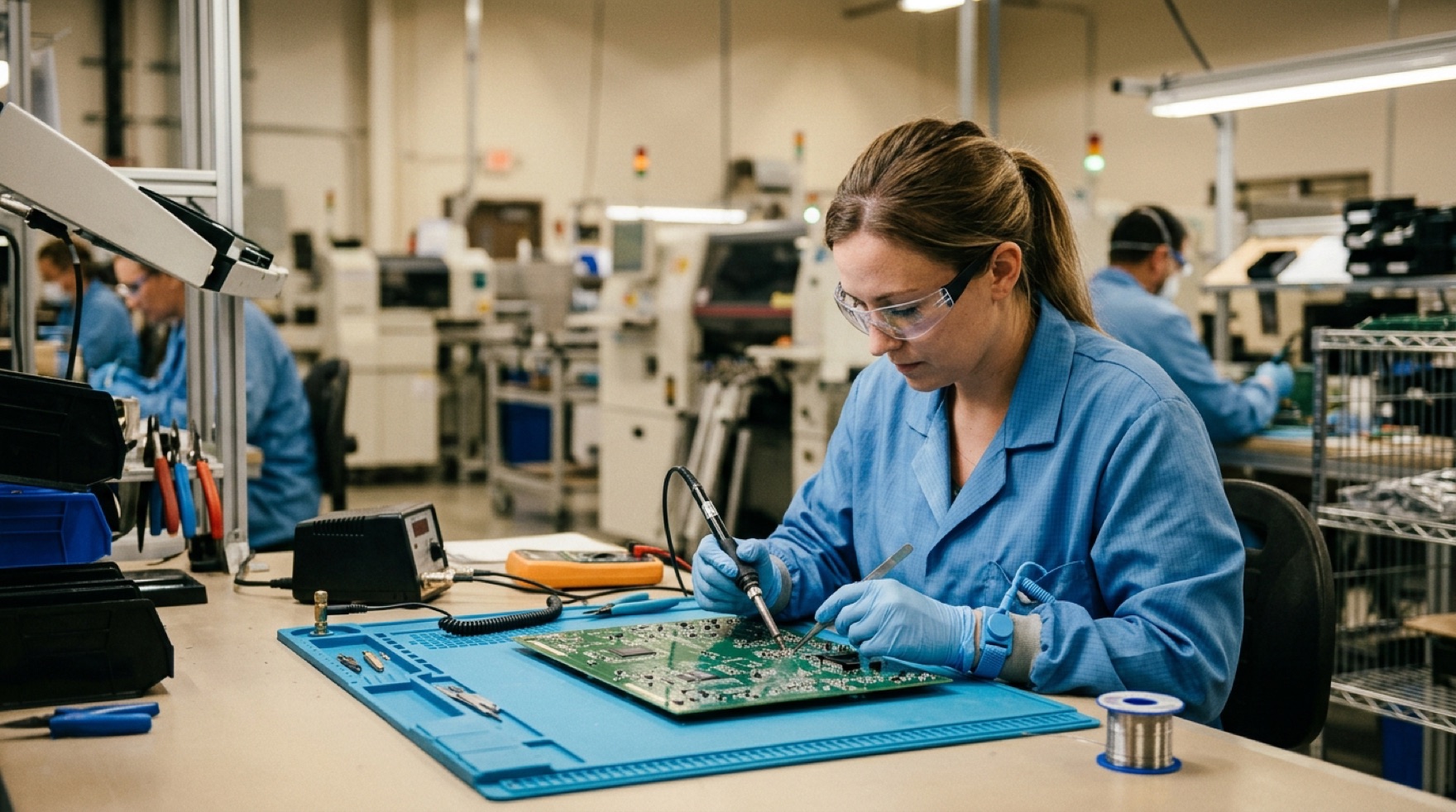
ESD Control Program for Electronics (ANSI/ESD S20.20)
A single spark you can't feel can scrap a wafer or seed a latent defect that fails months later in the field. ANSI/ESD S20.20 is the standard that turns static control from a habit into a documented program, with named required limits, defined ground paths, and compliance verification. Here is what the standard actually requires, and the numbers competitors keep getting wrong.

ESD Flooring, Footwear & Grounding: Choosing the Path
There is more than one way to keep an operator at the same potential as the parts they handle, and the right one depends on whether they sit, stand, or move. A wrist strap, an ESD floor paired with heel grounders, or both: each grounds a person, each has a number in ANSI/ESD S20.20, and each fails in a different way. Here is how to choose, and how the limits and test methods line up.

Chemical Safety in Fabs: Hydrofluoric Acid & Solvents
Hydrofluoric acid etches silicon dioxide, which is exactly why fabs use it, and exactly why it is one of the most dangerous chemicals a worker can touch. A dilute splash can feel like nothing for hours, then pull enough calcium out of the blood to stop a heart. Here is how HF and process solvents are governed, why calcium gluconate has to be on hand before anyone opens the bottle, and what a documented fatality teaches about handling.

Stay ahead of safety.
New articles, free templates, and regulatory updates in your inbox. No spam — unsubscribe anytime.