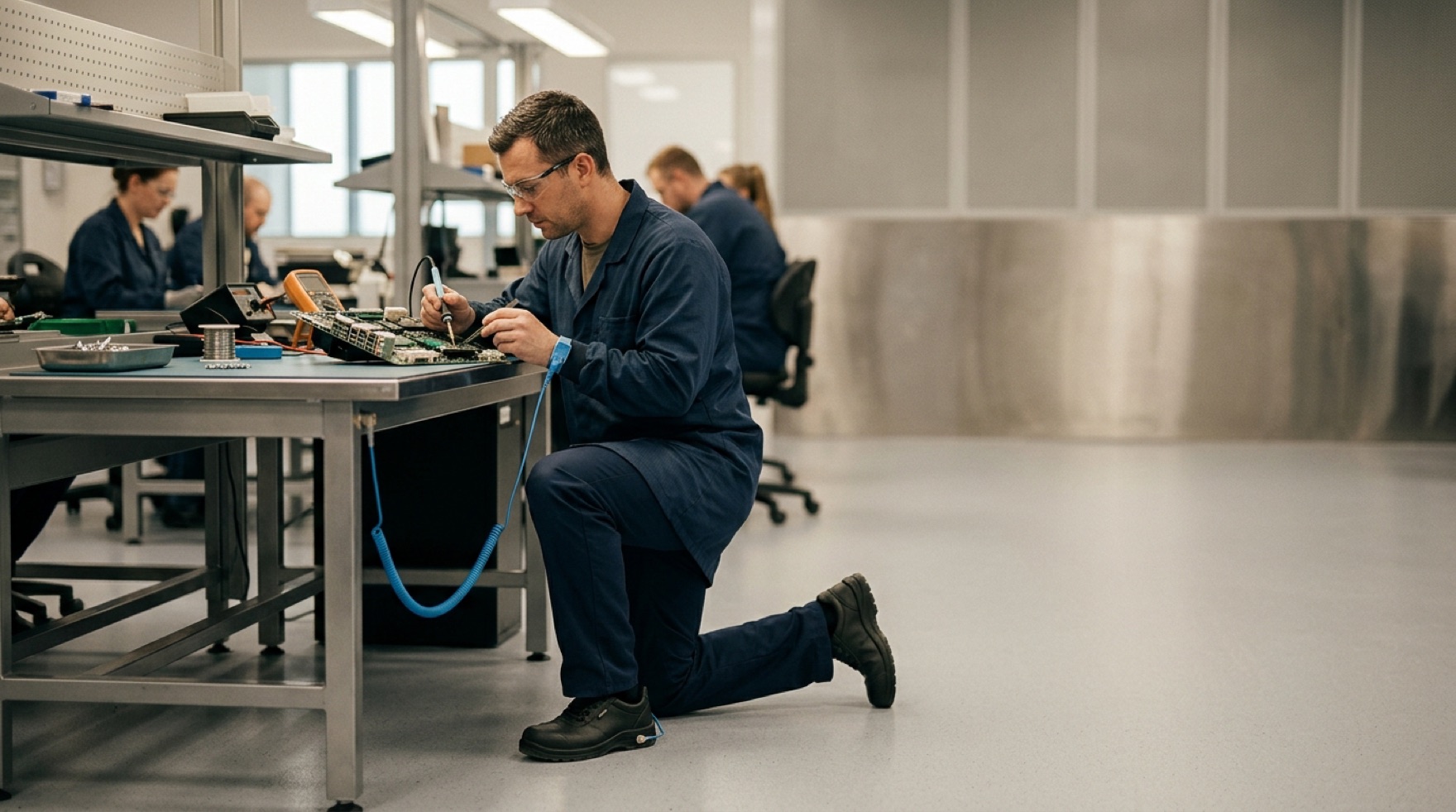
The short answer: There are two primary ways to ground a person handling ESD-sensitive parts, and the choice depends on the work. A wrist strap grounds a seated operator directly and must measure below 3.5 x 10^7 ohms as a worn system. An ESD floor combined with ESD footwear grounds a standing or moving operator through the floor and must keep the person below 1.0 x 10^9 ohms to ground and under 100 volts of body voltage. Both limits are set by ANSI/ESD S20.20; the floor is characterized with the ANSI/ESD STM7.1-2020 test method, and the person-plus-footwear-plus-floor system with STM97.1 and STM97.2. High-sensitivity work often uses both paths together.
How does grounding a person actually protect parts?
Grounding a person works by keeping their body at the same electrical potential as the grounded worksurface and the parts on it, so no charge builds up to discharge into a component. Charge is generated constantly by ordinary movement, walking across a floor, sliding out of a chair, peeling tape, and a floating, ungrounded operator stores it until they touch something conductive. The whole strategy is to provide a controlled, resistive path that bleeds that charge to ground continuously instead of letting it dump into a 100 volt HBM part all at once.
The resistance in that path is deliberate. A hard ground would drain charge instantly but would also make the person a shock and hardware risk, so ESD grounding uses static-dissipative resistance, high enough to limit current, low enough to drain charge before it accumulates to damaging levels. Every number in this article is a point on that balance, which is why the limits are ranges and ceilings rather than "as low as possible."
Wrist strap or ESD flooring and footwear: which do you use?
Use a wrist strap for seated work at a fixed bench, and use an ESD floor with ESD footwear for standing or mobile work; many high-sensitivity areas use both. The deciding factor is whether the operator stays connected to one grounded workstation or moves around the space. A wrist strap is the most direct and reliable ground for someone seated, but it tethers them to a point; flooring and footwear ground a person wherever they stand or walk, which is what standing assembly, tool bays, and cart-based material movement need.
The table lays the two paths side by side against their S20.20 limits and the methods used to verify them. Read it as a selection guide: the limit you have to meet is fixed by the standard, but which path you install is a decision about how people actually work.
| Grounding path | Grounds whom | S20.20 required limit | Verified with |
|---|---|---|---|
| Wrist strap system | A seated operator at a grounded workstation | Worn system resistance less than 3.5 x 10^7 ohms (person plus strap plus cord) | Shift or continuous compliance verification |
| ESD flooring plus ESD footwear | A standing or moving operator, through the floor | System resistance to ground less than 1.0 x 10^9 ohms and body voltage under 100 volts | STM97.1 (resistance) and STM97.2 (body voltage); floor material by STM7.1-2020 |
| Both, layered | High-sensitivity or CDM-prone handling | Each path meets its own limit above | Both verification routes on schedule |
Which standard sets the number, and which one is just the test?
ANSI/ESD S20.20 sets the pass or fail numbers; the STM methods only tell you how to measure. This is the single most common sourcing error in ESD flooring material, and getting it right is what separates a defensible spec from a copied one. ANSI/ESD STM7.1-2020 provides procedures for measuring the electrical resistance of floor materials and for qualifying and monitoring a floor after installation, but it does not state a pass limit of its own. The resistance a floor has to achieve is specified in S20.20.
The same split runs through the other methods, as the ESD Association's test methods are structured to describe. STM97.1 measures the resistance of the floor and footwear in combination with a person standing on the floor; STM97.2 measures the body voltage that same system generates when the person walks. Neither is a requirement; both feed a number that gets compared against the S20.20 limits of 1.0 x 10^9 ohms and 100 volts. When you write a specification or an audit finding, name S20.20 for the limit and the STM method for the measurement, and never state the limit as if it came from the test method.
What ties it all together at the workstation?
A common point ground ties the operator, the worksurface, and the floor into one equipotential system, and without it the individual limits do nothing. Grounding a wrist strap and a mat to different points can leave a voltage difference between them, which is the difference a charged part discharges across. S20.20's grounding and equipotential bonding requirement exists so that every conductor an ESDS item might touch, the person included, sits at the same potential, drained through a single defined ground reference.
That is also why footwear and flooring only work as a pair. An ESD floor grounds nothing if the operator wears insulating shoes, and ESD footwear grounds nothing on an ordinary insulating floor, because the ground path runs through both in series and is only as good as its weakest link. Specify, install, and verify them together, bond everything to the common point ground, and check each element against its S20.20 limit on the compliance schedule. The goal is not a floor that passes once on install day, but a ground path that still measures within limits after months of wear, cleaning, and traffic.