The short answer: There is no single national welding-fume standard in Canada. Occupational health and safety is split by jurisdiction: most employers fall under their province's or territory's OHS act and its regulations on ventilation and hazardous substances, while federally regulated workplaces follow the Canada Labour Code Part II and the COHSR. The national reference for the work is CSA W117.2-19 (R2023), "Safety in welding, cutting, and allied processes." Each jurisdiction sets its own occupational exposure limits (OELs) for hexavalent chromium and manganese, commonly based on ACGIH TLVs, so there is no one national number to quote. CCOHS puts local exhaust ventilation (LEV) first, with respirators selected under CSA Z94.4 used only where ventilation alone cannot control the exposure.
What is in welding fume, and why do chromium and manganese matter?
Welding fume is not a nuisance dust. CCOHS identifies the specific constituents that drive the health risk, and two of them decide how a fabrication shop has to think about ventilation. Chromium, present in most stainless steel, high-alloy materials, and welding rods, "converts to hexavalent chromium during welding," and CCOHS ties hexavalent chromium to an "increased risk of lung cancer," listing it among the carcinogenic forms. Manganese is present in "most welding processes, especially high-tensile steels," and its chronic effects "may include central nervous system problems."
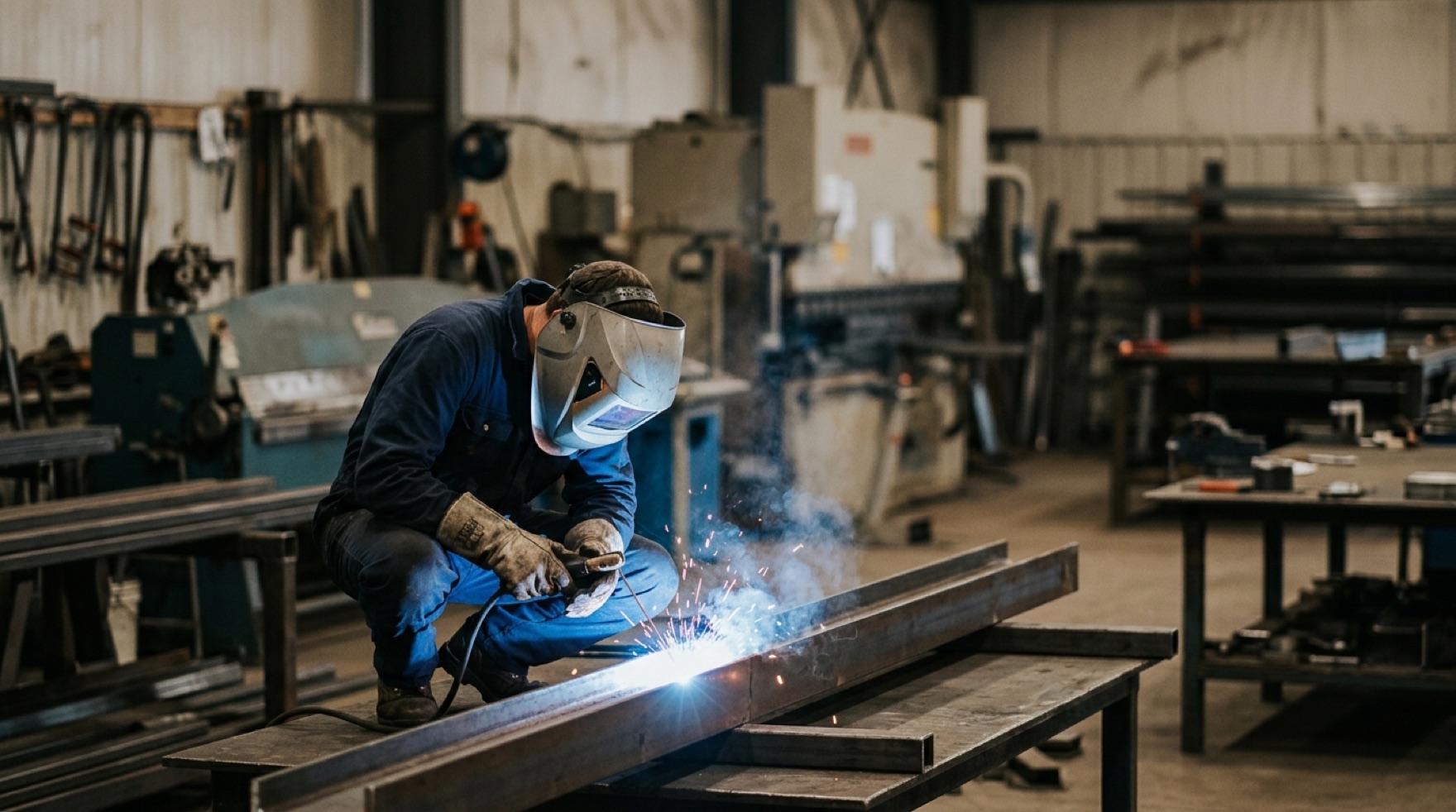
The exposure is heaviest where the chemistry and the geometry line up against the welder. Stainless and chrome-bearing alloys feed chromium into the plume, and any process that puts the operator's face close to rising fume, or that happens inside a tank, a vessel, or another poorly ventilated space, concentrates it. That is why a shop running gas metal arc or shielded metal arc welding on stainless has to treat the fume as a design problem for the ventilation system, not a personal-habit problem for the operator. Because the injury from a carcinogen is delayed, the exposure can feel harmless at the moment it is doing the damage.
Which law applies to welding fume in Canada?
The duty comes from the jurisdiction that governs the workplace, not from one national rule. Provincial and territorial OHS regulations require employers to control airborne hazardous substances and to provide ventilation, and each sets its own occupational exposure limits. In Ontario that duty sits within Regulation 833 (Control of Exposure to Biological or Chemical Agents); in British Columbia it sits within the WorkSafeBC OHS Regulation, including its Part on chemical agents and biological agents. Federally regulated employers carry an equivalent duty under the Canada Labour Code Part II and the COHSR. CSA W117.2-19 (R2023) is the national welding standard the industry works to, and CCOHS provides the practical guidance layered on top. Keep the roles straight: CSA W117.2 is a consensus standard, CCOHS is guidance, and the enforceable requirement is the OHS regulation that governs your site.
Is there a single Canadian exposure limit for hexavalent chromium?
No. This is the point that most often trips up a shop working from a US playbook. CCOHS does not publish one national figure for hexavalent chromium or manganese; on its welding-fume page it directs the reader to "see the applicable occupational exposure limits in your jurisdiction." Each province and territory sets its own OELs, and many adopt or adapt the ACGIH threshold limit values, which are revised over time. A number that is current and enforceable in one province may differ in the next, so importing a US permissible exposure limit and treating it as the Canadian rule is a mistake. Confirm the hexavalent chromium and manganese limits with the OHS regulator that governs your workplace, and remember that the numeric limit is a ceiling: the regulations still expect exposure to be reduced so far as is reasonably practicable, not merely held at the line.
How do you control the fume plume at the source?
Capture the plume at the arc before it rises to the operator's face, and treat respirators as the last layer rather than the first. CCOHS is direct that "local exhaust ventilation (LEV) is always the preferred method of removing welding fumes and gases." The order below runs from the most reliable control, which removes the fume mechanically, down to the least, which depends on a worker wearing equipment correctly on every weld.
- Reduce the fume at the process. Where the job allows it, a lower-fume process or consumable, a change that reduces chromium content, or automation that moves the operator away from the plume cuts the hazard before it forms. Removing the exposure sits above managing it.
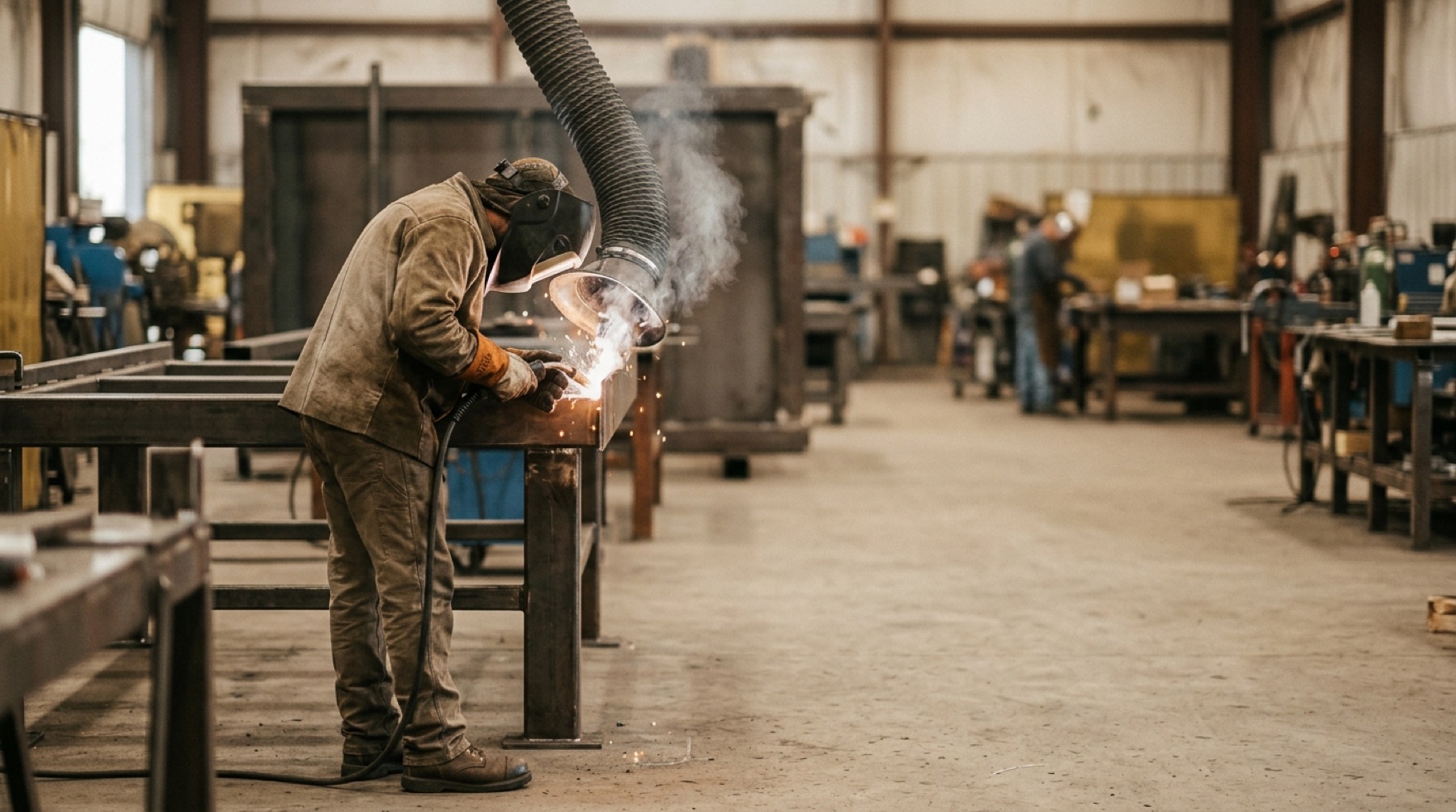
- Capture it at the source. A movable capture hood, an extracted bench, or an on-torch fume gun positioned close to the arc pulls fume from the breathing zone at the point it is generated. CCOHS gives an engineering target for a moveable hood: "provide an air velocity of at least 100 ft/min (0.5 m/s) across the welding arc," with the hood placed "about 1 duct diameter from the arc." Positioned there and repositioned as the work moves, source capture is the workhorse control for a fabrication shop.
- Dilute what escapes. General dilution ventilation lowers the average concentration in the room but does not protect a welder leaning over a rising plume, and it is close to useless inside a tank or vessel where the operator and the fume share a small volume. It supports the room; it does not replace capture at the arc.
- Protect the individual. Respiratory protection is used "where ventilation alone cannot adequately protect the welder," in the words of the CCOHS ventilation page, and the selection process is set out in CSA Z94.4. It is the layer that depends entirely on fit, condition, and consistent use, which is why it sits beneath the engineering controls rather than in place of them.
Positioning is the whole game with source capture. An extraction arm parked two feet from the arc, or left behind as the welder moves down a seam, is a capture device that is no longer capturing. The control only works while it stays close to the plume, which makes operator training on repositioning part of the engineering control, not separate from it.
Canada at a glance: what governs welding fume
The table sets out where each piece of the requirement comes from, so a shop can see which parts are law, which are the national standard, and which are guidance.
| Element | Canada (most workplaces) | Source of the duty |
|---|---|---|
| Governing law | Provincial/territorial OHS act + regulations on ventilation and hazardous substances; federal = Canada Labour Code Part II + COHSR | Provincial OHS regulator / ESDC Labour Program |
| Welding standard | CSA W117.2-19 (R2023), "Safety in welding, cutting, and allied processes" | CSA Group; referenced by CCOHS |
| Exposure limits (Cr(VI), manganese) | Set by each province/territory, commonly ACGIH TLV-based; no single national value | Provincial OHS regulation; CCOHS directs you to your jurisdiction |
| Primary control | Local exhaust ventilation; at least 100 ft/min (0.5 m/s) across the arc, hood about 1 duct diameter away | CCOHS: Welding - Ventilation |
| Respirators | Where ventilation cannot control exposure; selected under CSA Z94.4 | CCOHS; CSA Z94.4 |
The practical takeaway for a Canadian employer is to build the ventilation around source capture at the arc, confirm the hexavalent chromium and manganese OELs with the provincial or territorial regulator that governs the site, and add respiratory protection under CSA Z94.4 only where capture and dilution fall short. A shop that leads with a respirator and skips the ventilation is protecting the paperwork, not the welder. A shop that captures the plume where it forms is the one keeping a carcinogen out of a person who will not feel it arriving.