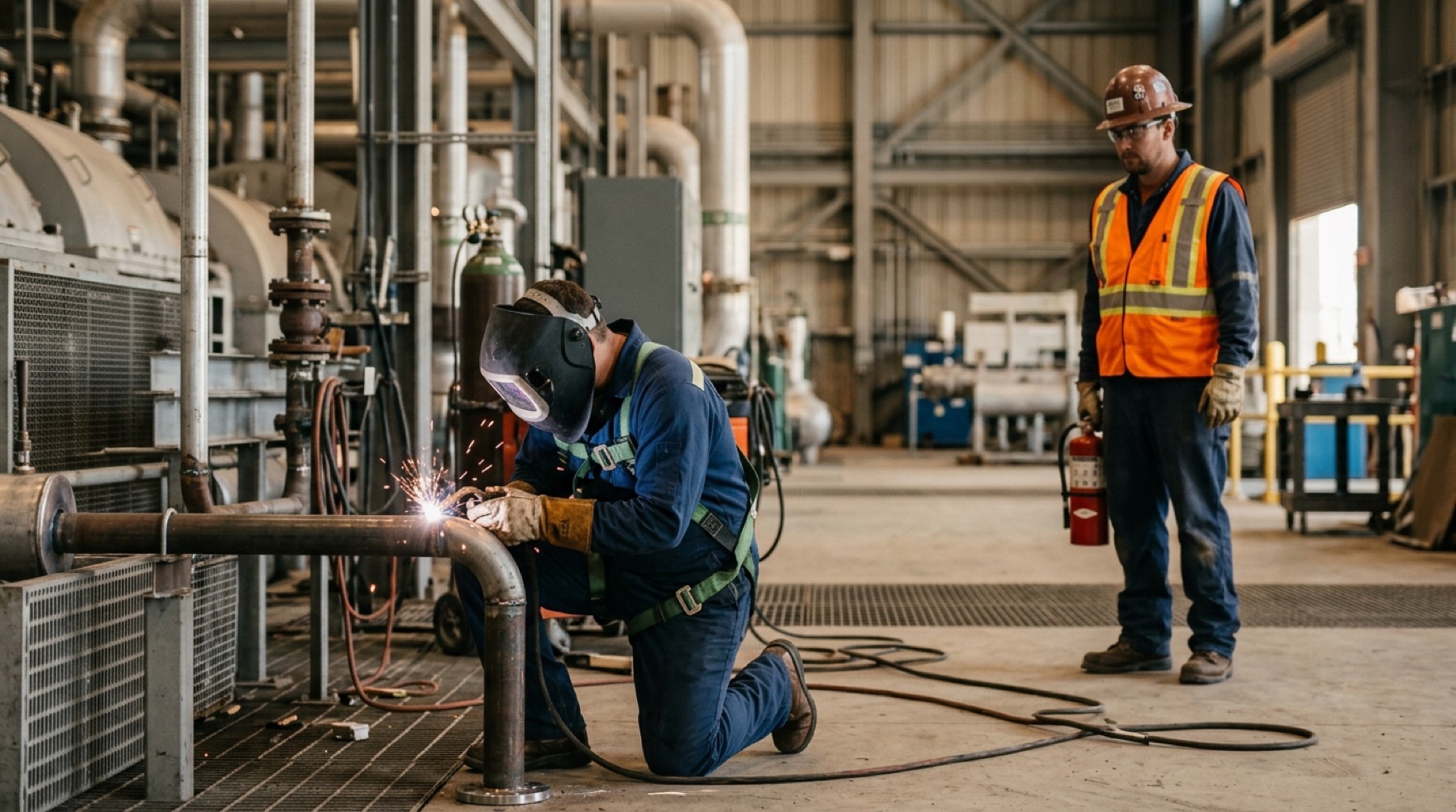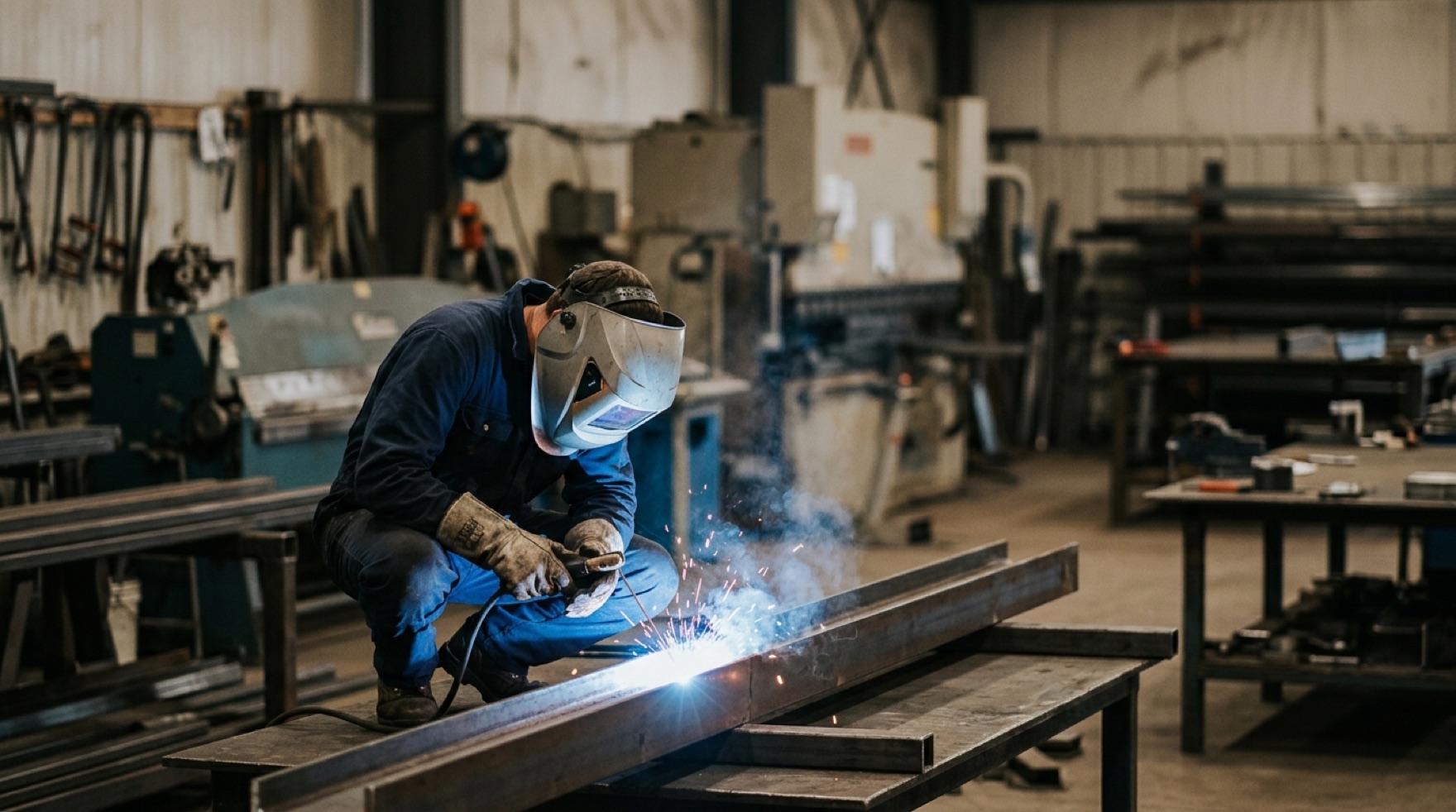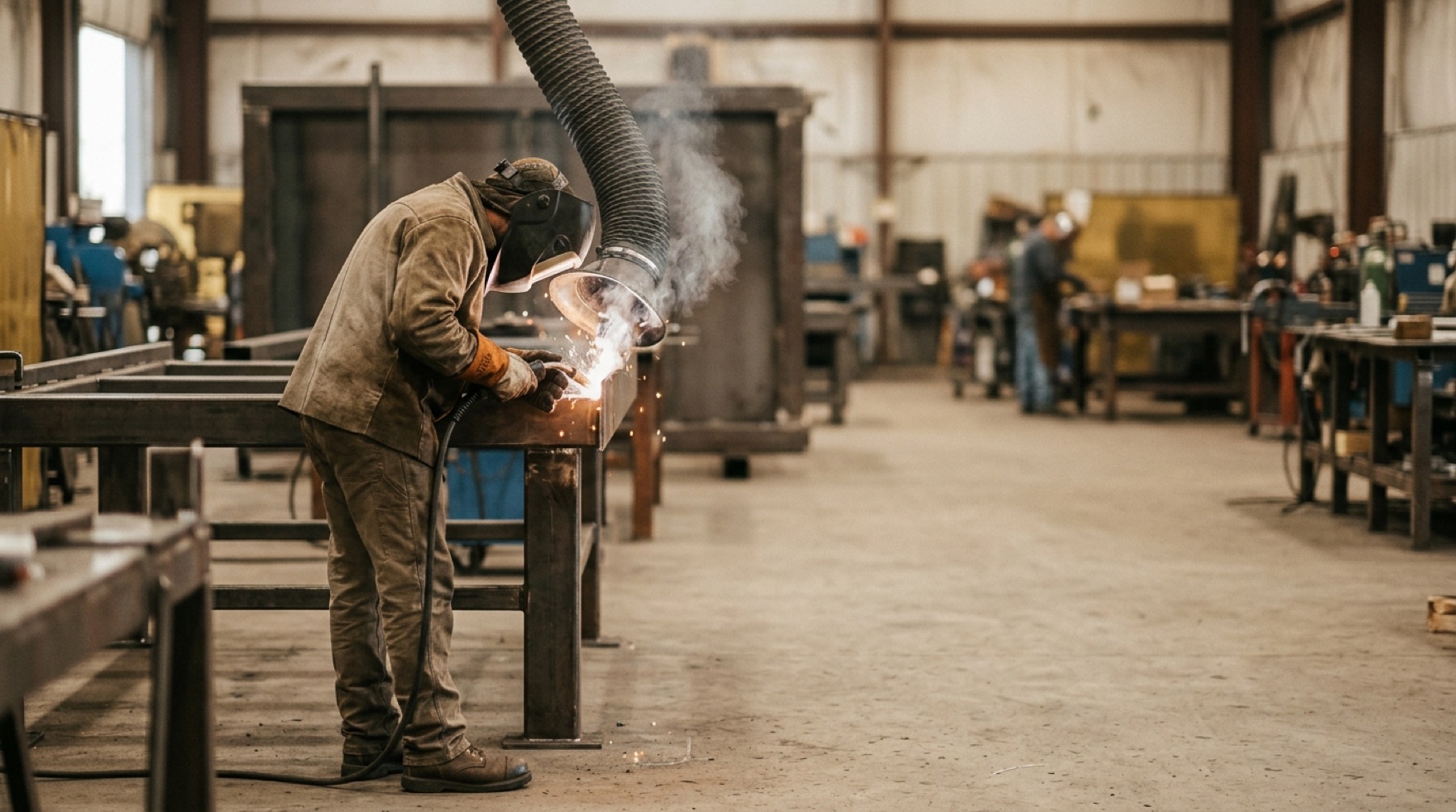
The short answer: Welding stainless steel and other chromium-bearing metals generates hexavalent chromium, Cr(VI), a confirmed carcinogen, in the fume plume. Under 29 CFR 1910.1026, the permissible exposure limit is 5 micrograms per cubic meter of air (5 µg/m³) as an 8-hour time-weighted average, with an action level of 2.5 µg/m³ that triggers monitoring and medical surveillance duties. The control that matters is capturing the plume at the arc before it reaches the breathing zone: source-capture local exhaust first, then general dilution ventilation, with respiratory protection under 29 CFR 1910.134 where those controls cannot hold exposure below the PEL.
What is hexavalent chromium in welding fume, and why is it regulated separately?
Hexavalent chromium is a form of chromium created when an electric arc vaporizes chromium in the base metal or the consumable and it oxidizes in the air, and it is regulated on its own because it causes lung cancer. It is not a nuisance dust. OSHA gave it a substance-specific standard, 29 CFR 1910.1026, precisely because the health outcome is a delayed, serious disease rather than an immediate irritation, which means the exposure can feel harmless at the moment it is doing damage.
The exposure is heaviest where the chemistry and the geometry line up against the welder. Stainless steel, high-chrome alloys, and chromate-coated metal all feed chromium into the weld fume plume, and processes that put the operator's face close to a rising plume, or that happen in a tank, a vessel, or another poorly ventilated space, concentrate it. That is why a fabrication shop running gas metal arc welding (GMAW) or shielded metal arc welding (SMAW) on stainless needs to treat Cr(VI) as a design problem for the ventilation system, not as a personal-habit problem for the operator.
What are the exposure limits, and how does an employer know if they are exceeded?
The enforceable limit is 5 µg/m³ as an 8-hour time-weighted average, and the action level that starts additional duties is 2.5 µg/m³. Both figures are set in 29 CFR 1910.1026: the PEL in 1910.1026(c) and the action level in 1910.1026(b). A permissible exposure limit is an OSHA figure and it is enforceable, which distinguishes it from an advisory ACGIH threshold limit value; for Cr(VI), the number that carries citation weight is the OSHA PEL.
Knowing whether a weld cell exceeds those limits is itself a requirement, not a guess. 1910.1026(d) makes the employer determine each welder's 8-hour TWA exposure, either through a scheduled air-monitoring program or a performance-oriented option that relies on objective data and representative sampling, and 1910.1026(d)(4) requires the employer to notify affected employees of their results in writing within 15 workdays. The operational point is that "we run stainless sometimes" is not an exposure assessment. Until the fume in the breathing zone is characterized, the shop does not know which controls the standard obligates it to run.
How do you control welding fume at the source?
Capture the plume at the arc before it rises to the operator's face, and treat respirators as the last layer, not the first. The reliability of a control depends on how little it asks of the welder in the moment, so the order below runs from the most reliable, which changes the process or removes the fume mechanically, down to the least, which depends on a worker wearing equipment correctly every minute of every weld.
- Reduce the fume at the process (most reliable). Where the job allows it, a lower-fume process or consumable, a switch that reduces chromium content, or automation that moves the operator away from the plume cuts the hazard before it forms. Elimination and substitution sit above every ventilation control because they remove the exposure rather than manage it.
- Capture it at the source. Source-capture local exhaust, a fume gun with on-torch extraction, a fume hood, or a movable capture arm positioned close to the arc pulls the weld fume plume away from the breathing zone at the point it is generated. Positioned within a few inches of the arc and repositioned as the work moves, source capture is the workhorse control for a fabrication shop, because it removes the contaminant instead of diluting it.
- Dilute what escapes. General dilution ventilation lowers the average concentration in the space but does not protect a welder leaning directly over a rising plume. It is a supporting control for the room, not a substitute for capture at the arc, and it is close to useless inside a tank or vessel where the operator and the plume share a small volume.
- Protect the individual (least reliable alone). Respiratory protection under 29 CFR 1910.134 is required where engineering and work-practice controls cannot bring exposure below the PEL, during the installation of those controls, in maintenance and repair tasks, and in emergencies, as 1910.1026(g)(1) sets out. It is the layer that depends entirely on fit, condition, and consistent use, which is why the standard positions it beneath the engineering controls rather than in place of them.
Positioning is the whole game with source capture. An extraction arm parked two feet from the arc, or left behind as the welder moves down a seam, is a capture device that is no longer capturing. The control only works while it stays close to the plume, which makes operator training on repositioning part of the engineering control, not separate from it.
When is a respirator required, and what does the program need?
A respirator becomes mandatory when the exposure determination or the task shows that engineering controls cannot keep the welder below 5 µg/m³, and once it is required the employer owes a full written program. 1910.1026(g)(1) lists the circumstances that require respiratory protection, and 1910.1026(g)(2) ties the program back to 29 CFR 1910.134. Handing a welder a respirator does not, by itself, meet the standard.
The program has specific, auditable parts. 29 CFR 1910.134(c)(1) requires a written respiratory protection program with worksite-specific procedures, administered by a program administrator qualified by training or experience under 1910.134(c)(3). Before a welder wears a tight-fitting respirator, 1910.134(e) requires a medical evaluation to confirm they can use one, and 1910.134(f) requires fit testing before first use and at least annually after that. The sequence is deliberate: medical clearance, then fit test, then use, so that the respirator the welder relies on is one they can physically tolerate and one that actually seals to their face.
What else does 1910.1026 require beyond the air itself?
Cr(VI) contaminates surfaces, clothing, and hands, so the standard reaches past ventilation into clothing, hygiene, and medical follow-up. 1910.1026(h) requires the employer to provide protective clothing and equipment at no cost where there is a hazard of skin or eye contact, and to handle contaminated clothing so the contamination is not spread or carried home. Fume that settles is still hexavalent chromium, which is why the standard treats housekeeping and clothing as exposure controls rather than tidiness.
Two further duties close the loop. 1910.1026(i) requires change rooms, washing facilities, and the practice of washing before eating or drinking, keeping ingestion out of the exposure pathways. 1910.1026(k) requires medical surveillance, offered at no cost, for employees exposed at or above the action level for 30 or more days a year, which is how a chronic carcinogen exposure gets caught in a person before it becomes a diagnosis. Taken together, the standard treats Cr(VI) as something to keep out of the lungs, off the skin, out of the gut, and under medical watch, because a control that only addresses the air leaves three other routes open.
Turning the limit into a working control plan
The 5 µg/m³ PEL is a statement about what a welder's lungs can be allowed to see across a shift, and every control in 29 CFR 1910.1026 exists to hold the fume plume below it. A defensible plan starts by characterizing the exposure under 1910.1026(d), leads with source capture at the arc, supports it with dilution ventilation, and adds respiratory protection under 1910.134 only where the engineering controls fall short, all while managing the clothing, hygiene, and medical surveillance the standard requires. Shops that lead with a respirator and skip the exposure assessment are protecting the paperwork, not the welder. Shops that capture the plume where it forms, and prove it with monitoring, are the ones keeping a carcinogen out of a person who will not feel it arriving.