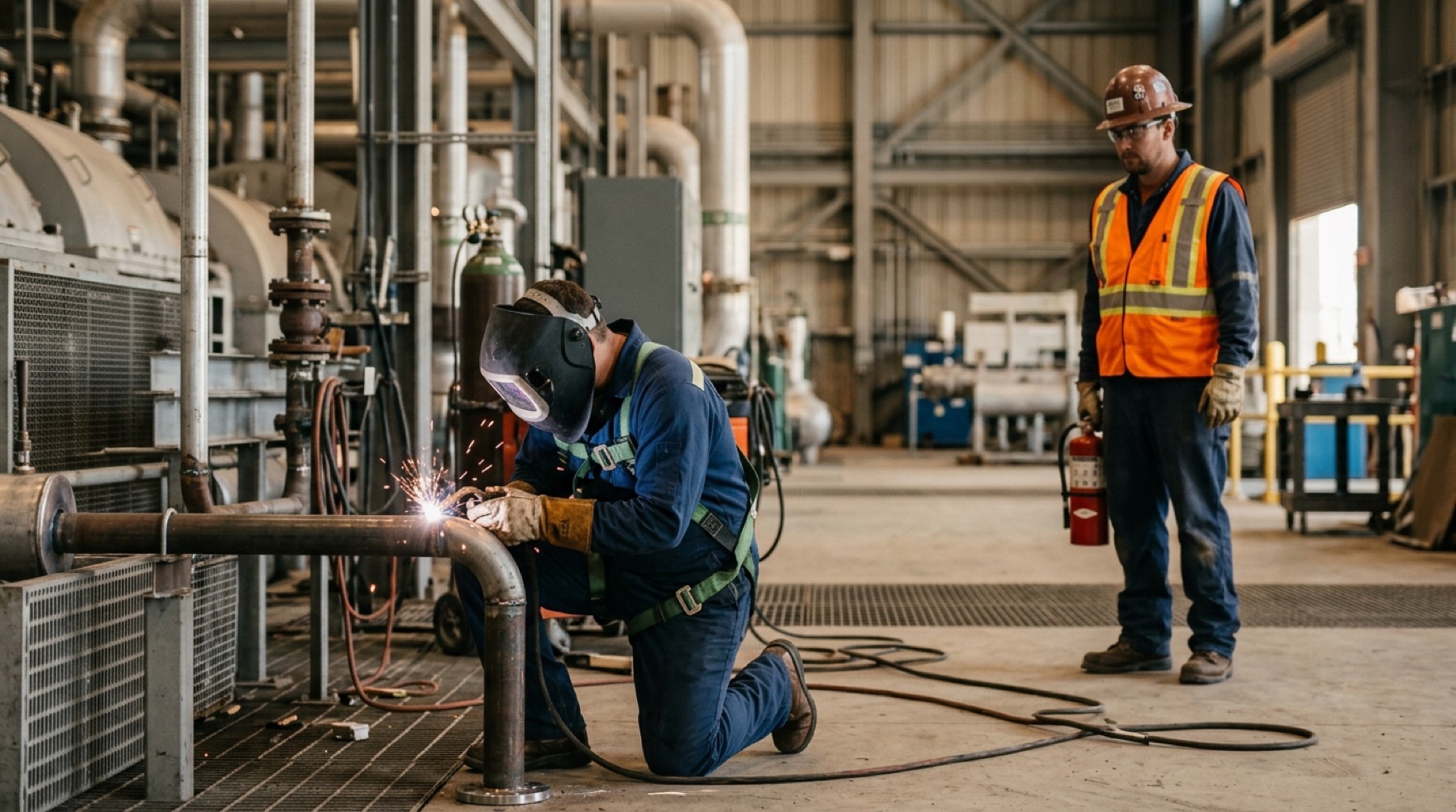
The short answer: Under 29 CFR 1910.252(a), welding and cutting are permitted only in areas made fire safe, combustibles within 35 feet of the work must be removed or protected, and a fire watch is required where combustibles cannot be moved. OSHA requires the fire watch to continue for at least a half hour (30 minutes) after the work is finished, per 1910.252(a)(2)(iii)(B). NFPA 51B, the consensus hot work standard adopted by many local fire codes, extends that post-work watch to at least 60 minutes. The written permit is the document that verifies the area was checked and the precautions were set before the arc was struck.
What is a hot work permit, and when is it required?
A hot work permit is written authorization confirming a specific area has been inspected and made fire safe before any welding, cutting, brazing, grinding, or other spark- or flame-producing work begins outside a designated area. 29 CFR 1910.252(a)(2)(iv) requires a person responsible for authorizing the work to inspect the area and designate the precautions, preferably in the form of a written permit. The permit is not paperwork for its own sake: it is the record that the fire-safe determination was actually made by a named person before, not after, the risk was created.
The trigger is location, not tool. 1910.252(a)(2)(xv) allows cutting or welding only in areas that are or have been made fire safe, and where the job cannot be moved to a shop's designated fire-safe area, such as a weld cell or a burn table with proper clearance, the permit process is how a temporary spot is verified and controlled. NFPA 51B, where a jurisdiction's fire code adopts it, requires the same permit-based system and defines the roles that manage it, which is why many facilities run a single permit that satisfies both the OSHA rule and the local NFPA-based code at once.
What must the fire-prevention check cover before the work starts?
The check has to clear a 35-foot zone around the work of combustibles, protect what cannot be moved, and close the paths sparks travel. 1910.252(a)(2)(v) requires combustible material to be swept from the floor for a radius of 35 feet, and combustible floors to be kept wet, covered with damp sand, or protected. Where movable fire hazards cannot be relocated, 1910.252(a)(1) requires guards to confine the heat, sparks, and slag. Thirty-five feet is not arbitrary: it is the distance the standard treats as the reach of the sparks and spatter a torch or arc throws.
Openings and hidden fuel are the part that housekeeping alone misses. 1910.252(a)(2)(iii)(A) requires a fire watch where appreciable combustible material is closer than 35 feet, where combustibles are more than 35 feet away but easily ignited by sparks, where wall or floor openings within a 35-foot radius expose combustibles in adjacent areas including concealed spaces, and where combustibles are adjacent to the opposite side of metal partitions and could ignite by conduction or radiation. Sparks travel through floor gaps and roll under walls, and heat conducts through steel to whatever is stacked against the far side, which is why the check has to look past the immediate work surface.
How long must a fire watch stay after the work is done?
OSHA requires the fire watch to be maintained for at least 30 minutes after welding or cutting operations are complete, and NFPA 51B extends that to at least 60 minutes where a local code adopts it. 1910.252(a)(2)(iii)(B) sets the OSHA half-hour minimum and requires the watcher to check for and extinguish smoldering fires; NFPA 51B (2019), Section 5.6.1.1 sets the longer 60-minute post-work watch. The reason for any waiting period at all is that hot work fires are frequently discovered after the crew has left, once a smoldering ignition has had time to grow.
A CSB investigation shows what the post-work check and the atmosphere verification exist to prevent. In its report on a November 2010 explosion at a DuPont facility in Buffalo, New York, the U.S. Chemical Safety Board found that a contract welder and a foreman were repairing an agitator support on top of an atmospheric storage tank when flammable vinyl fluoride vapor, flowing undetected from interconnected in-service tanks, entered the tank and ignited during the welding. The welder was killed and the foreman was burned. The CSB concluded the company had overlooked the hazard and recommended testing and, where needed, continuously monitoring tanks and adjacent spaces for flammables during hot work. The transferable point is that a fire watch and a 35-foot sweep control the combustibles you can see, while the permit still has to verify the atmosphere, because the fuel that kills is often the vapor no one tested for.
How do the OSHA and NFPA 51B requirements compare?
The two work together: OSHA sets the enforceable federal floor, and NFPA 51B sets the consensus practice that local fire codes frequently adopt on top of it. The table condenses the requirements a permit has to satisfy where both apply.
| Requirement | OSHA 29 CFR 1910.252(a) | NFPA 51B (where adopted by local code) |
|---|---|---|
| Permit / authorization | Responsible person inspects and designates precautions, preferably a written permit (1910.252(a)(2)(iv)) | Permit-required system with defined permit-authorizing individual and operator roles |
| Combustible clearance | Sweep and protect combustibles within a 35-foot radius (1910.252(a)(2)(v)) | Relocate or protect combustibles within 35 feet |
| Fire watch trigger | Required where combustibles are within 35 ft, easily ignited, or exposed through openings or partitions (1910.252(a)(2)(iii)(A)) | Required where a fire hazard remains after precautions |
| Post-work fire watch | At least 30 minutes after the work (1910.252(a)(2)(iii)(B)) | At least 60 minutes after the work (Section 5.6.1.1) |
Where a jurisdiction has adopted NFPA 51B, the longer duration governs, so a program built to the 60-minute watch satisfies both at once. Building the permit to the stricter of the two is the practical way to stay compliant without tracking which rule applies on which day.
Who signs the permit, and what does it actually document?
A named, authorized person signs it, and it documents that the fire-safe determination and the precautions were verified before the work began. 1910.252(a)(2)(iv) puts that inspection and authorization on the person responsible, and the permit records what they checked: the 35-foot clearance, the protection of what could not be moved, the openings and partitions, the fire watch assignment, and the extinguishing equipment on hand. An unsigned or after-the-fact permit proves none of that, and it is the first document a fire investigator asks for.
Treat the permit as a live control for one job in one place, not a standing pass. It should name the specific location and time window, so that when the work moves, the tank changes, or the shift ends, the authorization ends with it and a fresh check is required. The DuPont case is the argument for that discipline: the hazards that ignite hot work are specific to the exact spot and the exact conditions, and a permit that verifies those conditions before each job is what keeps the sweep, the watch, and the atmosphere check from becoming a formality.