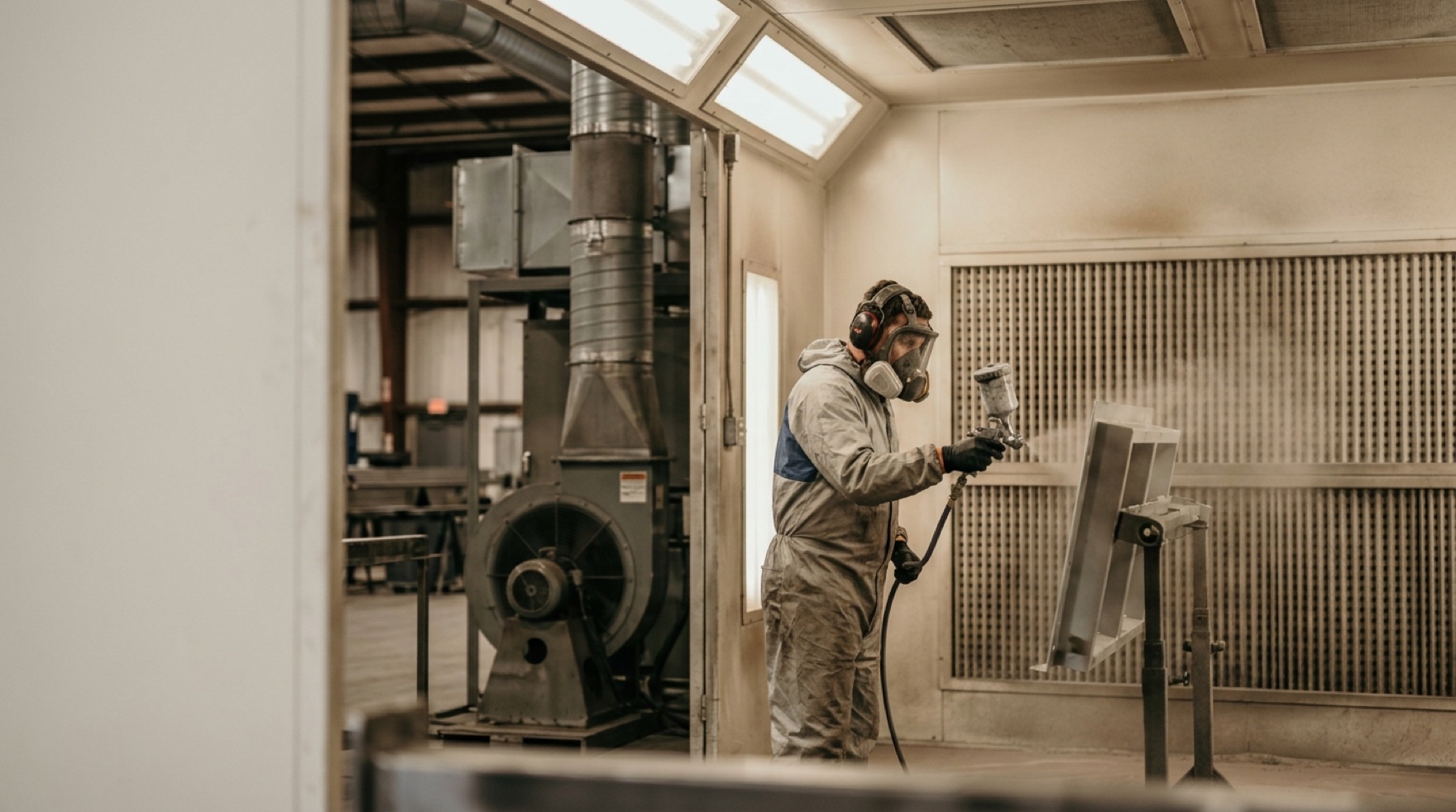
The short answer: There is no single national spray-booth standard in Canada equivalent to the US OSHA 1910.107, and NFPA 33 is not directly enforceable here; it may be referenced through a provincial fire code instead. Fire-safety requirements for spray application, including booth construction, ventilation, and the storage of flammable and combustible liquids, sit in the provincial or territorial fire code, most of which are based on the National Fire Code of Canada published by the National Research Council. Workplace ventilation and the control of flammable vapour are also addressed by provincial OHS regulations, and federally regulated workplaces carry equivalent duties under the Canada Labour Code Part II and the COHSR. CCOHS guidance frames the hazard the same way the fire codes do: ventilate the vapour away, keep every ignition source out, and control static.
Who sets spray-booth fire rules in Canada?
Two regimes govern a spray booth, and both are set by jurisdiction. The fire side, covering booth construction, ventilation, and how flammable and combustible liquids are stored and handled, lives in each province's or territory's fire code. The National Fire Code of Canada, developed by the Canadian Commission on Building and Fire Codes and published by the National Research Council, is the model code those provincial fire codes are generally based on, and it sets technical requirements for the storage, handling, use, and processing of flammable and combustible liquids. The occupational side, covering workplace ventilation and the control of flammable atmospheres, lives in the provincial OHS regulation, with the Canada Labour Code Part II and the COHSR covering federally regulated workplaces.
Because the enforceable clauses live in each province's fire code and OHS regulation, the specific booth, ventilation, and storage requirements differ from one jurisdiction to the next. The right move is to confirm them with both the fire authority and the OHS regulator that govern your site, and to check which edition of the fire code your province has adopted, rather than assume the US 1910.107 clause numbers carry over.
How is a spray-booth fire actually prevented?
A spray-booth fire needs three things together: flammable vapour in an ignitable concentration, an ignition source, and oxygen. The controls in the fire codes and in CCOHS guidance work by denying the first two, since oxygen is a given in an occupied shop. CCOHS describes the same three levers a designer pulls: strong ventilation to carry the solvent vapour and overspray away so the atmosphere never reaches an ignitable mix, removal of every ignition source, and control of static electricity when flammable liquids are moved.
On ventilation, CCOHS advises confirming that the ventilation systems are operational and the filters are not blocked before spraying starts, and notes that a downdraft ventilation spray booth carries a lower concentration of paint overspray. A booth with strong extraction but a blocked filter or a stalled fan has quietly let the vapour concentration climb back toward the ignitable range, which is why the check happens before every job, not once a year.
Which ignition sources have to be removed?
All of them, and CCOHS lists the ones a finishing shop actually has. Eliminate ignition sources such as open flames, welding torches, electrical outlets, heaters, motors, static electricity, and smoking, and do not spray near grinding or welding operations or any source of ignition. Inside the booth, use non-sparking equipment and make sure the equipment is grounded and bonded. The practical failure mode is a standard shop-grade light fixture, switch, or motor sitting inside a booth where flammable vapour and mist can be present: it is an ignition source parked in the fuel, which is why fire codes call for explosion-protected electrical and lighting equipment in the spray area.
Why does static electricity get its own rule?
Because it is an ignition source that appears wherever solvents and paints flow through hoses or are poured between containers. CCOHS explains that a static discharge with enough energy can cause a fire or explosion when a flammable vapour is within its ignitable range, and that the fix is to bond and ground. Bonding two containers ensures there is no difference in electrical potential between them and therefore no spark, and a container is grounded so any charge drains away. CCOHS requires these connections to be bare metal to bare metal, with all dirt, paint, rust, or corrosion removed from the points of contact, and applies them when flammable liquids are dispensed from a drum or transferred between conductive containers.
| Control | Canada (fire code + OHS, per CCOHS guidance) | Source of the duty |
|---|---|---|
| Governing framework | Provincial/territorial fire code (based on the National Fire Code of Canada) plus provincial OHS regulation; federal = Canada Labour Code Part II + COHSR | Provincial fire authority and OHS regulator / NRC / ESDC Labour Program |
| Ventilation | Ventilate to keep vapour below the ignitable level; verify the system runs and filters are clear before spraying; downdraft booth preferred | Provincial OHS regulation; CCOHS guidance |
| Ignition sources | Remove open flames, welding, heaters, motors, static, and smoking; explosion-protected electrical and lighting in the spray area | Provincial fire code; CCOHS guidance |
| Static control | Bond containers together and ground them when transferring flammable liquids, bare metal to bare metal | Provincial fire code; CCOHS guidance |
| NFPA 33 | Not directly enforceable; may be referenced through a provincial fire code as the design basis | Provincial fire authority |
For a safety leader, the split has a practical consequence. The US framework points to OSHA 1910.107 as the enforceable floor and NFPA 33 as the design basis; in Canada the enforceable floor is your province's fire code and OHS regulation, and NFPA 33 reaches the booth only if your fire code references it. Meeting the fire code and OHS clauses keeps the operation legal, but the day-to-day protection comes from the same maintenance CCOHS describes: fans that move the rated air, filters that are clear, ignition sources kept out, and every flammable-liquid transfer bonded and grounded. Confirm the adopted edition and the specific clauses with the fire authority and OHS regulator for your jurisdiction.