The short answer: There is no OSHA standard that caps how much an order picker can lift, so warehouse ergonomics is managed through recognized assessment tools and the employer's general duty to control a recognized hazard. OSHA states plainly that it has no standard limiting how much a person may lift or carry, and that musculoskeletal hazards from heavy or awkward lifting are addressed under Section 5(a)(1) of the OSH Act, the General Duty Clause. The practical program combines the Revised NIOSH Lifting Equation and ISO 11228-1 to measure the risk in each pick task, then engineers out the worst combinations: lifting from the floor, reaching over a beam, twisting under load, and repeating it at speed.
Does OSHA set a weight limit for order picking?
No. OSHA has no standard that sets a maximum weight a worker may lift or carry, a point the agency has restated repeatedly in its letters of interpretation. In its March 2004 interpretation, OSHA writes that it "does not have a standard which sets limits on how much a person may lift or carry," and that exposure to heavy-lifting and back-injury hazards "can be addressed under Section 5(a)(1) of the OSH Act." The General Duty Clause requires employers to furnish a workplace free from recognized hazards likely to cause death or serious physical harm.
That absence of a number is the reason ergonomics on a pick line has to be run as a risk-assessment program rather than a rule check. Compliance is not "stay under 50 pounds." It is demonstrating that the recognized musculoskeletal hazard in each task has been evaluated and controlled, using the assessment tools the field recognizes. When OSHA cites an employer for an ergonomic hazard, it does so under 5(a)(1) and points to a recognized method, most often the NIOSH Lifting Equation, to establish that the hazard was both recognized and feasible to reduce.
What makes order picking so hard on the body?
Order picking stacks the individual musculoskeletal disorder (MSD) risk factors that OSHA names, and stacking them is what drives injury. OSHA's ergonomics guidance lists the exposures behind work-related MSDs as "lifting heavy items, bending, reaching overhead, pushing and pulling heavy loads, working in awkward body postures and performing the same or similar tasks repetitively." A pick task rarely presents one of these in isolation. It presents most of them at once, on every case.
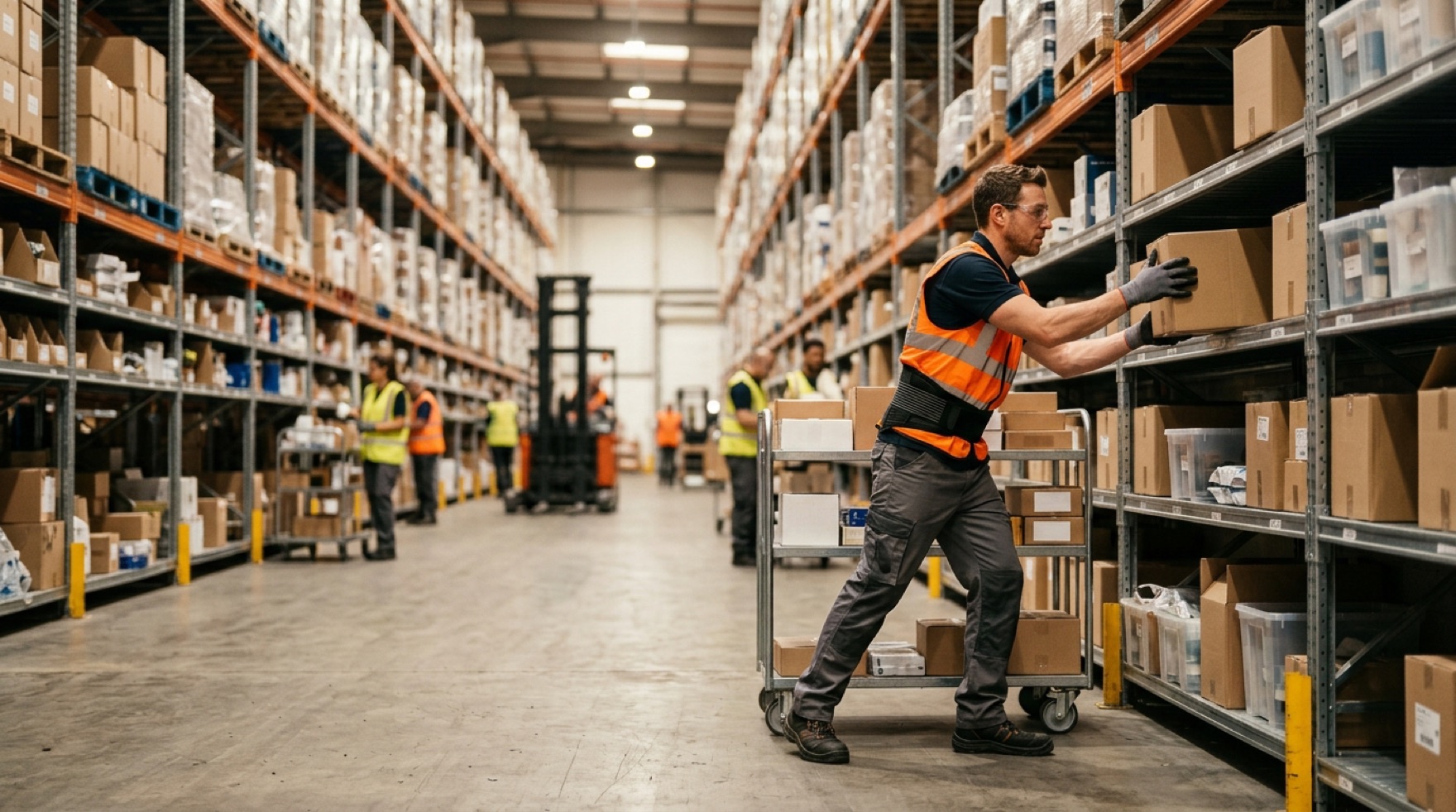
Picture the pick face. A carton in the bottom pick slot has to be lifted from near the floor, which puts the load low and the spine in flexion. A carton on a high shelf has to be lifted above the shoulder, which loads the rotator cuff. Either one is often held out beyond a rack beam or the lip of a flow rack, so the load sits far from the body and the effective moment on the low back climbs. The picker then rotates to place it on a conveyor or a pallet, adding torso twist, and does the whole sequence at a rate set by the pick rate, adding frequency and removing recovery time. Each factor alone is manageable. The combination is what the assessment tools are built to expose, because the combination is what the low back and shoulder actually feel.
How do the NIOSH equation and ISO 11228-1 fit in?
They are the two recognized methods for putting a number on a lifting task, and using one is how an employer shows a recognized hazard was assessed. The Revised NIOSH Lifting Equation starts from a load constant of 51 pounds, the weight a typical worker can lift under ideal conditions, and reduces it for each way the real task departs from ideal: the load's horizontal distance from the body, its vertical height, the vertical travel, the twist, the frequency, and the quality of the grip. OSHA's own materials describe this, noting in the poultry-processing eTool that NIOSH established that a worker "could lift about 51 pounds without a significant increase in risk of injury" only where the load is held close, at waist height, without twisting, and with good handholds. The output is a recommended weight limit for that specific task and a lifting index that compares the actual load to it.
ISO 11228-1, "Ergonomics, Manual handling, Part 1: Lifting, lowering and carrying," is the international standard covering the same territory, and it is the anchor a program can cite where an international or corporate standard is in play. The two are complementary: NIOSH gives the task-level arithmetic most North American programs use, ISO 11228-1 gives the recognized international framework for manual lifting, lowering, and carrying. Neither is an OSHA regulation, and both matter precisely because OSHA has no number of its own. They are how you convert "this pick looks heavy" into an assessed, documented, defensible risk figure.
Which pick tasks should be assessed first?
Assess the tasks that combine the most risk factors and repeat the most, because those are where the recommended weight limit falls furthest below the actual load. A carton picked from a floor-level slot, reached out over a beam, and twisted onto a conveyor at a high pick rate is the worst case, and it is also common. The table below maps the MSD risk factors OSHA names onto what they look like at the pick face, and the control that removes them, so an assessment turns into a work order rather than a memo.
| MSD risk factor | What it looks like in order picking | Control that reduces it |
|---|---|---|
| Load low or on the floor (spinal flexion) | Bottom pick slot, pallet-level pick, ground stack | Raise the pick slot to knuckle-to-shoulder height; tilt or lift the pallet; golden-zone slotting |
| Load above the shoulder | Top-shelf pick, high flow-rack lane | Slot fast-moving and heavy SKUs into the power zone; use a lift or step for high picks |
| Load far from the body (long reach) | Reaching over a beam, deep flow rack, wide pallet | Bring the pick face forward; shorten reach depth; gravity flow rack that presents the case at the lip |
| Torso twist | Turning to place on a conveyor or side pallet behind the picker | Reposition the conveyor or pallet in front; turn the feet, not the spine |
| High frequency, low recovery | High case-per-hour pick rate, no micro-pauses | Rotate tasks, balance the pick rate, engineer the heavy lifts out so the rate is survivable |
| Poor coupling (grip) | Slippery cases, no handholds, oversized cartons | Handholds or cutouts, right-sized cases, gloves that improve grip |
Slotting is the highest-impact control on that list because it changes the horizontal and vertical geometry of every future pick, not just one. Placing the fastest-moving and heaviest SKUs in the power zone, roughly knuckle to shoulder height and close to the body, moves the load out of both the floor slot and the overhead slot at once. That is engineering the hazard out at the source, which sits above training and rotation in the hierarchy of controls.
Where do lifting technique and training sit?
Training is a real control, but it is the weakest layer and cannot rescue a task the layout has made unsafe. OSHA's ergonomics process puts training alongside management support, early symptom reporting, hazard identification, and solution implementation, not on its own. Teaching a picker to keep the load close, turn the feet instead of the spine, and get help or a lift for an awkward case reduces risk on the margin. It does not change the recommended weight limit of a floor-level pick reached over a beam, because the geometry that drives that limit is fixed by the rack, not by the worker's posture.
That is why early reporting matters as much as instruction. MSDs develop over weeks of cumulative loading, so the useful signal is a picker reporting shoulder or low-back discomfort before it becomes a recordable strain. A program that makes that report easy, then feeds it back into slotting and pick-face design, catches the awkward SKU while the fix is still a slotting change. A program that leads with "lift with your legs" and stops there is leaning on the one control the injury data shows is not enough on its own.
Building an order-picking ergonomics program that holds
The through-line is that order picking is a recognized musculoskeletal hazard with no regulatory weight limit, so the employer's job is to assess it with a recognized method and engineer down the worst combinations. Use the NIOSH Lifting Equation or ISO 11228-1 to score the high-frequency, high-factor picks, slot the heavy and fast SKUs into the power zone, bring the pick face and the conveyor in close to kill the reach and the twist, and treat early discomfort reports as the leading indicator they are. Done that way, the program protects the picker's back and shoulders while keeping the pick line staffed and productive, and it gives the safety leader a documented, defensible answer under Section 5(a)(1) when an inspector asks how the lifting hazard was controlled.