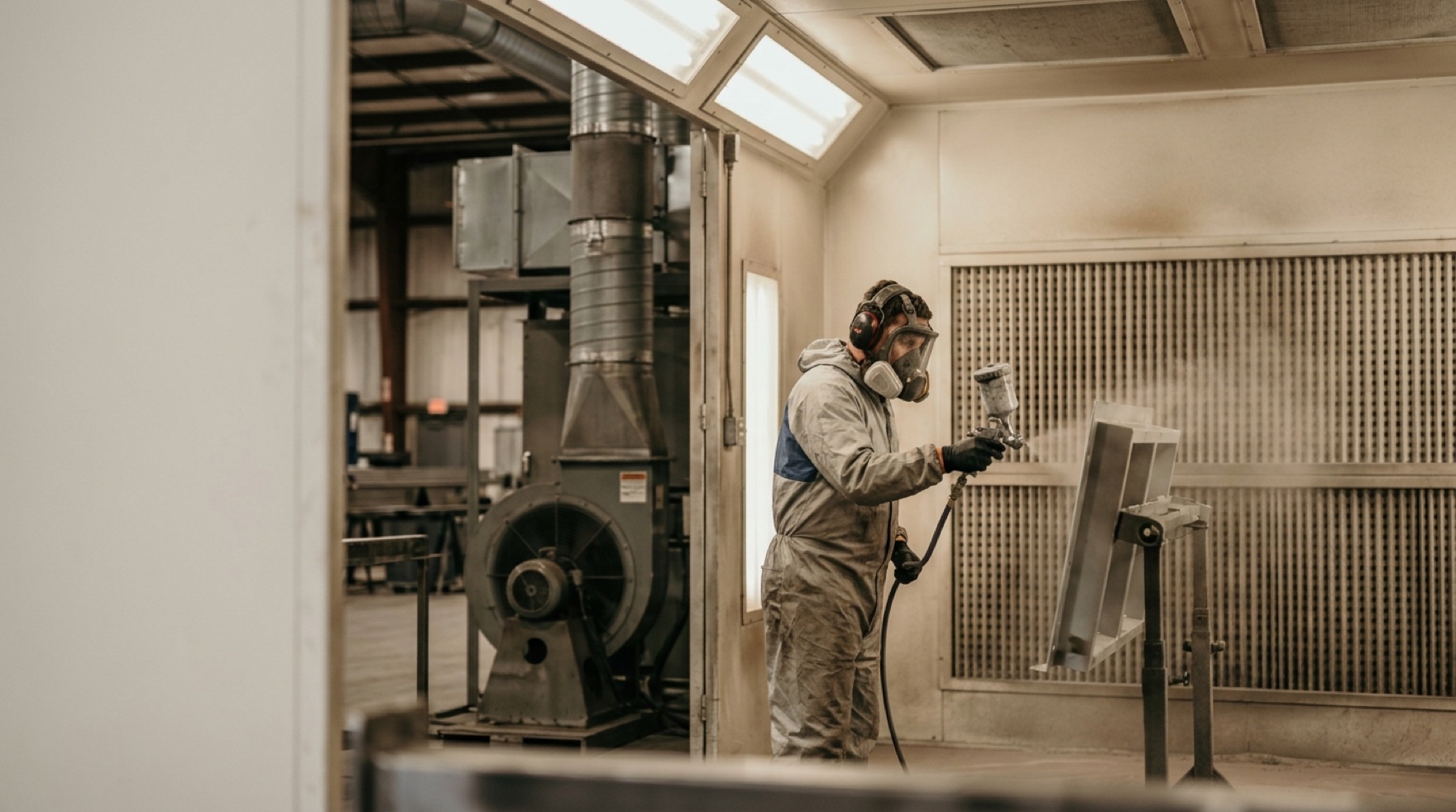
The short answer: 29 CFR 1910.107 controls spray-finishing fires by attacking the fire triangle directly: mechanical ventilation keeps flammable vapor below an ignitable concentration (1910.107(b) and (d)), electrical and other ignition sources are excluded from the spray area and for 20 feet around it (1910.107(c)), and combustible overspray residue is kept from accumulating (1910.107(g)). The booth's open-face air velocity must be at least 100 linear feet per minute for conventional spraying, and electrical equipment inside the spraying area must be explosion-proof for Class I, Group D locations. The standard is OSHA's enforceable floor; NFPA 33 is the consensus standard it is built on.
How does 1910.107 prevent spray-booth fires?
A spray-booth fire needs three things together: flammable vapor in an ignitable concentration, an ignition source, and oxygen. 1910.107 is organized to deny at least one of them at all times, and it does so mainly by removing the first two, since oxygen is a given in an occupied shop. Ventilation dilutes and carries away the solvent vapor and overspray so the atmosphere never reaches an ignitable mix, ignition-source rules keep sparks and flames out of the space where vapor could still be present, and housekeeping rules stop dried overspray from becoming the fuel for a later fire.
Reading the standard that way makes the individual clauses easier to apply, because each one maps to a leg of the triangle. A booth that has strong ventilation but non-explosion-proof lighting inside it has controlled the fuel concentration and then installed an ignition source in the same box. A booth with correct electrical gear but residue caked on the walls has removed the spark but stockpiled the fuel. The clauses only work as a set.
What does 1910.107 require, clause by clause?
The requirements below are the load-bearing provisions of the standard, each tied to the fire-control job it does. Use the table as a compliance map: the middle column is the rule, the right column is why it is there.
| Clause | Requirement | Fire-control role |
|---|---|---|
| 1910.107(b)(5)(i) | Average air velocity over the open face of the booth is at least 100 linear feet per minute for conventional air spraying (electrostatic operations may run lower, not less than 60 lfm). | Dilutes and removes vapor so the atmosphere stays below an ignitable concentration. |
| 1910.107(d)(2) | Mechanical ventilation is kept operating at all times while spraying, and for enough time afterward to exhaust vapor from drying articles and residue. | Prevents a vapor build-up during and just after application, when concentration peaks. |
| 1910.107(d)(3) | Each booth has an independent exhaust duct discharging to the exterior of the building. | Keeps flammable exhaust from being recirculated into occupied space or other booths. |
| 1910.107(c)(2) | No open flame or spark-producing equipment in any spraying area, nor within 20 feet of it, unless separated by a partition. | Removes ignition sources from the zone where vapor may reach an ignitable level. |
| 1910.107(c)(6) | Electrical equipment in the spraying area is explosion-proof for Class I, Group D locations; equipment within 20 feet meets Class I, Division 2. | Keeps normal electrical arcing and hot surfaces from igniting the atmosphere. |
| 1910.107(g)(1) | Spraying is not conducted outside predetermined spraying areas. | Confines the vapor and overspray to a space that is ventilated and ignition-controlled. |
| 1910.107(g)(2) | Spraying areas are kept as free as practical of combustible residue deposits, cleaned daily where needed. | Removes the accumulated overspray fuel that turns a small ignition into a spreading fire. |
| 1910.107(g)(7) | "No smoking" signs are posted conspicuously in large letters at all spraying areas and paint storage rooms. | Addresses the most common portable ignition source a worker can carry in. |
| 1910.107(f)(1) | Where automatic sprinklers protect the area, they conform to 1910.159. | Provides suppression to limit a fire that starts despite the other controls. |
Why is the Class I electrical classification the rule shops get wrong?
Because it is invisible until it ignites, the electrical classification is the requirement most often missed, and it is unforgiving. Inside a spraying area, the atmosphere can contain a flammable vapor and mist, so 1910.107(c)(6) requires electrical equipment there to be explosion-proof and approved for Class I, Group D locations, and equipment outside the booth but within 20 feet to meet Class I, Division 2. A standard shop-grade light fixture, switch, or fan motor placed inside a booth is a code violation and, more to the point, an ignition source sitting in the fuel.
Interlocks close the gap between the ventilation and the equipment for the higher-risk electrostatic processes. For electrostatic hand spraying, 1910.107(i)(8) requires the electrical equipment to be interlocked with the ventilation so it cannot operate unless the ventilating fans are running, which prevents anyone from charging up an electrostatic gun in a booth whose fans have failed or been switched off. The principle generalizes even where the interlock is not mandated: energized spray equipment and stalled ventilation is the exact combination that lets vapor reach an ignitable level with a live ignition source already present.
How does 1910.107 relate to NFPA 33?
1910.107 is the enforceable OSHA standard, and NFPA 33, the Standard for Spray Application Using Flammable or Combustible Materials, is the industry consensus standard that carries the more current and detailed engineering practice. OSHA's rule sets the compliance floor, while NFPA 33 is where a designer finds the up-to-date detail on booth construction, ventilation design, and keeping the vapor concentration safely below the lower explosive limit. Treat OSHA as the minimum a compliance officer will check and NFPA 33 as the design basis a fire-safe booth is actually built to.
For a safety leader, that split has a practical consequence. Meeting 1910.107 clause by clause keeps the operation legal and closes the common ignition and ventilation gaps, but a booth engineered to the current edition of NFPA 33, maintained so the fans move the rated air and the residue never accumulates, is what keeps the atmosphere out of the ignitable range on a normal production day. The standard tells you what is required; the maintenance is what keeps the fire triangle broken shift after shift.