The short answer: Canada has no single national machine-guarding standard the way the US has 29 CFR 1910.212. Occupational health and safety is split by jurisdiction: most employers fall under their province's or territory's OHS act and regulations, while federally regulated workplaces follow the Canada Labour Code Part II and the COHSR. Provincial rules generally require safeguards that protect workers from hazardous power-transmission parts and prevent access to the point of operation, and the recognized national reference for how those guards are designed is CSA Z432, Safeguarding of machinery. Clearing a jam or reaching into the feed is a servicing task, so the machine has to be isolated and locked out under CSA Z460-20, Control of hazardous energy, before a hand crosses the guard line.
What does Canadian law require for guarding a packaging line?
The duty to guard comes from the jurisdiction that governs the workplace, not from one national rule. Provincial and territorial OHS regulations require employers to fit machinery with safeguards that protect workers from hazardous moving parts and stop access to the point of operation, which on a packaging line is the feed area where hands can reach the mechanism. In British Columbia, WorkSafeBC OHS Regulation Part 12 (Tools, Machinery and Equipment) section 12.2 requires machinery to have safeguards that protect workers from hazardous power-transmission parts, prevent access to hazardous points of operation, and safely contain ejected material. In Ontario, the parallel duty sits within Regulation 851 (Industrial Establishments). Federally regulated employers carry an equivalent duty under the Canada Labour Code Part II and the COHSR.
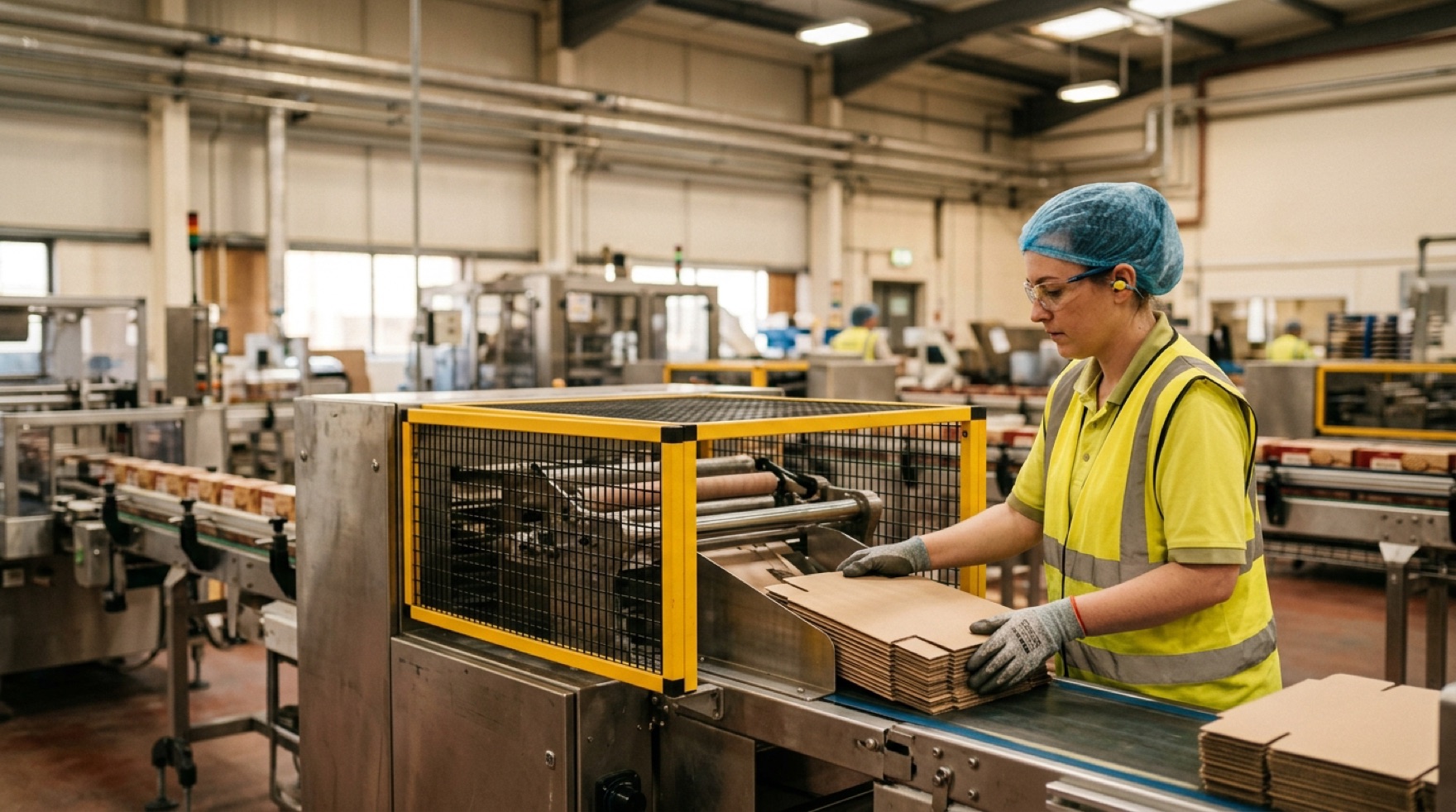
A packaging line is a chain of exactly the hazards these rules name: the infeed that sweeps product into the machine, the nip where a conveyor belt meets its pulley, the rotating augers and turntables on a wrapper or filler, and the sealing and cutting stations downstream. The equipment reads as low-risk because it moves cartons and bottles rather than steel, so the automated sweep and the reciprocating head look harmless next to a press. That impression is the trap: the forces are still enough to crush a chest or amputate a hand, the cycle is fast and repeating, and the operator is stationed within arm's reach of the danger zone for the whole shift. Guarding is what keeps the operator's reach and the machine's cycle out of the same space.
What standard defines how the guard is designed?
The recognized national reference is CSA Z432, Safeguarding of machinery. It sets out the risk-assessment method and the guard and safeguarding-device options, and it fixes the dimensions that decide whether a guard actually works. WorkSafeBC Part 12 makes this concrete: section 12.3 states that the application, design, construction and use of safeguards, including an opening in a guard and the reach distance to a hazardous part, must meet the requirements of CSA Z432-94. In other words, the province does not spell out every guard opening itself; it points to the CSA standard for the reach distances and opening sizes that keep a hand from getting through.
CCOHS guidance on safeguarding describes the same guard families the standard recognizes: fixed guards, interlocked guards, adjustable guards, self-adjusting or self-closing guards, and distance guards, plus safeguarding devices such as photoelectric and other presence-sensing devices, pullback and restraint devices, safety trip controls, two-hand controls, and interlocked gates. CCOHS is clear that selection should follow safe-design principles and the hierarchy of control, which runs elimination, substitution, engineering controls, administrative controls, and personal protective equipment, rather than relying on protective equipment or operator behaviour alone. On a packaging line the practical order is to design the reach out of the job, enclose what remains with a fixed or interlocked guard, and treat any opening left for loading as a dimension governed by CSA Z432, not a convenience.
Why does the feed area keep injuring people?
The feed is the one place the process regularly needs a human hand: to load, to straighten a leaning container, to pull a piece of debris, or to clear a jam. That is why the point of operation and the infeed are where injuries cluster. A guard that stops the routine reach only when the operator chooses to open it is a guard the operator will eventually reach around, and an opening sized for product but large enough for a wrist defeats the guard whatever the rest of the enclosure looks like. This is the exact problem CSA Z432 addresses through reach distances and opening dimensions, and the reason WorkSafeBC ties those numbers to the standard rather than leaving them to judgment.
CCOHS guidance on working around machinery frames feeding and jam recovery as tasks that must be assessed in their own right. It advises identifying every in-running nip point on the machine, examining how stock is fed in and how product is removed, and deciding whether the machine needs to be locked out before any adjustment or repair. Un-jamming and recovery from crashes are called out as tasks to plan for, not treated as incidental to normal running. The transferable point is that a guard is only as good as its smallest reachable gap, and the feed is where that gap tends to live.
Is clearing a jam a lockout task?
Usually yes. Clearing a jam, a clog, or a misaligned feed is a servicing activity, and the recognized standard is CSA Z460-20, Control of hazardous energy - Lockout and other methods. CCOHS guidance built on CSA Z460 describes a step sequence for reaching a zero-energy state: prepare for shutdown, notify affected workers, shut the equipment down, isolate it from its energy sources, dissipate residual or stored energy, apply lockout devices, and verify isolation before anyone performs the work, then remove the devices in a controlled way afterward. Reaching into a stalled packaging machine before that sequence is complete is the wrong default; the right default is to bring the machine to zero energy before a hand crosses the guard line.
There is a narrow qualification. CCOHS notes that where activities such as removing jams, clogs, or misaligned feeds are performed, standard safeguards may be removed only if other controls are in place to reduce or eliminate the hazard. That is the whole engineering problem on a packaging line. An interlocked guard that positively stops the machine and cannot be defeated by reaching around it can be that alternative control. An opening the operator can reach through while the machine still cycles is not. Because the boundary between an acceptable alternative control and a required full lockout is set by the regulation that governs your workplace, confirm the specific requirement with your OHS regulator rather than assuming the exception applies.
How do you keep hands out of the feed and the jam points?
Design the reach out of the job first, then make the safe method the only method that reaches the hazard. Ranking the controls this way keeps protection off the operator's split-second judgment, which is where reaching-in injuries begin. The table maps the recurring packaging-line hazards to the guarding method and the Canadian reference behind it.
| Hazard on the line | Guarding method | Canadian reference |
|---|---|---|
| Point of operation: infeed sweep, filling or sealing head, tray or chipboard remover | Fixed barrier, or an interlocked guard that de-energizes the machine when opened, with any opening sized to the CSA reach distances so no body part reaches the danger zone | WorkSafeBC Part 12 s. 12.2, 12.3; CSA Z432 |
| In-running nip points: conveyor belt-to-pulley, wrapping and film rollers, drive nips | Fixed nip-point guards enclosing the in-running contact | CSA Z432; provincial OHS regulation |
| Rotating parts: augers, wrap turntables, drive shafts, screw feeds | Enclosing guards secured to the machine and containing ejected material | WorkSafeBC Part 12 s. 12.2; CSA Z432 |
| Clearing a jam, clog, or misaligned feed inside the machine | Isolate and lock out before any reach, unless a positive-stop alternative control is in place; never a bare reach into a live jam | CSA Z460-20; provincial lockout requirement |
| A required opening for loading or manual feed | Opening dimensioned to a safe reach distance, with a supplemental safeguarding device where reach still exposes the danger zone | CSA Z432 (openings and reach distances) |
Then write the jam-clearing procedure the way the machine should already enforce it, and train to it as a task rather than a slogan. Assess feeding, un-jamming, and cleaning as distinct tasks the way CCOHS describes, close the reach path in the guard so the de-energized method is the only one that reaches the product, and give operators, including temporary operators, task-specific training on the jam procedure before they run the line alone. A guard that cannot be reached around, a jam procedure that isolates and locks out first, and a task assessment that treats a routine jam as a hazardous-energy event are what keep the operator's hands and the machine's cycle apart. Because guarding and lockout duties are set province by province, build the program to CSA Z432 and CSA Z460, then confirm the enforceable requirements with the OHS regulator that governs your workplace.