The short answer: On a packaging line, 29 CFR 1910.212(a)(1) requires guarding that protects operators from the point of operation, ingoing nip points, and rotating parts, and 1910.212(a)(3)(ii) requires the point-of-operation guard to be designed so the operator cannot get any part of the body into the danger zone during the operating cycle. Clearing a jam or reaching into the feed is servicing: 1910.147(b) names "unjamming" as a covered activity, so the machine has to be de-energized, through lockout/tagout or an interlock that stops it, before a hand goes in. The consensus standard ANSI/PMMI B155.1 puts a task-based risk assessment behind those requirements and assigns duties to both the machine builder and the user.
What does OSHA require for guarding a packaging line?
OSHA requires at least one method of guarding on every packaging machine that exposes an operator to the point of operation, an ingoing nip point, a rotating part, or flying material. 29 CFR 1910.212(a)(1) lists those hazards by name and requires guarding to protect the operator and other employees from them, and 1910.212(a)(2) requires the guard to be affixed to the machine where possible and to not create a hazard of its own. A packaging line is a chain of exactly those hazards: the infeed that sweeps product into the machine, the nip where a conveyor belt meets its pulley, the rotating augers and turntables on a wrapper or filler, and the sealing and cutting stations downstream.
The reason machine guarding matters here more than the search volume suggests is that packaging equipment reads as low-risk. It moves cartons and bottles, not steel, so the automated sweep and the reciprocating head look innocuous next to a press brake. That impression is the trap. The forces are still enough to crush a chest or amputate a hand, the cycle is fast and repeating, and the operator is stationed within arm's reach of the danger zone for the whole shift. Guarding is what keeps the operator's reach and the machine's cycle from occupying the same space.
What is the point of operation, and why does the feed area keep injuring people?
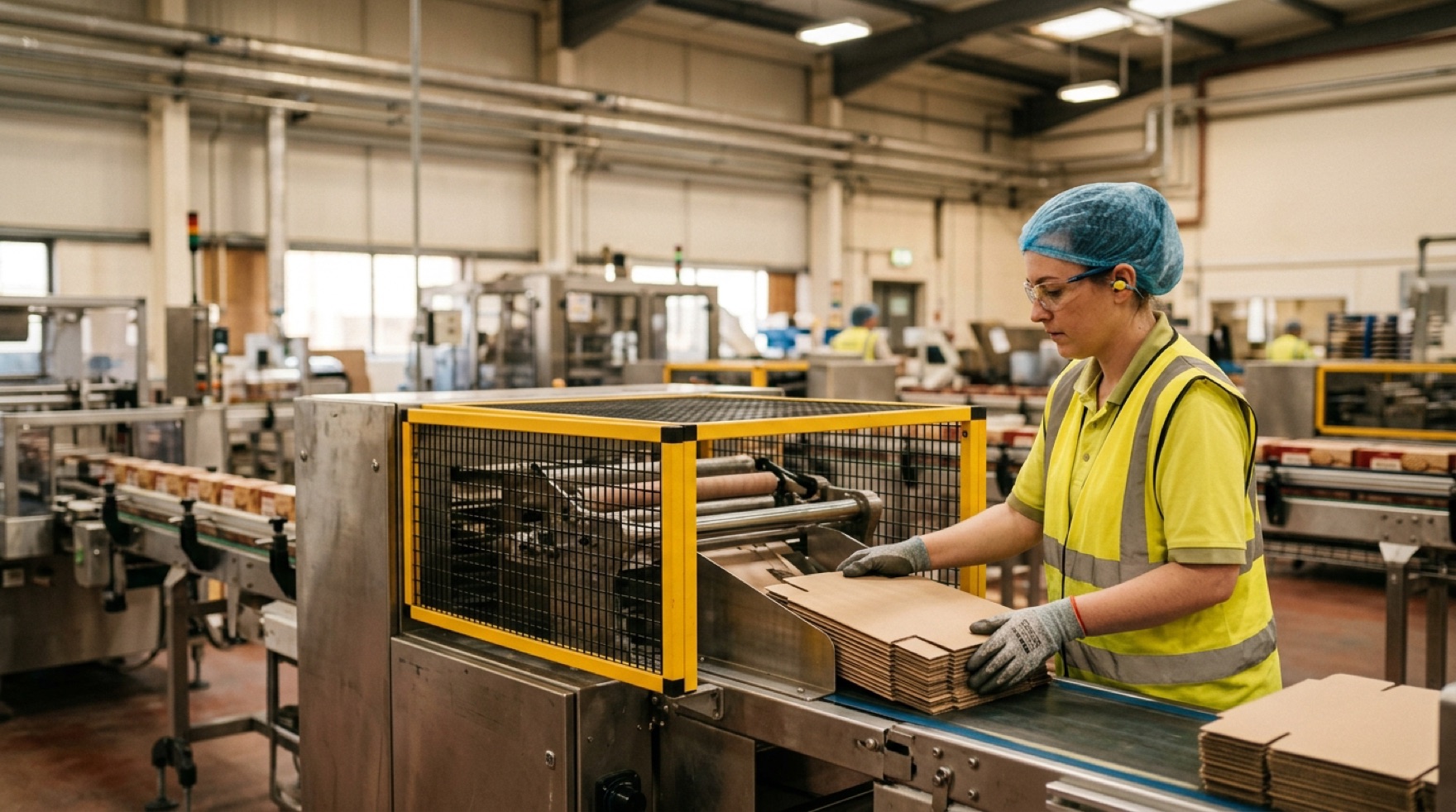
The point of operation is where the machine actually does work on the product, and on a packaging line it is usually the feed, the sweep, and the sealing or cutting head, which is exactly where the operator has a reason to reach. 29 CFR 1910.212(a)(3) defines the point of operation as "the area on a machine where work is actually performed upon the material being processed," and 1910.212(a)(3)(ii) requires the guard to be "so designed and constructed as to prevent the operator from having any part of his body in the danger zone during the operating cycle." The feed injures people because it is the one place the process regularly needs a human hand: to load, to straighten a leaning container, to pull a piece of debris. A guard that stops the routine reach only if the operator chooses to open it is a guard the operator will eventually reach around.
A Washington State FACE investigation shows the mechanism directly. In report 00WA012, a 24-year-old temporary worker operating a bottle depalletizer at a soft-drink bottling plant was caught in the chipboard-remover section and died of traumatic asphyxia. The point where each layer of bottles entered the remover was only partly guarded: a 16-by-24-inch opening was left in the interlocked plexiglass doors so the operator could reach in to remove a wooden stabilizing ring. Unstable 20-ounce bottles jammed nine or ten times a shift, and the safe procedure was to switch to manual and open the interlocked doors, which stopped the machine. Investigators concluded the worker instead put his body through the opening, past the guard and its interlock, into the running machine. The Washington FACE team's finding is that the guard let a person reach a hazardous area without shutting the machine down. The transferable point is that a guard is only as good as its smallest reachable gap, which is what 1910.212(a)(3)(ii) is written to close.
Is clearing a jam covered by lockout/tagout?
Usually yes. Clearing a jam is servicing, and 29 CFR 1910.147(b) lists "unjamming of machines or equipment" in its definition of servicing and maintenance, alongside cleaning, lubricating, and making adjustments where the employee may be exposed to unexpected energization. That places jam-clearing inside the lockout/tagout standard, which is why a bare reach into a stalled machine is the wrong default. The right default is to bring the machine to a zero-energy state before a hand crosses the guard line.
1910.147(a)(2)(ii) pulls jam-clearing that happens during normal production into the standard whenever an employee has to remove or bypass a guard, or place a part of the body into the area where work is performed on the material. Both conditions describe a routine packaging jam. There is a narrow exception: minor servicing that is routine, repetitive, and integral to production is not covered "provided that the work is performed using alternative measures which provide effective protection." That exception is the whole engineering problem. An interlocked guard that positively stops the machine and cannot be defeated by reaching around it can be the alternative measure. An opening the operator can reach through while the machine still cycles is not, which is the gap the Washington case turned on.
Where does ANSI/PMMI B155.1 fit, and who is responsible?
ANSI/PMMI B155.1 is the consensus safety standard specific to packaging machinery, and it puts a documented risk assessment behind the guarding that OSHA requires. Where 1910.212 states the outcome the guard has to achieve, ANSI/PMMI B155.1 describes the method: identify the reasonably foreseeable hazards across the machine's life cycle, including setup, clearing jams, and cleaning, then estimate and reduce each risk to an acceptable level through the hierarchy of controls before relying on operator behavior. It applies to new, modified, and rebuilt packaging machinery and to the conveying equipment used within the packaging function.
The part that matters operationally is that the standard assigns duties to both the supplier and the user, so the risk assessment does not end when the machine is delivered. The builder designs and guards the machine and documents the residual risks; the user reassesses those risks in the actual installation, keeps the guarding and interlocks effective, and covers the tasks the builder could not fully control, jam-clearing and manual feeding chief among them. Treating B155.1 as a shared, living assessment rather than a delivery document is what keeps the guard matched to how the line is really run, because the injuries cluster in the tasks the original design assumed would be rare.
How do you keep hands out of the feed and the jam points?
Design the reach out of the job first, then make the safe method the only method that reaches the hazard. Ranking the controls this way keeps protection off the operator's split-second judgment, which is where reaching-in injuries begin. The table maps the recurring packaging-line hazards to the guarding method and the clause behind it.
| Hazard on the line | Guarding method | Standard |
|---|---|---|
| Point of operation: infeed sweep, filling or sealing head, chipboard or tray remover | Fixed barrier, or an interlocked guard that de-energizes the machine when opened, with any opening sized so no body part reaches the danger zone | 1910.212(a)(3)(ii) |
| Ingoing nip points: conveyor belt-to-pulley, wrapping and film rollers, drive nips | Fixed nip-point guards enclosing the in-running contact | 1910.212(a)(1) |
| Rotating parts: augers, wrap turntables, drive shafts, screw feeds | Enclosing guards secured to the machine | 1910.212(a)(1), (a)(2) |
| Clearing a jam or removing debris inside the machine | Lockout/tagout, or an interlock that positively stops the machine, before any reach; never a bare reach into a live jam | 1910.147(b), (a)(2)(ii) |
| A required opening for loading or manual feed | Opening dimensioned to a safe reach distance, with a supplemental device where reach still exposes the danger zone | 1910.212(a)(2), (a)(3)(ii) |
Then write the jam-clearing procedure the way the machine should already enforce it, and train to it as a task, not a slogan. The Washington workers all agreed no one should get a hand or body into the running system, and the plant had a correct manual-and-interlock method on paper; the fatality happened anyway because a faster reach through an existing opening was physically possible. Close that path in the guard, make the de-energized method the only one that reaches the product, and give operators, including temporary operators, task-specific training on the jam procedure before they run the line alone. A guard that cannot be reached around, a jam procedure that de-energizes first, and training that treats a routine jam as a lockout event are what keep the operator's hands and the machine's cycle out of the same space, which is the whole point of 1910.212 and 1910.147.