The short answer: There is no national Canadian exposure limit written for metalworking fluid (MWF) mist. Exposure control is set by jurisdiction: most employers fall under their province's or territory's OHS regulation on airborne chemical agents, while federally regulated workplaces follow the Canada Labour Code Part II and the COHSR. Most provinces adopt the ACGIH TLVs. The mineral oil mist limit often quoted, 5 mg/m3 as a time-weighted average in Ontario's table, applies to pure, highly and severely refined oil and excludes metalworking fluids, so there is no single province-assigned number for MWF aerosol itself. The duty that applies everywhere is to keep exposure below any applicable limit and, more generally, as low as reasonably achievable through enclosure and local exhaust ventilation.
Is there a Canadian exposure limit for metalworking fluid mist?
Not a single national one. Occupational exposure limits (OELs) in Canada are set province by province, and most jurisdictions adopt the ACGIH TLVs either directly or through their own tables. That means the enforceable number for an airborne contaminant depends on which regulator governs the workplace: in Ontario the limits sit in Regulation 833 (Control of Exposure to Biological or Chemical Agents); in British Columbia they sit in the WorkSafeBC OHS Regulation Part 5 (Chemical Agents and Biological Agents). Federally regulated employers carry an equivalent duty under the Canada Labour Code Part II and the COHSR.
A jurisdictional detail matters for coolant mist specifically. Ontario's table lists mineral oil mist (CAS 8012-95-1) at 5 mg/m3 as an inhalable-fraction time-weighted average for the pure, highly and severely refined grades, with poorly and mildly refined oil marked for control to as low as possible. The entry itself is written to exclude metalworking fluids, so that 5 mg/m3 figure is not an MWF-mist limit. For the aerosol coming off flood coolant, through-spindle coolant, or a straight cutting oil, there is no single assigned OEL, and the operative duty becomes keeping exposure as low as reasonably achievable. Confirm the exact limit, monitoring, and control requirements with the OHS regulator that governs your workplace rather than importing a number from another jurisdiction.
| Item | Canada (most workplaces) | Source of the duty |
|---|---|---|
| Governing law | Provincial/territorial OHS regulation on airborne chemical agents; federal = Canada Labour Code Part II + COHSR | Provincial OHS regulator / ESDC Labour Program |
| How OELs are set | Province by province, most adopting the ACGIH TLVs | Provincial exposure-limit tables (e.g. Ontario Reg. 833) |
| Mineral oil mist (pure, highly/severely refined) | 5 mg/m3 TWA, inhalable, in Ontario's table; the entry EXCLUDES metalworking fluids | Ontario Reg. 833 exposure limits (CAS 8012-95-1) |
| MWF mist itself | No single assigned OEL; control as low as reasonably achievable | Provincial OHS regulation; CCOHS guidance |
What does coolant mist do, and where does the hazard come from?
CCOHS describes the health picture the way provincial regulators do. Inhaling MWF mist causes asthma and lung irritation (hypersensitivity pneumonitis), chronic bronchitis, and impaired lung function. Bacterial contamination in the mist adds flu-like symptoms and irritation of the eyes, nose, and throat. The hazard is the fine aerosol thrown into the operator's breathing zone when the fluid stream breaks up at high velocity against the tool and workpiece, so a mist thin enough to be invisible can still be the exposure.
That places fluid management inside the respiratory-control question, not beside it. Water-based fluids support microbial growth, and a neglected sump becomes a reservoir of the bacteria and fungi the mist then carries into the lungs. Monitoring concentration and cleanliness, keeping tramp oil and swarf out of the tank, and maintaining the fluid to the supplier's specification all reduce the microbial load that drives the sensitization CCOHS names.
How do you control MWF mist on a CNC in Canada?
CCOHS sets out the same order regulators expect: cut mist at the source first, then capture what remains, and treat respirators as the last layer. The source-reduction measures it lists are specific. Deliver the fluid at low pressure. Reduce the flow rate. Add mist suppressants where appropriate. And do not use compressed air to blow clean parts covered in MWF, because the air pressure drives the fluid airborne. Each of these lowers how much aerosol is generated before any collector has to catch it.
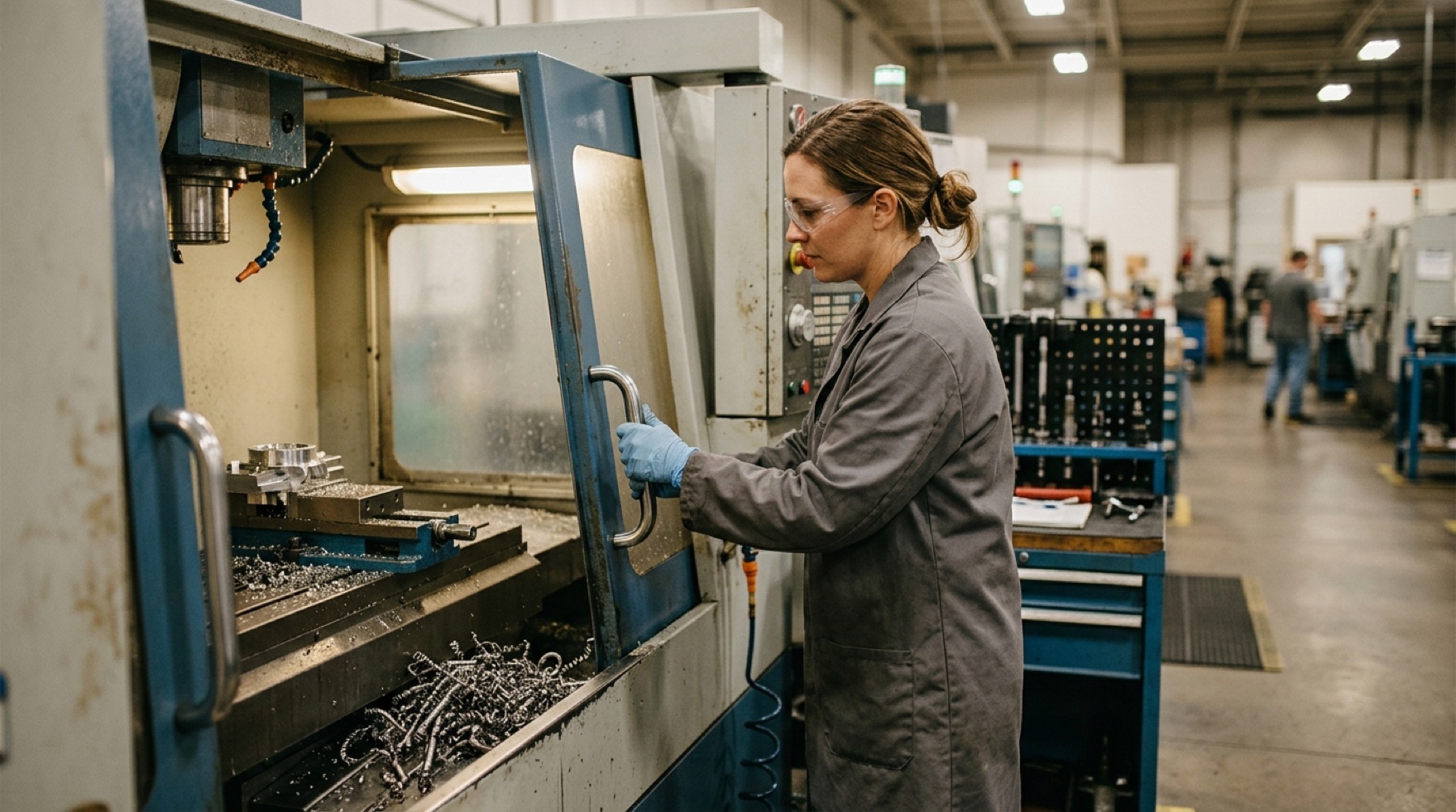
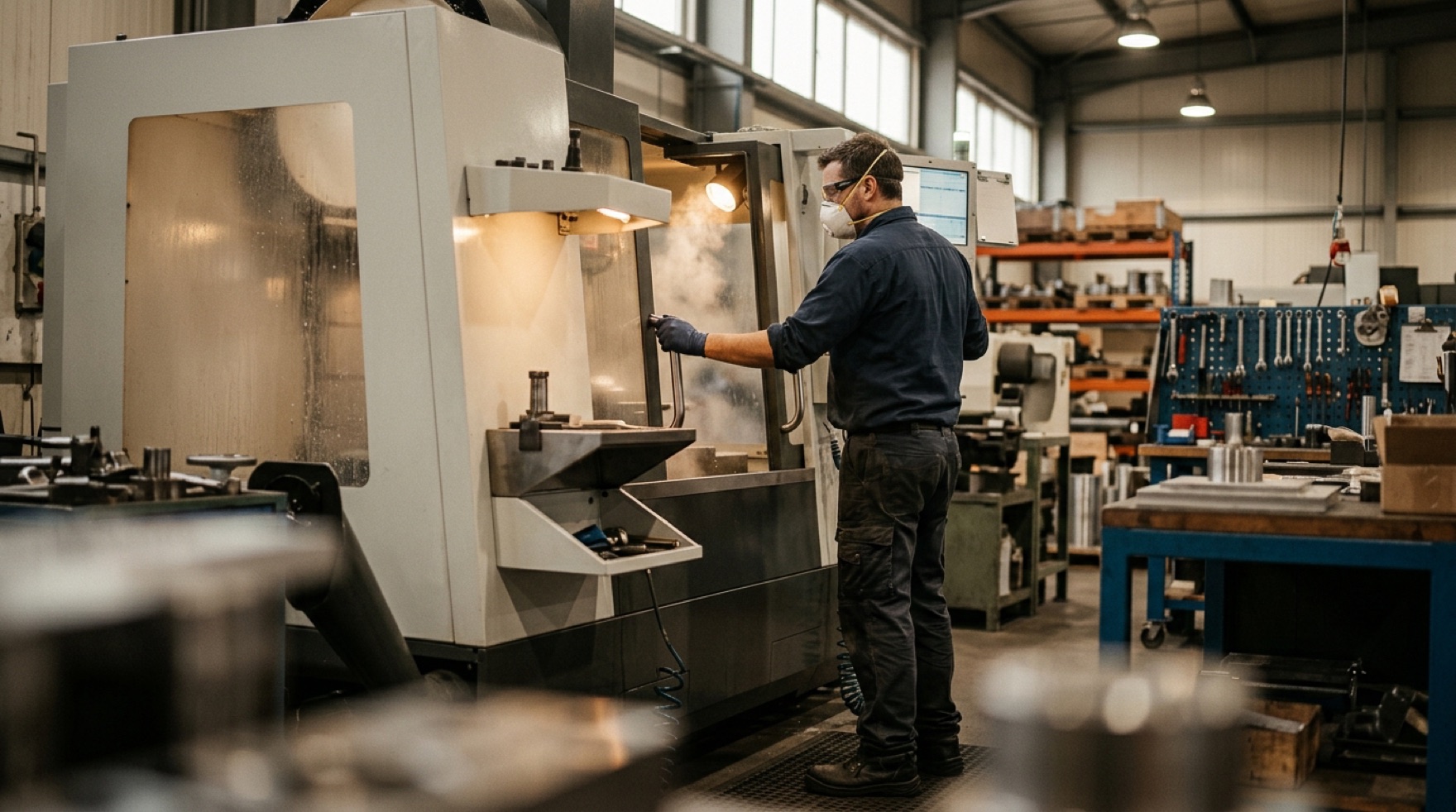
For what remains, CCOHS points to two engineering controls. Install complete enclosures or splash guards, sized to the operation, to keep the fluid contained and away from the operator. Then fit local exhaust ventilation, which CCOHS calls the most effective approach because exhaust near the source prevents the accumulation and recirculation of the contaminant. On a CNC that means keeping the enclosure doors closed during the cycle and ducting the captured mist to a collector rather than letting it drift back into the shop. General dilution ventilation is a backstop for what escapes capture, not a substitute for it. Respiratory protection covers only the measured remainder after engineering controls, and its selection and use are set by the province's OHS regulation.
How does WHMIS 2015 fit metalworking fluids?
The hazard-communication regime for the fluids themselves is WHMIS 2015, built on the Hazardous Products Act and the Hazardous Products Regulations, not the US HazCom standard. A metalworking fluid supplied for use in a Canadian workplace is a hazardous product with a compliant label and a safety data sheet, and the employer's duties include worker education, workplace labelling, and keeping the SDS available. The SDS carries the exposure and handling information that anchors the mist-control program, and it is where a workplace confirms the composition and any additive-specific hazard behind the aerosol and dermatitis risk. WHMIS education is a duty under the OHS regulation that governs the workplace, so the specifics are confirmed with that regulator.
The practical takeaway for a Canadian shop is to treat the missing single number as the reason to control by design rather than to a citation threshold: minimize mist at source, enclose and exhaust at the machine, manage the fluid as a living system, and confirm the applicable OEL and WHMIS duties with the regulator for your jurisdiction. A personal air sample in the operator's breathing zone, not a visual check of the shop, is what shows the controls are working.