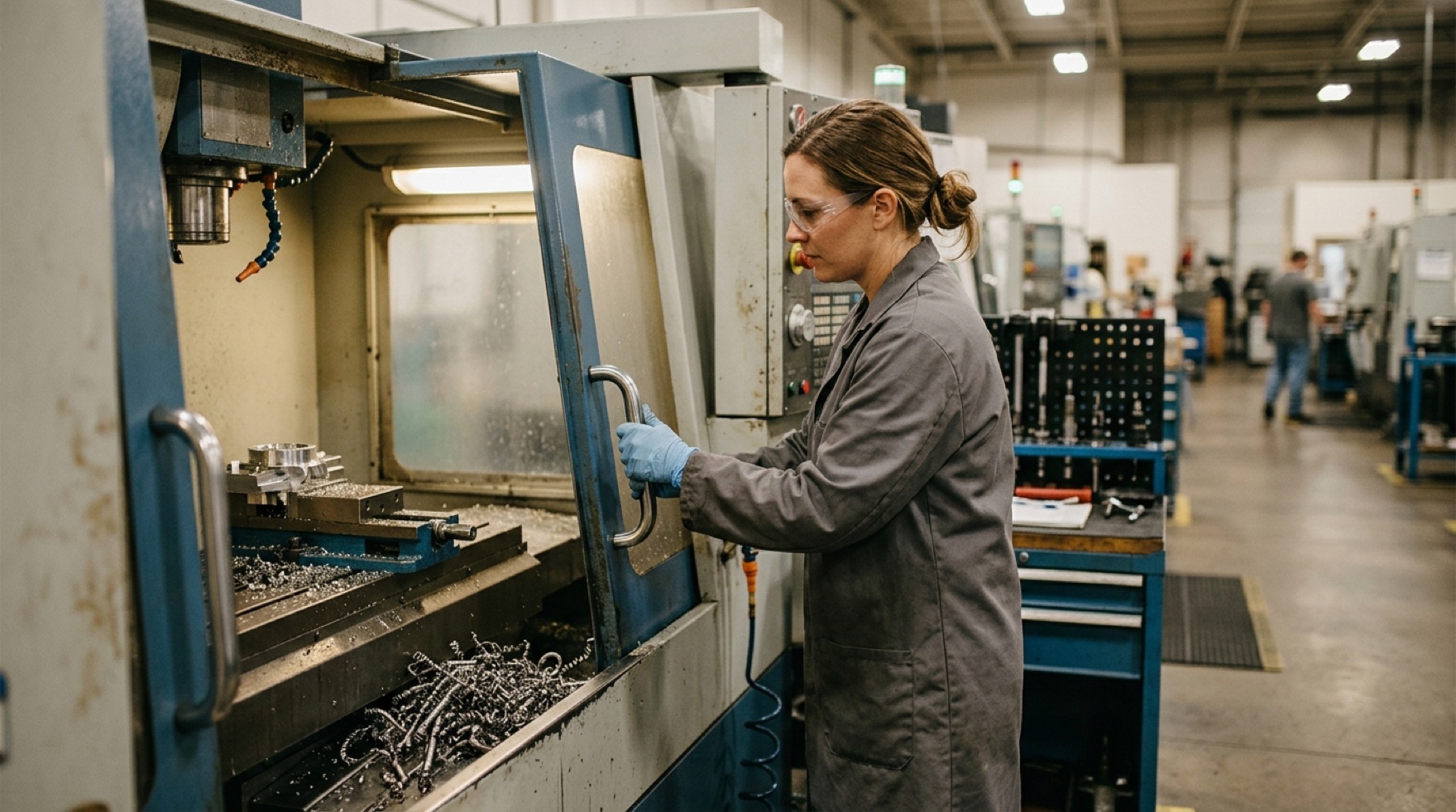
The short answer: A CNC machine must be guarded so the operator cannot reach the point of operation or the rotating parts while it runs. 29 CFR 1910.212(a)(1) requires guarding against hazards including the point of operation, rotating parts, and flying chips and sparks, and 1910.212(a)(3) requires the point of operation itself to be guarded. For turning centers and automatic numerically controlled turning machines, the consensus standard ANSI B11.22 calls for an enclosure that prevents access to the cutting zone during the automatic cycle, typically an interlocked door. Swarf and chips add a second hazard set: hot, sharp material that causes lacerations and eye injuries and must never be cleared by hand or while the spindle turns.
What does OSHA require for guarding a CNC machine?
OSHA requires one or more guarding methods that keep employees clear of the machine's dangerous motion. 29 CFR 1910.212(a)(1) states that guarding "shall be provided to protect the operator and other employees in the machine area from hazards such as those created by point of operation, ingoing nip points, rotating parts, flying chips and sparks," and 1910.212(a)(3) requires that the point of operation of a machine whose operation exposes an employee to injury be guarded so the operator cannot put any part of the body into the danger zone during the operating cycle. Those two clauses cover almost everything dangerous on a CNC: the cutting zone, the rotating chuck and workpiece, and the stream of chips coming off the tool.
1910.212 sets the duty but not the machine-specific design, and that is where the ANSI B11 machine-tool standards come in. For turning centers and automatic numerically controlled turning machines, ANSI B11.22 specifies safety requirements built around an enclosure that prevents access to the cutting zone during the automatic cycle, generally an interlocked door that stops the cycle if opened. ANSI B11.22 is a voluntary consensus standard rather than an OSHA regulation, but 1910.212(a)(3) directs that point-of-operation guarding conform to "any appropriate standards," which is how a consensus standard like B11.22 becomes the practical benchmark a compliance officer measures a turning center against.
Why is rotating stock the most dangerous hazard on a lathe?
Rotating stock is the deadliest hazard on a turning machine because it entangles clothing, gloves, or a rag and pulls the worker into the machine faster than anyone can react. A chuck, a workpiece, or bar stock protruding from the tailstock has no point where a human can safely make contact while it spins, and once clothing catches, the rotation does the rest. This is precisely the hazard that a full, interlocked enclosure on a CNC turning center is designed to remove, by making it impossible to reach the rotating zone during the cycle.
A Michigan FACE investigation shows the mechanism on an unguarded machine. In MiFACE report 14MI034, a male lathe operator in his twenties was killed in spring 2014 when his shirt became entangled on a 1 7/8-inch length of 1-inch bar stock protruding from the tailstock of a manual engine lathe. The bar's cut edge had a burr, the machine sat in a dimly lit and congested area that limited his movement, and there was no barrier between him and the rotating stock. His shirt pocket caught on the burr, the shirt wrapped around the stock and tightened at his neck and chest, and he died about two weeks later from brain injury caused by loss of oxygen. Michigan FACE identified reaching over or walking behind unguarded rotating bar stock, the burr that caught his clothing, the congested layout, and his level of training as contributing factors. The case is a manual lathe, but the failure transfers directly: the same rotating-stock entanglement is what a CNC turning center's interlocked enclosure exists to prevent, and it is why loose clothing, gloves, and rags stay away from any turning machine.
What makes swarf and chips dangerous, and how do you handle them?
Swarf and chips are dangerous because they come off the tool hot, hardened, and with edges sharp enough to cut, and they injure operators mainly during clearing and handling, not cutting. Long, stringy swarf from a turning operation can wrap the tool and the part and whip; short chips fly under coolant pressure; and a pile of chips in the sump or on the way cover is a mass of small blades. The recurring injuries are hand and forearm lacerations from clearing chips and eye injuries from flying particles.
The controls are specific and non-negotiable. Never clear chips by hand or with the spindle turning: use a hook, a brush, or the chip conveyor with the machine stopped, because reaching toward a running spindle to pull a nest of swarf is how a hand ends up in the rotating zone. Eye and face protection is required by design here, not by preference, since 29 CFR 1910.133(a)(1) requires appropriate eye or face protection whenever an employee is exposed to flying particles, which a machining operation produces continuously. Cut-resistant gloves protect the hands during chip handling and deburring away from the machine, but gloves must come off before touching any rotating part, because a glove that catches turns into the same entanglement hazard as a loose sleeve. A chip conveyor moving under power is itself a hazard with in-running nip points, so it is guarded and locked out for clearing under the same logic as the spindle.
How do interlocks and lockout fit a CNC guarding program?
Interlocks protect the operator during the automatic cycle, and lockout protects whoever reaches inside for setup, clearing, or maintenance. The interlocked enclosure that ANSI B11.22 calls for keeps the door closed and the cycle stopped whenever the guard is open, which addresses the running machine. It does nothing for the person who opens the door to change a tool, clear a chip nest, or free a jammed conveyor, because at that moment the guard is intentionally defeated and the operator is inside the danger zone.
That gap is what 29 CFR 1910.147 is written to close. Servicing and maintenance where unexpected startup or stored energy could injure a worker, including reaching into the enclosure to clear swarf or work on the spindle, drive coolant, or chip conveyor, calls for the machine to be locked out rather than merely paused at a stopped cycle. Two rules follow for a defensible program. First, interlocks are never bypassed to run the machine with the door open, because that removes the only barrier between the operator and the rotating stock the whole enclosure exists to contain. Second, any task that puts a hand past the guard moves from the interlock regime to the 1910.147 lockout regime. Keeping those two regimes distinct, the interlock for operating and the lockout for reaching in, is what keeps a CNC guarding program honest once the novelty of the enclosure wears off and the temptation to prop the door starts.