The short answer: Isocyanates are the hardener in most two-component polyurethane paints, and CCOHS describes them as highly toxic and strong respiratory sensitizers that can cause asthma at very low airborne concentrations. Canada regulates them through split jurisdiction: most employers fall under their province's or territory's OHS act and regulations, while federally regulated workplaces follow the Canada Labour Code Part II and the COHSR. Provincial chemical-agent regulations require the employer to assess exposure and control it, engineering first and respiratory protection second. The occupational exposure limits themselves are set province by province and are generally based on the ACGIH threshold limit value for the specific isocyanate, so there is no one national number to quote.
What are isocyanates, and why are they dangerous in spray coating?
Isocyanates are the reactive component that cross-links a two-component (2K) polyurethane coating into a hard, durable film. The three a finishing shop meets most often are hexamethylene diisocyanate (HDI), methylene bisphenyl isocyanate (MDI), and toluene diisocyanate (TDI). CCOHS states plainly that polyurethane paints often contain isocyanates, which are highly toxic, and that inhalation can cause severe irritation of the eyes, nose, throat, and lungs along with shortness of breath.
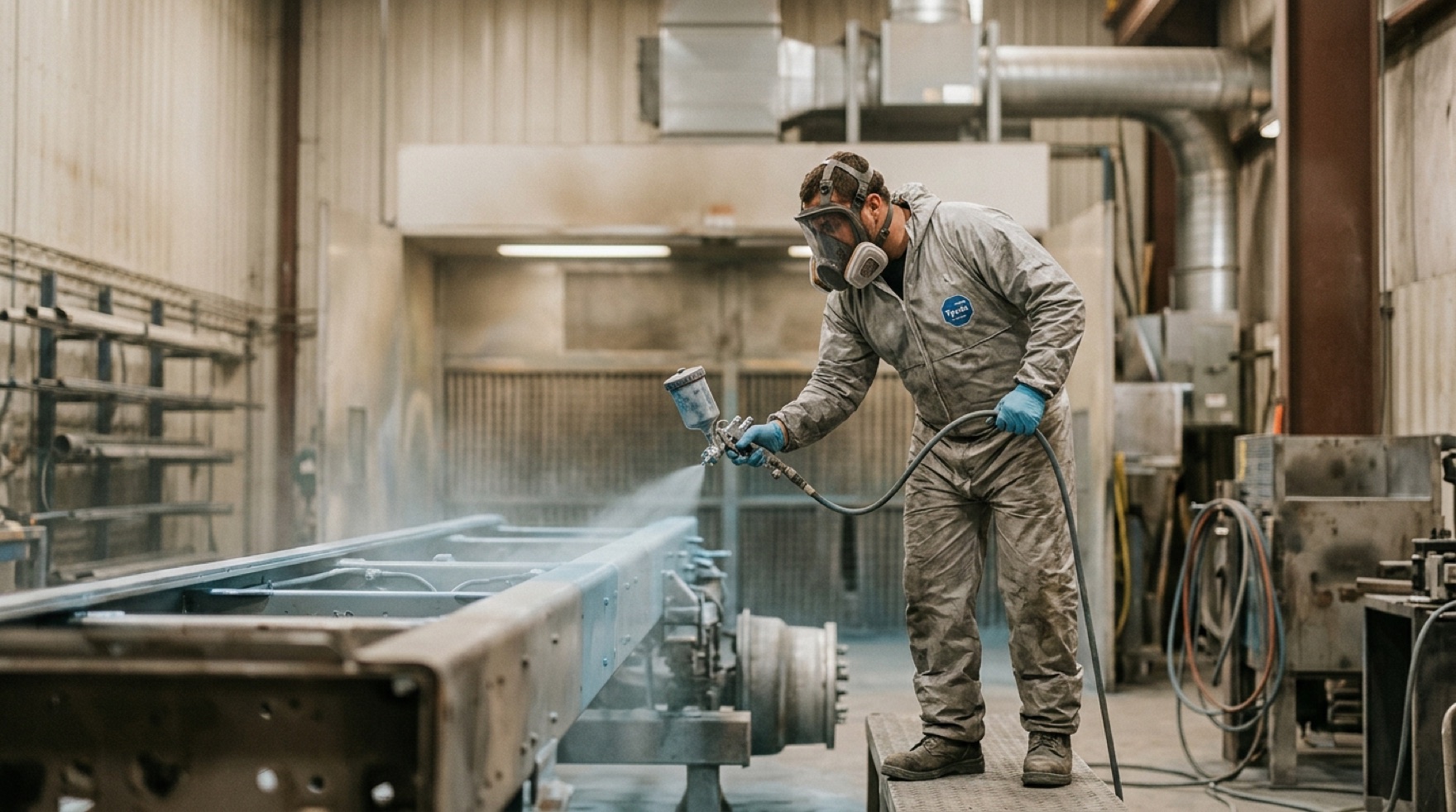
Spraying is what turns a manageable chemical into an inhalation problem. Atomizing a 2K coating through a spray gun produces a fine aerosol of paint droplets and isocyanate vapour that a worker breathes directly and that drifts through the surrounding shop. The same reactivity that builds the film also reacts with the moist tissue of the airway. So the hazard is not limited to the person holding the gun: anyone in the spray area during and shortly after application is exposed until ventilation clears the aerosol.
Who sets isocyanate exposure limits in Canada?
The limit comes from the jurisdiction that governs the workplace, not from one national standard. Provincial and territorial OHS regulations require employers to control worker exposure to hazardous substances such as isocyanates and to keep exposure below the applicable occupational exposure limit. In Ontario that duty sits within Regulation 833 (Control of Exposure to Biological or Chemical Agents); in British Columbia it sits within the WorkSafeBC OHS Regulation Part 5 (Chemical Agents and Biological Agents); in Alberta it sits within the OHS Code. Federally regulated employers carry an equivalent duty under the Canada Labour Code Part II and the COHSR.
Those regulations set numeric limits that are generally drawn from the ACGIH threshold limit value for each specific isocyanate, but the adopted value and the effective date differ from one province to the next. Because a sensitizer can matter at a brief peak rather than only as a shift average, the ACGIH-based limits for isocyanates are typically low and paired with short-term ceiling or excursion values. Rather than repeat a figure that may not match your province, confirm the current isocyanate limit for HDI, MDI, or TDI with the OHS regulator that governs your workplace. CCOHS material is a guidance reference, not the enforceable limit.
Why is the number on the safety data sheet not a safe target?
Because isocyanates are sensitizers, the exposure limit is written to protect the working population, not the individual who has already been sensitized. CCOHS highlights the high possibility of sensitization from isocyanate exposure, resulting in asthmatic or other allergic symptoms even at very low exposures. Sensitization works like an acquired allergy: after enough exposure a worker's airways become primed, and from then on a concentration well below the limit can set off an asthmatic response. The limit reduces how many workers cross that threshold; it cannot make exposure safe for a worker who already has.
That is why isocyanate asthma is a leading cause of occupational asthma and why it can end a career. A sensitized sprayer can react to a trace a colleague does not notice, which usually means removal from any further isocyanate work rather than a lower dose. Skin contact matters too, not only as a dermatitis concern, so glove and coverall protection belongs in an isocyanate program alongside the respirator and the booth.
What controls actually reduce isocyanate exposure?
Rank the controls the way the hierarchy demands, and the two that carry the load are engineering ventilation and, for isocyanate spraying, supplied air. CCOHS advises using a downdraft ventilation spray booth, which carries a lower concentration of paint overspray, and confirming that the ventilation is operational and the filters are not blocked before spraying starts. It also recommends High-Volume, Low-Pressure (HVLP) spray equipment to cut the overspray a worker generates in the first place. The booth is the control that protects everyone in the area, not just the operator.
Respiratory protection then handles the exposure the booth cannot. For isocyanate work CCOHS is explicit that special ventilation systems, respirators, or separate supplied air (breathing air) may be required, because spraying produces a mixed aerosol and vapour rather than vapour alone and because an air-purifying cartridge has no reliable end-of-service warning for isocyanates. Under WHMIS 2015, the supplier and workplace labels and the safety data sheet for the coating identify the isocyanate hazard and the sensitization warning, and the employer must train workers to read them. Any required respirator use is selected, fitted, and maintained under the Canadian respirator standard CSA Z94.4, "Selection, use, and care of respirators," which provincial regulators generally reference, so the respirator works inside a program rather than as a stand-alone item handed to a sprayer.
| Element | Canada (most workplaces) | Source of the duty |
|---|---|---|
| Governing law | Provincial/territorial OHS act + regulations; federal = Canada Labour Code Part II + COHSR | Provincial OHS regulator / ESDC Labour Program |
| Exposure limit | Set province by province, generally based on the ACGIH TLV for the specific isocyanate (HDI, MDI, TDI); no single national number | Provincial chemical-agent regulation (e.g. Ont. Reg. 833; WorkSafeBC OHSR Part 5) |
| Hazard communication | WHMIS 2015 label and safety data sheet identify the isocyanate and sensitization hazard; worker training required | Hazardous Products Act + Hazardous Products Regulations |
| Respiratory protection | Separate supplied air may be required for isocyanate spraying; program built to CSA Z94.4 | CCOHS guidance; provincial OHS regulation; CSA Group |
The practical takeaway for a Canadian employer is to spray isocyanate coatings in a working downdraft booth, protect the operator with supplied air selected under CSA Z94.4, keep isocyanate off the skin, and communicate the hazard through WHMIS 2015. Then confirm the exact exposure limit, health-surveillance triggers, and recordkeeping duties with the provincial, territorial, or federal OHS regulator that governs the workplace, because those specifics are set by jurisdiction and are what a regulator will check after a worker reports breathing trouble.