The short answer: Servicing the high-voltage system of an electric or hybrid vehicle is electrical work, and Canada regulates it by jurisdiction rather than through one national rule. Most repair shops fall under their province's or territory's OHS act and regulations; federally regulated workplaces follow the Canada Labour Code Part II and the COHSR. The recognized national reference for the electrical work itself is CSA Z462, "Workplace electrical safety," the Canadian companion to NFPA 70E. CCOHS guidance is direct on the method: disconnect the low-voltage battery that controls the system, follow the manufacturer's shutdown sequence, and confirm no high-voltage energy is present with a CAT-rated voltmeter before hands go in.
Which rules govern high-voltage EV work in Canada?
There is no single Canadian standard written specifically for servicing electric and hybrid vehicles. Occupational health and safety is split: most workplaces answer to their province's or territory's OHS act and its regulations, while federally regulated workplaces answer to the Canada Labour Code Part II and the COHSR. Provincial electrical-safety and hazardous-energy provisions, for example those in Ontario Regulation 851 or the WorkSafeBC OHS Regulation, set the enforceable duties, and they generally require that work on or near energized equipment be planned, controlled, and carried out by a competent worker.
The recognized reference that translates those duties into a working method is CSA Z462, "Workplace electrical safety." CSA Z462 is based on NFPA 70E and is harmonized with the Canadian Electrical Code and with CSA Z460, "Control of hazardous energy," the lockout standard. It specifies how to assess shock and arc-flash risk, how to build safe work procedures, and how to select personal protective equipment. CSA Z462 is guidance backed by provincial OHS law, so the standard describes the method while the enforceable obligation lives in the regulation that governs the shop. CCOHS provides plain-language guidance on top of both, and CCOHS is guidance rather than law.
How high is the voltage, and why does that reclassify the job?
CCOHS reports that the high-voltage systems powering these vehicles run at roughly 200 to 800 volts, a level a conventional 12-volt vehicle never approaches and one at which contact can be fatal. That single fact reclassifies the work. A task that looks like removing a component becomes electrical work on an energized system, and it carries the same obligation to isolate and verify that any other high-voltage job does. The lithium-ion packs also weigh a great deal, roughly 300 to 600 kilograms by CCOHS's figures, so handling one is a manual-materials hazard on top of the electrical one.
Treat the vehicle as energized until it is proven otherwise. The 12-volt side still starts and controls the car, so the vehicle can behave normally while the traction pack behind it holds a lethal charge. CCOHS notes that while the high-voltage battery can be disconnected from the drivetrain, some stored energy remains afterward, and certain components stay energized after the ignition is off. The practical implication for a service bay is that high-voltage work needs a defined procedure and a competent technician, not the assumption that automotive experience transfers to a system that behaves like industrial electrical equipment.
How do you isolate the system and prove it dead?
The sequence is to isolate the high-voltage system, allow the stored energy to dissipate, and then verify no high-voltage energy is present before touching a high-voltage part. CCOHS's guidance is to disconnect the low-voltage battery that controls the high-voltage system before removing the high-voltage battery and its cables, and to follow the vehicle manufacturer's service and emergency-response information for the specific model, because that information governs the shutdown steps and the discharge time. Isolating the pack applies the same logic that CSA Z460 is built around: put the energy in a known, secured, zero state before work begins.
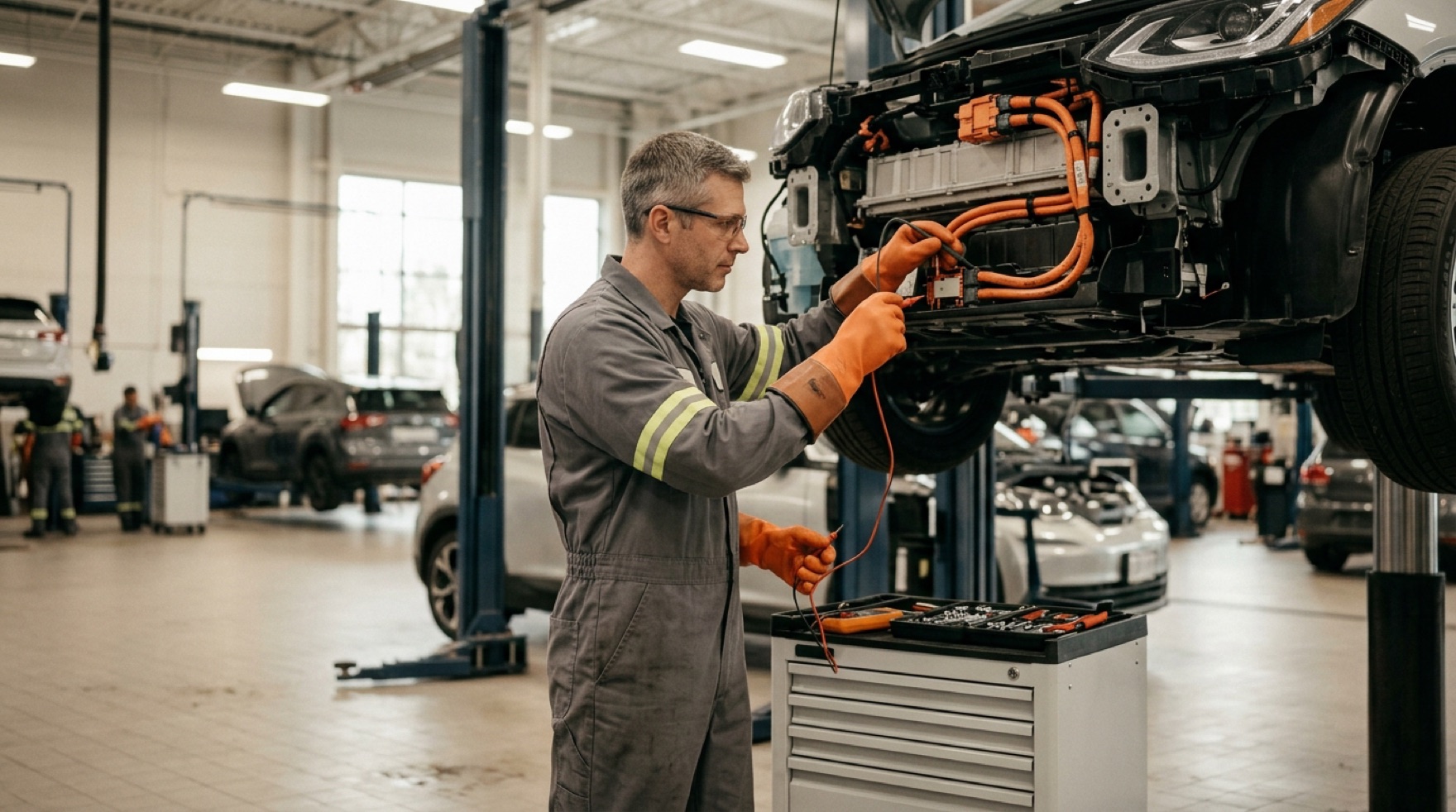
Isolation is not the end of the sequence. Because stored energy remains after the pack is disconnected, the controlling step is verification. CCOHS is explicit that a technician should verify there is no high-voltage energy present using a CAT-rated voltmeter before working on the system. The technician measures with a meter rated for the voltage, confirms no voltage is present, and only then proceeds. The high-voltage cabling on these vehicles is coloured orange by convention, which is the visual signal to stop and treat a circuit as energized, but identification should rely on the manufacturer's service information rather than colour alone, because damage or a prior repair can move an energized conductor.
What PPE and procedure does CSA Z462 call for?
CCOHS calls for high-voltage insulated or dielectrically tested gloves that are tested before each use, worn with insulated tools, and CSA Z462 is the standard that frames how such protective equipment is selected against the assessed shock and arc-flash risk. The glove is only protection if it is sound, so the before-each-use check, an inspection and an air test that traps air in the glove to reveal a leak, is part of the routine rather than an occasional step. A voltmeter rated for the system voltage is what turns "the pack should be isolated" into "the circuit is verified dead," and insulated tools keep an accidental slip from bridging a live terminal.
The table below sets out the control sequence and the Canadian reference behind each step. Because the numeric details, the required competency, and the recordkeeping differ by province, confirm the electrical-safety and hazardous-energy requirements with the OHS regulator that governs your workplace and with the manufacturer for the vehicle in front of you.
| Control step | What it involves | Canadian reference |
|---|---|---|
| Risk assessment | Assess shock and arc-flash risk and select PPE before work begins | CSA Z462 |
| Disconnect low-voltage battery | Cut the 12-volt system that controls the high-voltage system | CCOHS guidance |
| Isolate the high-voltage system | Follow the manufacturer's shutdown sequence to isolate the pack | Manufacturer info; CSA Z460 (lockout) |
| Allow stored energy to dissipate | Wait the manufacturer-specified discharge time; stored energy remains after disconnect | Manufacturer service information |
| Prove dead | Confirm no high-voltage energy is present with a CAT-rated voltmeter | CCOHS guidance; CSA Z462 |
| PPE and tools | High-voltage insulated or dielectrically tested gloves, tested before each use; insulated tools | CCOHS guidance; CSA Z462 |
What if the battery is damaged?
A damaged high-voltage battery is a different and more serious hazard than a healthy one. CCOHS warns that damaged packs can enter thermal runaway, a self-sustaining chemical reaction in which a cell generates more heat than it can shed, and that the lithium hexafluorophosphate in the cells can break down under heat, damage, or overcharging to produce hydrofluoric acid. The result can be a release of corrosive, flammable, and toxic liquids and gases. For that reason CCOHS points to full PPE with a self-contained breathing apparatus and face-piece mask where the situation requires it, and a damaged pack calls for the manufacturer's emergency-response guidance rather than routine service steps.
Building a high-voltage service program that holds
Servicing an electric or hybrid vehicle safely comes down to one instruction repeated at every step: prove the high-voltage system is dead before you touch it, and keep it that way while you work. Disconnecting the low-voltage control battery, following the manufacturer's shutdown sequence, letting the stored energy dissipate, verifying with a CAT-rated voltmeter, and working in tested insulating gloves are the concrete actions that satisfy the provincial OHS duty and CSA Z462, and each one exists because a technician cannot see voltage. Because the enforceable details are provincial, build the program to CSA Z462 and the manufacturer's information, then confirm the specific electrical-safety and hazardous-energy rules with the regulator that governs your workplace.