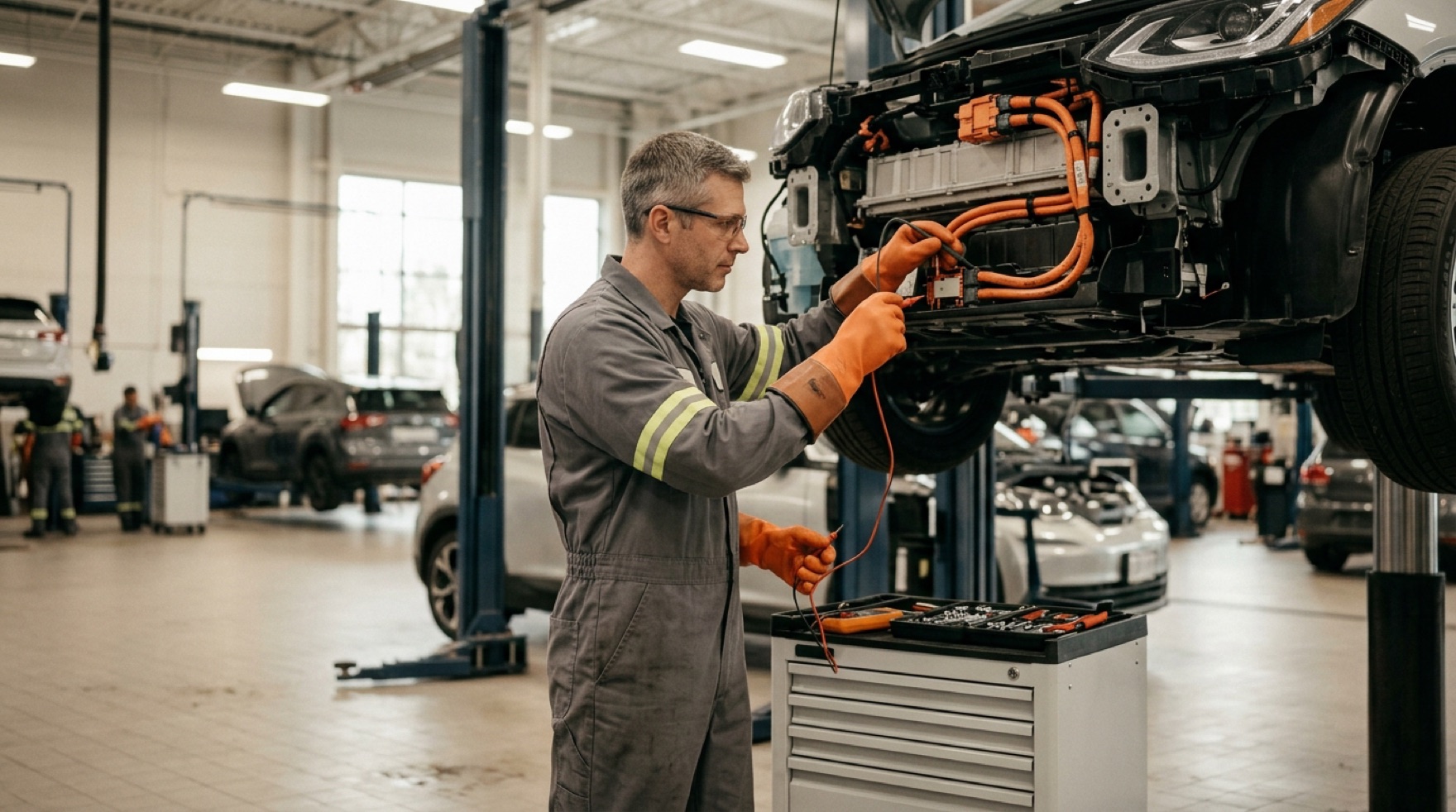
The short answer: Working on the high-voltage system of an electric or hybrid vehicle is electrical work governed by 29 CFR 1910.333 and the consensus practices in NFPA 70E, not ordinary automotive repair. The high-voltage battery commonly runs at several hundred volts DC, well above the level at which electric shock can stop the heart, so the system must be de-energized before a technician works on or near it. That means isolating the pack at the manufacturer's service disconnect, waiting the specified time for the capacitors to discharge, and then using a meter to verify the circuit is dead, exactly as 1910.333(a)(1) and 1910.333(b)(2)(iv)(B) require. Only a qualified person, wearing rated insulating gloves and using insulated tools, should perform that work.
What makes servicing an EV or hybrid different from a conventional car?
The difference is the high-voltage traction system, which stores and moves electrical energy at a level a conventional 12-volt vehicle never approaches. The battery pack, inverter, and motor circuits on a modern electric or hybrid vehicle typically operate at several hundred volts DC, commonly in the 200 to 800 volt range, and contact with an energized part at that level can be fatal. That single fact reclassifies the work: a job that looks like removing a component becomes electrical work on an energized system, and it carries the same obligation to de-energize and verify that any other high-voltage task does.
Treat the vehicle as an energized system until it is proven otherwise. The 12-volt side of the car still starts and controls things, so the vehicle can behave normally while the traction pack behind it holds a lethal charge. The practical implication for a service bay is that high-voltage work needs a defined procedure and a qualified technician, not the assumption that automotive experience transfers to a system that behaves like industrial electrical equipment.
How do you tell which components are high voltage?
The industry convention is that high-voltage cables and components are colored orange, so orange cabling is the visual signal to stop and treat a circuit as energized. Orange sheathing runs between the high-voltage battery, the inverter, the electric motor or motor-generator, the electric air-conditioning compressor, and the charging system, and it is deliberately distinct from the low-voltage wiring around it. When you see orange, assume high voltage and do not cut, pierce, or disconnect it without following the de-energization procedure.
The convention is a starting point, not a guarantee. Not every high-voltage cable on every vehicle is orange, and damage, a prior repair, or an aftermarket modification can put an energized conductor where the color code does not warn you. That is why identification relies on the manufacturer's service information for the specific vehicle rather than on the cable color alone: the service data shows where the high-voltage components sit, how the system is isolated, and which parts stay live after isolation.
How do you de-energize the high-voltage system safely?
De-energize at the manufacturer's service disconnect, wait the specified discharge time, then verify the system is dead with a meter before touching a high-voltage part. 29 CFR 1910.333(a)(1) requires that live parts an employee may be exposed to be de-energized before the employee works on or near them, unless de-energizing introduces a greater hazard or is infeasible, and high-voltage EV service is a case where de-energizing is both feasible and required. Removing or opening the high-voltage service disconnect, sometimes called the service plug, isolates the battery pack from the rest of the vehicle so no current flows through the circuits the technician will handle.
Isolation is not the end of the sequence. The inverter and DC link capacitors store energy after the pack is disconnected, so manufacturers specify a waiting period, often several minutes, for those capacitors to discharge before any high-voltage component is opened. The controlling step is verification: under 1910.333(b)(2)(iv)(B), a qualified person must use test equipment to confirm the circuit parts are de-energized, and that same discipline applies here. A technician measures across the terminals with a meter rated for the voltage, confirms zero volts, and only then proceeds. The service disconnect should also be secured so the system cannot be re-energized while someone is working on it, applying the lockout logic that 1910.333(b)(2) is built around.
What PPE and tools does high-voltage service require?
High-voltage service requires rated rubber insulating gloves and insulated tools, used by a qualified person under 29 CFR 1910.333(c)(2). That paragraph limits work on circuits that have not been de-energized to qualified persons who are familiar with the proper use of precautionary techniques, personal protective equipment, insulating materials, and insulated tools, and it is the anchor for the PPE a technician wears during isolation, verification, and any contact with high-voltage parts. Class 0 rubber insulating gloves, which carry a maximum use voltage of 1,000 volts AC under Table I-4 of 29 CFR 1910.137, are the common selection for the voltage range these systems run at, typically worn with leather protectors over them.
The gloves only protect if they are sound. 1910.137(c)(2)(ii) requires insulating equipment to be inspected for damage before each day's use, and requires insulating gloves to be given an air test along with the inspection, so a technician rolls the glove to trap air and checks for leaks before relying on it. Insulated tools keep an accidental slip from bridging a live terminal, and a meter rated for the system voltage is what turns "the pack should be isolated" into "the circuit is verified dead." The table below maps the rubber insulating glove classes and their maximum use voltages from Table I-4 of 1910.137.
| Glove class | Maximum use voltage (AC rms) | Typical application |
|---|---|---|
| Class 00 | 500 V | Low-voltage work |
| Class 0 | 1,000 V | Common EV and hybrid high-voltage service |
| Class 1 | 7,500 V | Higher-voltage electrical work |
| Class 2 | 17,000 V | Utility and industrial |
| Class 3 | 26,500 V | Utility and industrial |
| Class 4 | 36,000 V | Utility and industrial |
Does OSHA regulate EV service, and what standard applies?
Yes. OSHA's electrical safety-related work practices in 29 CFR 1910.333 apply to high-voltage vehicle work, and the consensus practices in NFPA 70E fill in how to do it. There is no separate OSHA standard written specifically for electric vehicles, so the general electrical work-practice rules govern: de-energize before working on or near live parts, verify the de-energized state, and restrict energized or high-voltage work to qualified persons. NFPA 70E, the standard for electrical safety in the workplace, defines what a qualified person is, sets shock-protection approach boundaries, and specifies insulating PPE, and it is the reference that translates OSHA's requirements into a working procedure for the bay.
Compliance with 1910.333 is the floor, and the operational point sits above it. The reason to build a written high-voltage procedure, train and qualify the technicians who use it, and stock rated gloves and meters is that the standard's requirement to verify a de-energized state only protects anyone if the shop actually has the equipment and the trained person to carry it out. A service bay that sends an untrained technician at an orange cable with ordinary tools has met none of the intent of the rule, whatever the sign on the wall says.
Building a high-voltage service program that holds
Servicing an electric or hybrid vehicle safely comes down to one instruction repeated at every step: prove the high-voltage system is dead before you touch it, and keep it that way while you work. Isolating the pack at the service disconnect, waiting out the capacitor discharge, verifying zero volts with a rated meter, and working in inspected Class 0 gloves are the concrete actions that satisfy 1910.333 and NFPA 70E, and each one exists because a technician cannot see voltage. The shops that treat high-voltage work as a qualified, procedure-driven task, with the gloves, the meter, and the training to match, are the ones that keep a routine repair from becoming an electrical fatality.