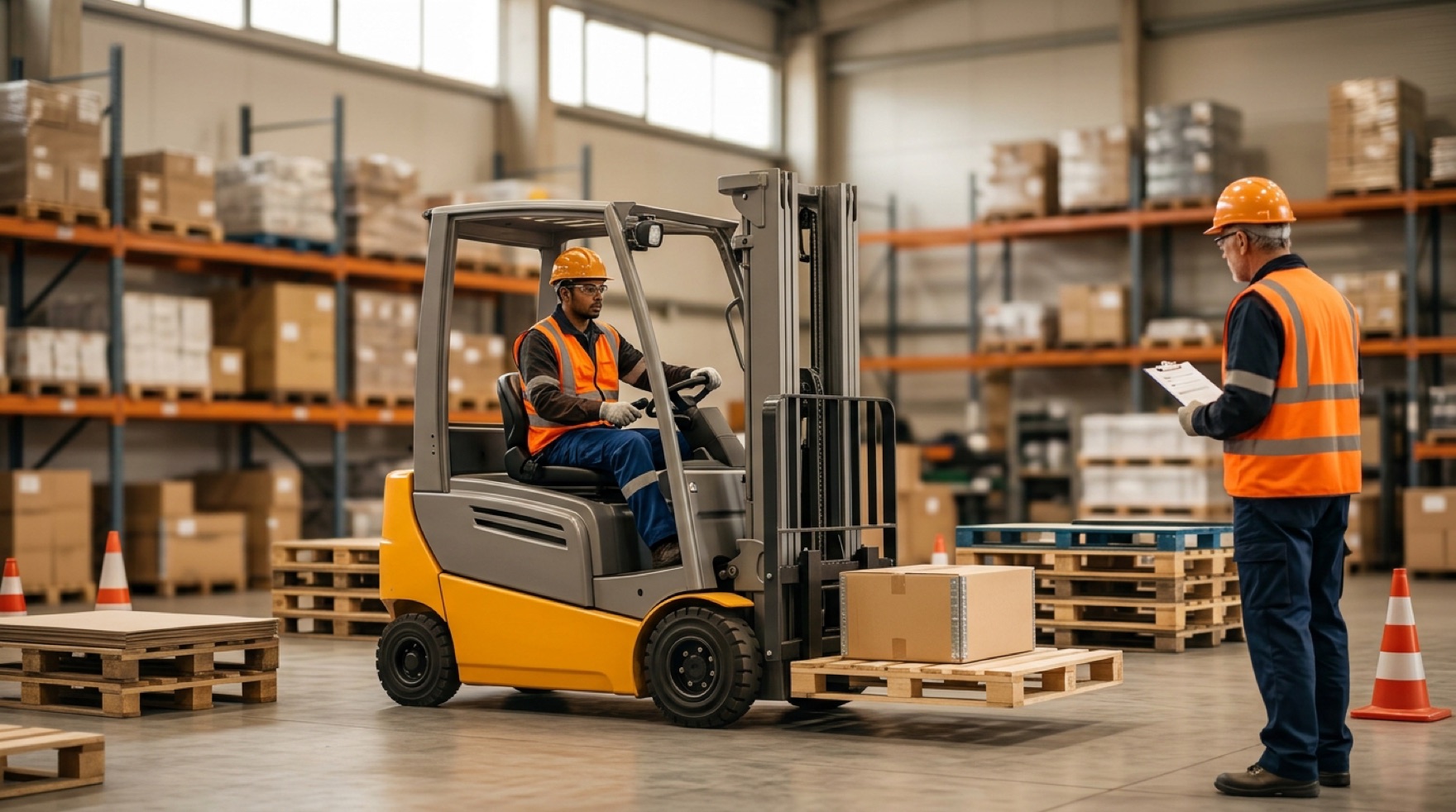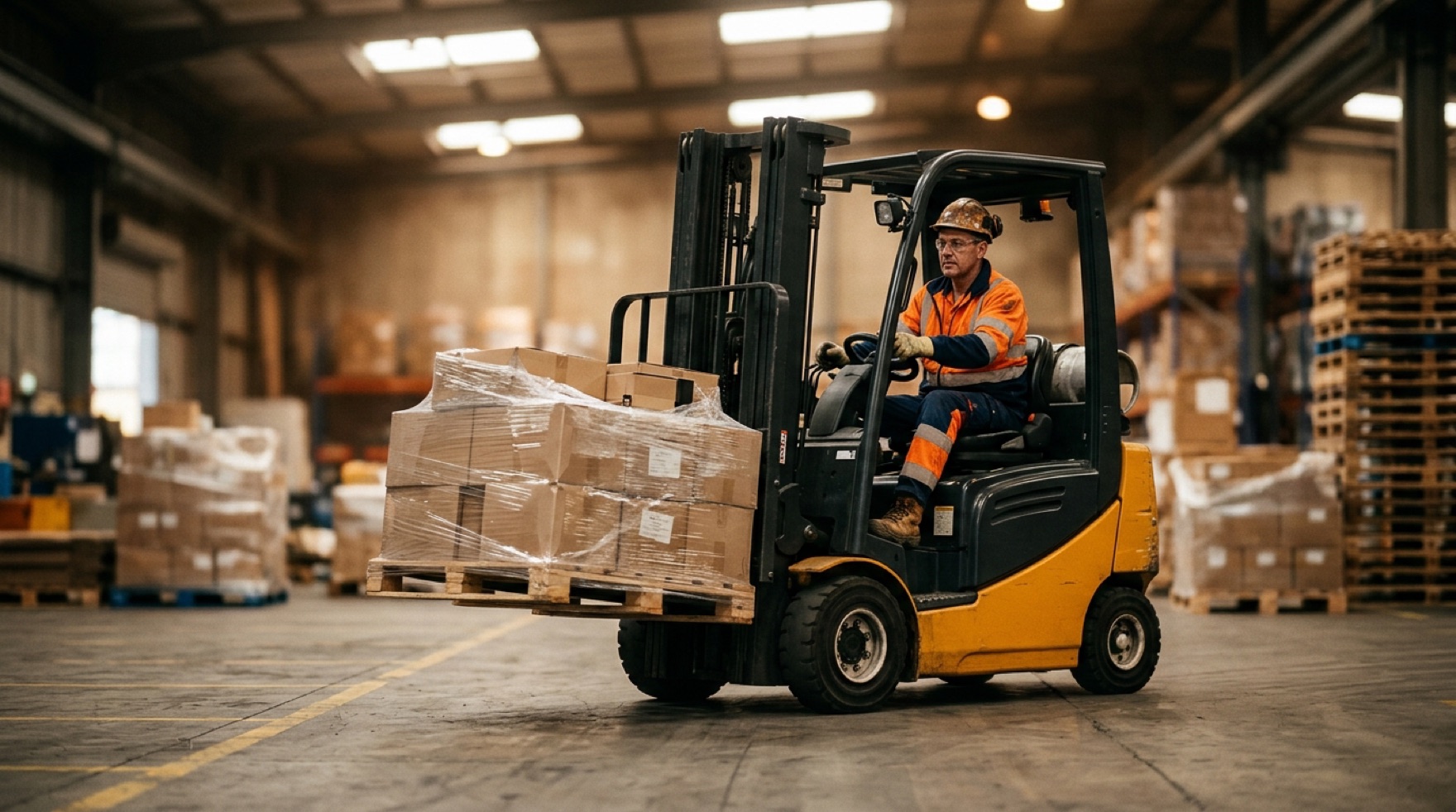
The short answer: A sit-down counterbalance forklift stays stable only while the combined center of gravity of the truck and its load stays inside the stability triangle, an imaginary triangle joining the two front wheels and the pivot point at the center of the steer axle. Raising a load, carrying it beyond the rated load center, turning, and traveling on a grade all move that combined center of gravity toward a side of the triangle, and a tip-over begins the moment it crosses. Load-handling limits and the truck's capacity are set by ASME B56.1 and the truck's data plate, and OSHA's operating rules in 29 CFR 1910.178 exist to keep the center of gravity inside the triangle during real work.
What is the forklift stability triangle?
The stability triangle is the base of support a counterbalance forklift actually balances on: two points at the front wheels and one at the pivot in the center of the rear steer axle. Because the rear axle pivots at its center, the truck's real footprint is a triangle, not a rectangle, and the machine is upright only while the combined center of gravity of truck plus load sits inside that triangle. The moment the combined center of gravity moves outside a side of the triangle, the truck rotates over that side.
Two directions of tipping follow from that geometry. Longitudinal tipping, forward over the front wheels, is driven by too much load, a load carried too far out, or braking hard with the forks raised. Lateral tipping, sideways over one of the triangle's sloping sides, is driven by turning, speed, and grades. Lateral tip-over is the more common and less forgiving failure, because the operator's survival space is on the side the truck is falling toward.
How does a load change the machine's balance?
A load moves the combined center of gravity forward and upward, and how far it moves depends on the load center and the lift height. The load center is the distance from the face of the forks to the load's own center of gravity, and many forklifts are rated at a 24-inch load center, meaning the rated capacity assumes the load's center of gravity sits 24 inches or less from the fork face, as OSHA's load-handling guidance describes. Push the load's center of gravity farther out, or lift it higher, and the truck's safe capacity drops well below the number stamped on it.
Worked example. Picture a truck with a rated capacity of 4,000 pounds at a 24-inch load center. That rating is a statement about balance, not just weight: it means 4,000 pounds acting 24 inches ahead of the fork face keeps the combined center of gravity inside the triangle. Handle a bulky pallet whose center of gravity sits 36 inches out, and the same 4,000 pounds now acts through a longer lever arm, pushing the combined center of gravity toward the front side of the triangle, so the truck's safe capacity at 36 inches is lower than 4,000 pounds. Raise that load to stacking height and the center of gravity also climbs, which shrinks how much lateral movement the truck can tolerate in a turn. This is why the data plate, required to be present and legible, has to be read against the actual load and height, and why 1910.178(o)(6) limits forward tilt with an elevated load and restricts back tilt when stacking.
What actually tips a forklift over?
Tip-overs cluster around a raised load in a turn, especially with any speed or grade added. Each of those factors moves the combined center of gravity toward the edge of the stability triangle, and in combination they overwhelm it quickly. Traveling with the forks high, cornering faster than the load allows, and driving on a ramp or uneven surface are the recurring ingredients in lateral tip-over investigations.
A California FACE investigation shows the combination at work. In report 95CA008, a 37-year-old shop foreman was backing a counterbalance forklift down a slight grade with a roughly 150-pound load of cardboard raised about 60 inches off the ground when he made a turn and the truck tipped onto its side. He was thrown from the seat and crushed by the rollover protective structure. The investigators concluded that stability is greatly compromised at that fork height and more so when backing down a grade, and that the forks should be raised only as far as necessary to clear the surface while traveling. The transferable point is that no single factor tipped the truck: a raised load, a turn, and a grade together carried the combined center of gravity outside the triangle, which is precisely the condition the operating rules are written to prevent.
If a forklift starts to tip, should you jump?
No. On a sit-down forklift with an overhead guard, staying in the seat is the survivable choice, and jumping is what turns a tip-over into a fatality. When a truck goes over, the operator who jumps tends to land in the path of the descending overhead guard or mast, while the operator who stays belted in the seat rides the protected space down. The same California FACE case makes the point in reverse: the foreman was thrown from the seat because he was not restrained, and the rollover structure that should have protected him landed on him instead.
That is why the seatbelt is a stability control, not a comfort item. The rollover protective structure only protects the operator who stays inside it, so the survival sequence is to stay in the seat, hold on firmly, brace your feet, and lean away from the direction of the fall. Keeping the operator inside the guard is the last line of defense once the combined center of gravity has already left the triangle, and it is the difference the investigation records between a survivable tip-over and a fatal one.
Keeping the center of gravity inside the triangle
Every stability rule an operator follows is really one instruction: keep the combined center of gravity inside the stability triangle. Reading the data plate against the real load center and height, carrying loads low while traveling, tilting back only as needed, slowing before turns, and treating grades with extra caution all serve that single goal, and ASME B56.1 and the operating rules in 29 CFR 1910.178 are built around it. When the triangle is respected the truck stays upright, and when it is not, as the California investigation shows, the seatbelt and overhead guard are what stand between a tip-over and a death.