The short answer: CCOHS confirms that every jurisdiction in Canada has regulations dealing with confined space entry, but the detail sits in each province's or territory's OHS regulation, or the COHSR Part XI (Confined Spaces) for federally regulated sites. The recurring duties are consistent across the country: a competent person assesses the hazards before entry, the atmosphere is tested before anyone enters, an entry permit records the tests and controls, an attendant stays outside, and rescue is arranged before entry begins. The shared management standard is CSA Z1006, Management of Work in Confined Spaces. Because the acceptable atmospheric limits and permit content are set by each jurisdiction, confirm the exact figures in the regulation that governs your workplace rather than assuming one national threshold.
What counts as a confined space in a facility?
CCOHS defines a confined space as a fully or partially enclosed space that is not primarily designed or intended for continuous human occupancy, that has restricted means of entry or exit, or a configuration that can complicate rescue, and that can hold a hazard from its design, contents, or the work done inside. In facilities work that captures boiler and furnace fireboxes, storage tanks, sumps and pits, sewer and drainage vaults, manholes, and the insides of large air handlers and ductwork. The label matters because it triggers the whole program of assessment, testing, permitting, and rescue, so Canadian facilities teams inventory and mark their confined spaces rather than judging each one at the hatch.
The governing rule is jurisdictional. In Ontario, confined space entry sits in a dedicated regulation, Ontario Regulation 632/05 (Confined Spaces), separate from the general industrial regulation. In British Columbia it sits in the WorkSafeBC OHS Regulation Part 9 (Confined Spaces). Federally regulated workplaces follow COHSR Part XI. Each sets its own wording for the program, the plan, and the permit, so the first task is to confirm which regulation applies to the site.
What has to happen before entry: testing, permit, attendant, rescue?
The atmosphere is tested before anyone enters. WorkSafeBC Part 9 requires that before a worker enters a confined space the employer ensures the atmosphere is tested, and that the test is done close to the time of entry. CCOHS describes the safe oxygen band as greater than 19.5 percent and less than 23 percent, with an oxygen-deficient atmosphere at 19.5 percent or below, but the exact acceptable values and the order of testing are set in the governing regulation, so read the number off the rule that applies to your site rather than importing a figure from another jurisdiction. Testing checks the oxygen level and screens for flammable and toxic atmospheres before entry is authorized.
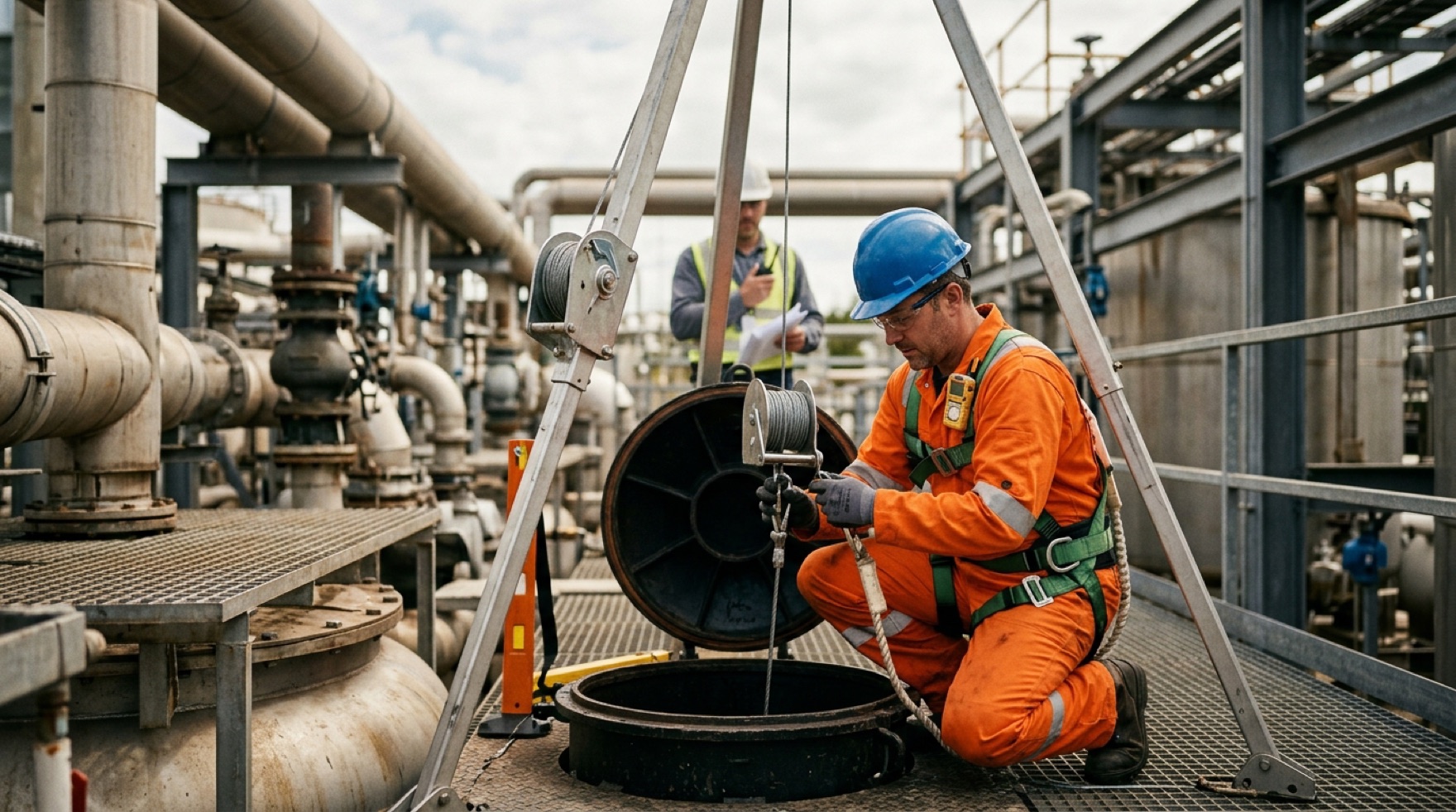
An entry permit records what was found and what controls are in place. Across jurisdictions the permit identifies the space, the workers, the hazards, the atmospheric test results, the precautions and isolation used, and a time by which it expires. An attendant stays outside the space, keeps track of who is inside, maintains communication, and summons rescue when it is needed, without entering to attempt the rescue themselves. Rescue arrangements are in place before entry begins. This is the duty CCOHS is most emphatic about, because it reports that roughly 60 percent of confined-space fatalities are would-be rescuers who entered without protection to help a downed worker. Non-entry rescue, retrieving a worker from outside with a line and harness, is the design goal precisely because entry rescue by an unequipped attendant is how one death becomes two.
| Requirement | Canada (recurring across jurisdictions) | Source |
|---|---|---|
| Governing law | Provincial or territorial confined-space regulation; federal = COHSR Part XI | Provincial OHS regulator / ESDC Labour Program |
| Management standard | CSA Z1006, Management of Work in Confined Spaces | CSA Group |
| Atmospheric testing | Test the atmosphere before entry; oxygen and flammable/toxic screening | WorkSafeBC Part 9 (s. 9.25); CCOHS |
| Entry permit | Records space, workers, hazards, test results, controls, and expiry | Provincial regulation (e.g. Ontario Reg. 632/05); WorkSafeBC Part 9 |
| Attendant and rescue | Attendant stays outside; rescue arranged before entry; non-entry rescue preferred | CCOHS; provincial regulation |
The transferable point for a Canadian facilities team is that the permit is the gate, not paperwork filled in after the decision to enter. A permit that cannot be completed, because the atmosphere has not been tested, the isolation is not done, or rescue has not been arranged, is the regulation telling the crew the space is not ready. Build the program to CSA Z1006, then confirm the exact atmospheric limits, permit content, and rescue-response duties with the OHS regulator that governs the workplace.