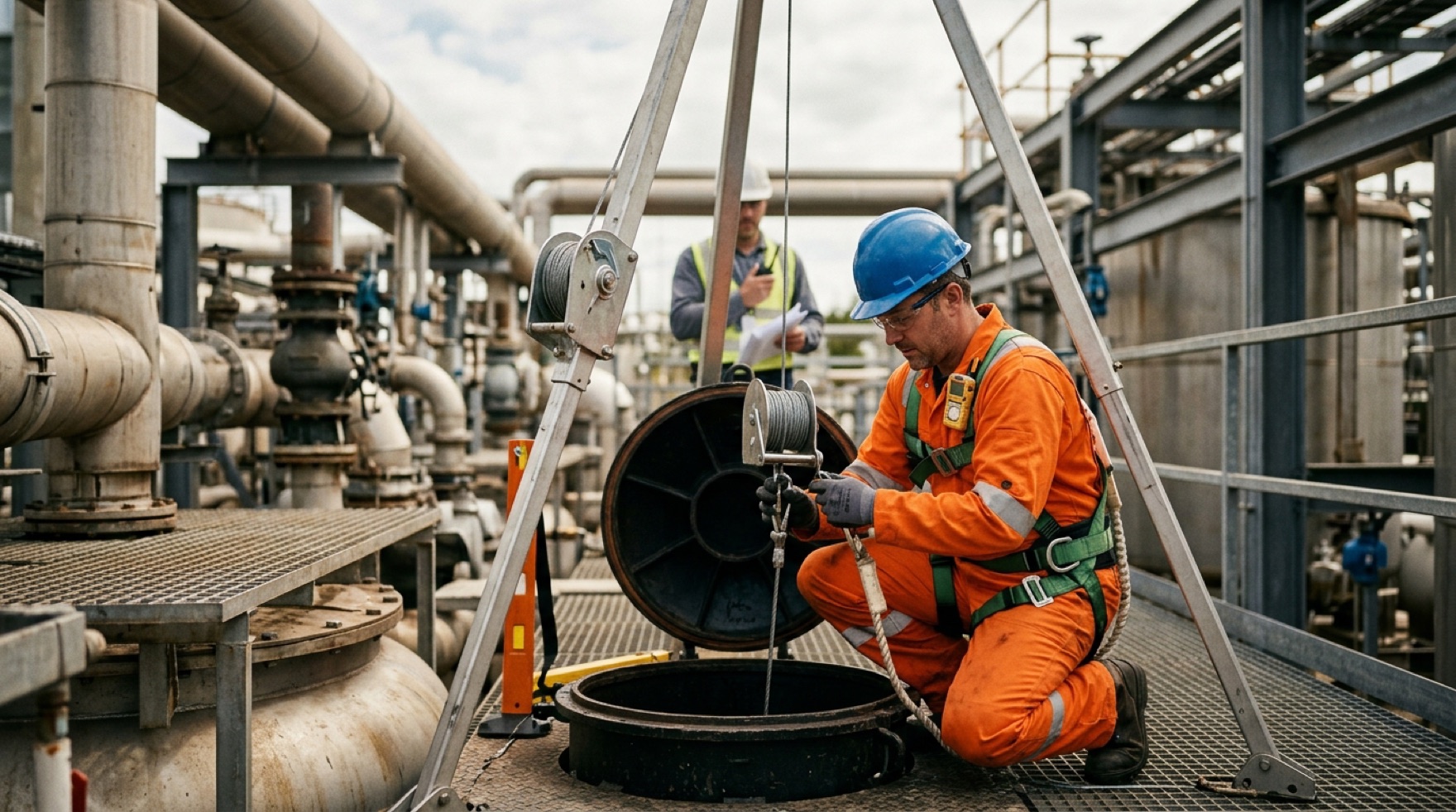
The short answer: Under 29 CFR 1910.146, a permit-required confined space is one large enough to enter and not designed for continuous occupancy that also holds a serious hazard, such as a hazardous atmosphere or a material that could engulf an entrant. Before anyone enters, the employer must test the atmosphere, control the hazards, issue a written entry permit, and station an attendant outside with a way to summon rescue. The acceptable oxygen range is 19.5 to 23.5 percent, and testing is done in a set order: oxygen first, then combustible gases, then toxic gases. The table below lays out the conditions that must be verified before entry, and the roles that hold the entry together.
What makes a confined space "permit-required"?
A permit-required confined space is a confined space that also contains a serious, potentially fatal hazard. 1910.146(b) first defines a confined space as one large enough to bodily enter, with limited means of entry or exit, and not designed for continuous occupancy, then defines a permit-required space as one with one or more added hazards: a hazardous atmosphere, a material with the potential to engulf an entrant, an internal configuration that could trap or asphyxiate, or any other recognized serious safety or health hazard. In a facility, that captures boiler and furnace fireboxes, sumps and pits, storage tanks, sewer and drainage vaults, manholes, and the insides of large air handlers and ductwork.
The distinction drives everything that follows. A space that is merely confined can be entered under an alternate procedure if the only hazard is atmospheric and it can be controlled by ventilation. A permit-required space cannot: it triggers the full program of testing, permitting, attendants, and rescue. Classifying each space correctly, before the work order lands, is the decision the rest of the standard is built on, which is why facilities teams inventory and label their permit spaces rather than judging each one at the hatch.
What atmospheric conditions must be verified before entry?
The atmosphere must be tested and shown to be within acceptable limits before anyone enters, and it must be tested in a specific order. 1910.146(d)(5)(i) requires testing conditions in the space to confirm acceptable entry conditions exist before entry is authorized, and 1910.146(d)(5)(iii) sets the order: test first for oxygen, then for combustible gases and vapors, then for toxic gases and vapors. The order is not arbitrary. Oxygen comes first because most combustible-gas meters need adequate oxygen to read correctly, and an oxygen problem is the most immediately lethal.
| Condition | Acceptable value | Source clause |
|---|---|---|
| Oxygen concentration | 19.5% to 23.5% by volume | 1910.146(b) |
| Oxygen deficient | Below 19.5% (a hazardous atmosphere) | 1910.146(b) |
| Oxygen enriched | Above 23.5% (a hazardous atmosphere) | 1910.146(b) |
| Testing order | Oxygen, then combustible gases and vapors, then toxic gases and vapors | 1910.146(d)(5)(iii) |
| When to test | Before entry is authorized, to confirm acceptable entry conditions exist | 1910.146(d)(5)(i) |
The oxygen limits explain a hazard that facilities workers underestimate. An oxygen-deficient atmosphere, below 19.5 percent, gives almost no warning: purging a tank with nitrogen, rust consuming oxygen in a closed vessel, or displacement by a heavier gas can drop the level below survivable without any smell or sensation. An oxygen-enriched atmosphere, above 23.5 percent, makes ordinary materials burn violently. Neither is something an entrant can detect unaided, which is the entire reason the standard requires an instrument reading before entry rather than a judgment call at the opening.
Who does what: entrant, attendant, and entry supervisor?
Permit-space entry is a three-role operation, and the roles are defined so that no one works unmonitored. The authorized entrant does the work inside. The attendant stays outside. The entry supervisor authorizes and oversees the entry. Separating these duties is what allows a problem inside the space to be caught by someone who is not affected by it.
The attendant's job is the one facilities teams most often shortchange, and it is the one the standard is most specific about. Under 1910.146(i), the attendant continuously maintains an accurate count of entrants (i)(3), remains outside the space until relieved (i)(4), communicates with entrants to monitor their status (i)(5), orders evacuation when a hazard appears (i)(6), and summons rescue as soon as it is needed (i)(7). Critically, the attendant does not enter to attempt a rescue, because that is how one fatality becomes two. The entry supervisor under 1910.146(j) verifies, by checking the permit, that the required tests were done and controls are in place before signing, confirms rescue services are available, and terminates the entry when conditions change. Non-entry rescue, retrieving a downed entrant from outside with a retrieval line and harness, is the design goal, because entry rescue by an unequipped attendant is the deadliest move in confined-space work.
A California FACE investigation shows the pattern in its most tragic form. In report 11CA008, two laborers, brothers aged 16 and 22, died while flushing the drainage system of an organic waste recycling facility, a network of underground pipes accessed by manhole shafts. The younger worker was overcome by hydrogen sulfide and fell to the bottom of a 10-foot shaft; the older collapsed at the bottom after climbing down to reach his brother. The investigators identified the high hydrogen sulfide concentration and the absence of a confined-space program among the contributing factors. The transferable point is the one the attendant rule exists to prevent: the second death came from an untrained rescue into an atmosphere that had already dropped one worker, which is exactly why 1910.146(i) keeps the attendant outside and 1910.146(k) requires a planned rescue capability.
What has to be on the entry permit?
The entry permit is the document that proves the space was made safe before entry, and 1910.146(f) lists what it must contain. It identifies the space and the purpose of entry, the date and authorized duration, the authorized entrants, the current attendant, and the entry supervisor who signs it. It records the space's hazards, the measures used to isolate the space and control those hazards, the acceptable entry conditions, and the results of the atmospheric tests with the time and the tester's identity. It lists the rescue and emergency services and how to summon them, the communication procedures, and any equipment required.
For a facilities team, the permit is not paperwork for its own sake: it is the checklist that forces the sequence. A permit that cannot be completed, because the atmosphere has not been tested, or rescue has not been arranged, or the isolation is not done, is the standard telling the crew the space is not ready. The permit is canceled and the entry ends when the authorized duration passes or conditions change, under 1910.146(e), so it also bounds how long the verified-safe condition is assumed to hold. Treating the permit as the gate, rather than a form filled in after the decision to enter, is what keeps the atmosphere, the isolation, and the rescue plan from being skipped.