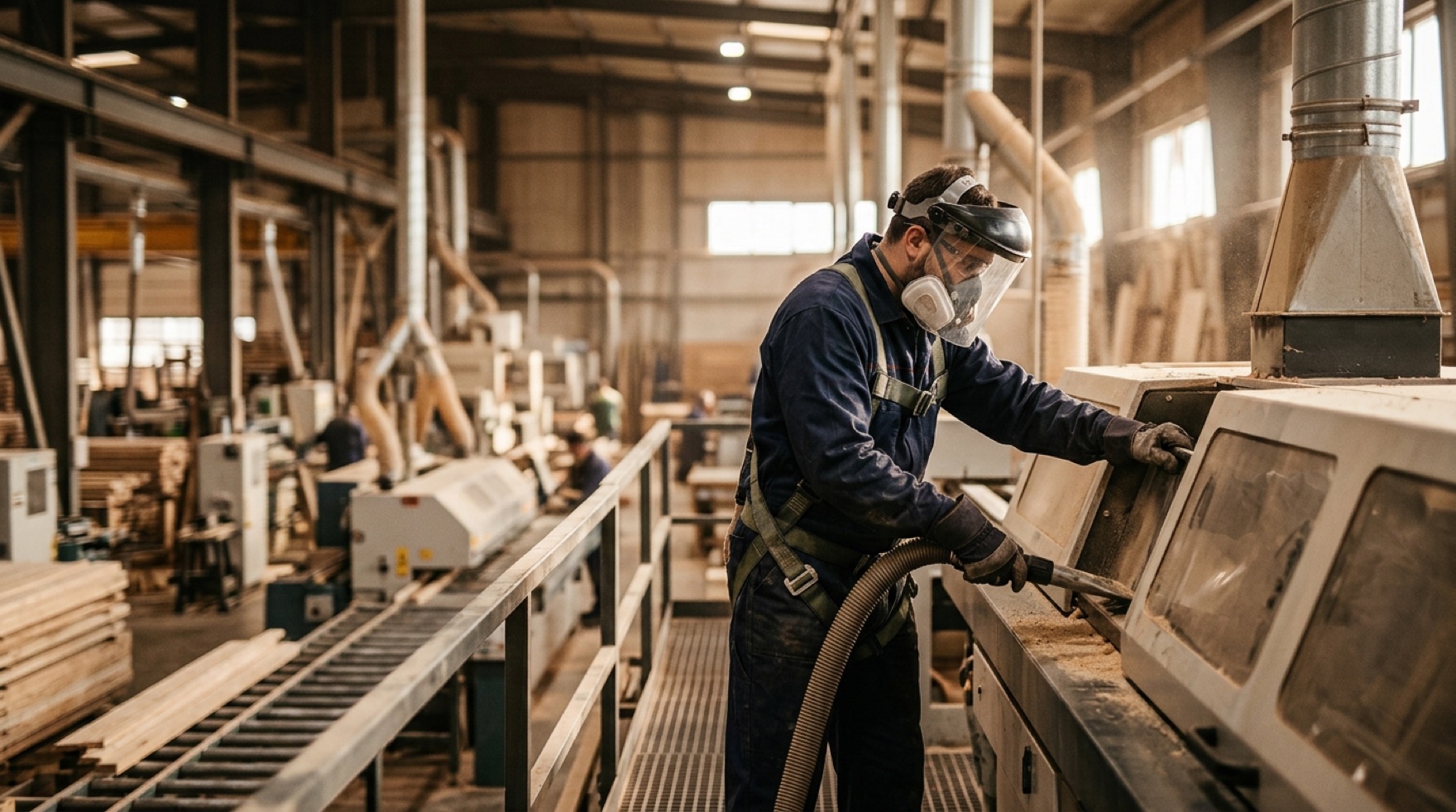
The short answer: Wood dust is two hazards in one, and Canada regulates each through a different channel, neither of which is a single national rule. As a health hazard, wood dust is controlled under each province's or territory's OHS regulation, which sets the occupational exposure limit (OEL) and the duty to keep exposure as low as reasonably practicable; federally regulated workplaces carry equivalent duties under the Canada Labour Code Part II and the COHSR. As a fire and explosion hazard, settled and airborne dust is governed by provincial fire codes and OHS regulations built on the model National Fire Code of Canada. Canada has no combustible-dust standard of its own, so many wood-processing facilities reference the US consensus standards NFPA 664 and NFPA 652 as good practice. CCOHS classifies wood dust as a carcinogen, so the same dust control protects both lungs and the building.
Who regulates wood dust in Canada?
The duty comes from the jurisdiction that governs the workplace, not from one federal standard. Most employers fall under their province's or territory's OHS act and regulations, which set both the occupational exposure limit for wood dust and the general duty to control combustible material and ignition sources. Federally regulated workplaces carry equivalent duties under the Canada Labour Code Part II and the COHSR. CCOHS provides the practical guidance that ties the two hazards together, but it is guidance, not law: the enforceable requirement is whatever your provincial, territorial, or federal regulator sets.
Because the health hazard and the fire hazard are written into different instruments, a Canadian wood shop has to satisfy two sets of rules at once. The OHS regulation drives ventilation, exposure limits, and respiratory protection. The fire code drives dust accumulation, ignition control, and the design of dust-collection equipment. A single dust-collection system usually serves both, which is why CCOHS treats housekeeping as a health control and a fire control in the same breath.
What is the wood dust exposure limit in Canada?
The numeric OEL is set province by province, and most jurisdictions adopt the ACGIH threshold limit value (TLV) framework, so the limits track ACGIH values but are enforced by each regulator. Where you state a number, tie it to the regulation that governs your site rather than assuming one national figure. Two published examples show what the values look like in practice.
CCOHS, citing the ACGIH TLV, reports a limit of 0.5 mg/m3 (8-hour TWA) for western red cedar and 1 mg/m3 for all other wood species. WorkSafeBC sets an exposure limit of 1 mg/m3 (8-hour TWA) for wood dust of allergenic species and carries ACGIH notations that matter for classification: oak and beech are noted A1 (confirmed human carcinogen), mahogany and walnut A2 (suspected human carcinogen), and western red cedar as both a dermal and a respiratory sensitizer. These are examples, not a national rule, so confirm the limit and the sampling method with the OHS regulator for your jurisdiction.
Why is wood dust a carcinogen and a sensitizer?
CCOHS states plainly that wood dust "causes cancer of the nasal cavity (nose area) and paranasal sinuses (spaces in and around the nasal cavity) and of the nasopharynx." That is not a distant abstraction for someone standing at a sander or a table saw for a full shift; it is a chronic inhalation exposure that source capture is meant to control, and the reason the OEL exists.
The respiratory picture is broader than cancer. CCOHS records that western red cedar has "a clear association with the development of asthma," and lists effects across species that include allergic contact dermatitis, decreased lung function, rhinitis, and eye irritation. Under WHMIS 2015, wood dust handled as a hazardous product carries a safety data sheet and workplace labelling, and the SDS is where a worker finds the species-specific hazards. Respiratory protection is a supplement to local exhaust ventilation and housekeeping, not a substitute for either.
How does Canada treat the fire and explosion hazard?
CCOHS is direct: "Wood dust is also a safety concern because it can cause a fire or explosion," and it advises workplaces to "not allow wood dust to accumulate, including on ledges, ceiling beams, light fixtures, hidden areas, etc." That instruction points at the mechanism behind a dust explosion. A small primary event generates a pressure wave; the wave lifts dust that had settled on overhead surfaces into a fuel-air cloud; and the secondary explosion that follows draws on years of accumulated housekeeping debris, which is why it is usually far larger than the event that started it. The risk is not only at the machine, it is on every joist, duct run, and light fixture above head height.
Canada has no single federal combustible-dust standard. The enforceable requirements come from provincial fire codes and OHS regulations, most of which are built on the model National Fire Code of Canada, and they govern accumulation, ignition control, and dust collection. Because those instruments do not always spell out the engineering detail, many Canadian wood-processing facilities reference the US consensus standards NFPA 664 (woodworking and wood processing) and NFPA 652 (fundamentals of combustible dust) as good practice, including their approach to a dust hazard analysis and to accumulation limits. Those NFPA documents are consensus standards, not Canadian law, so treat them as the design reference and confirm the enforceable accumulation and housekeeping duties with the fire and OHS authorities that govern your workplace.
How do you control both hazards at once?
Keep dust out of the air and off the overhead steel first, then remove ignition sources, then protect the equipment that still holds dust. In order, that means source capture and a properly designed dust-collection system at each machine; a housekeeping program that reaches beams, ducts, and fixtures using vacuuming rather than compressed air, which only re-suspends the cloud; ignition control through bonded and grounded equipment, electrical gear suited to a dust-laden area, and hot-work discipline; and engineered explosion protection on collectors and ductwork where the hazard assessment calls for it. The same collection system that strips the respirable fraction a worker inhales is the one that removes the fugitive layer that feeds a secondary explosion, which is the argument that usually justifies the investment.
| Hazard | Canada (most workplaces) | Source of the duty |
|---|---|---|
| Health (inhalation) | Provincial/territorial OHS regulation sets the wood dust OEL; keep exposure as low as reasonably practicable | Provincial OHS regulator; ACGIH TLV framework; CCOHS guidance |
| Exposure limit example | Western red cedar 0.5 mg/m3; other species 1 mg/m3 (ACGIH TLV, cited by CCOHS); WorkSafeBC 1 mg/m3 for allergenic species | CCOHS; WorkSafeBC exposure limit table |
| Carcinogen and sensitizer | Cancer of the nasal cavity, paranasal sinuses, and nasopharynx; western red cedar linked to asthma; WHMIS 2015 SDS and labelling | CCOHS; Hazardous Products Regulations |
| Fire and explosion | Provincial fire codes and OHS regulations built on the National Fire Code of Canada; no national dust standard | Provincial fire/OHS authority; NFPA 664 and NFPA 652 referenced as good practice |
| Federal workplaces | Equivalent health and fire duties | Canada Labour Code Part II + COHSR |
The practical takeaway for a Canadian employer is to manage wood dust as one program with two payoffs: an OHS exposure control that protects the airway, and a fire-code control that protects the building. Confirm the exposure limit and the accumulation and housekeeping duties with the OHS and fire authorities that govern your site, treat CCOHS as the practical floor and NFPA 664 as the engineering reference, and keep the settled layer from building on the surfaces nobody looks at. That layer is the fuel; the ignition source is only the trigger.