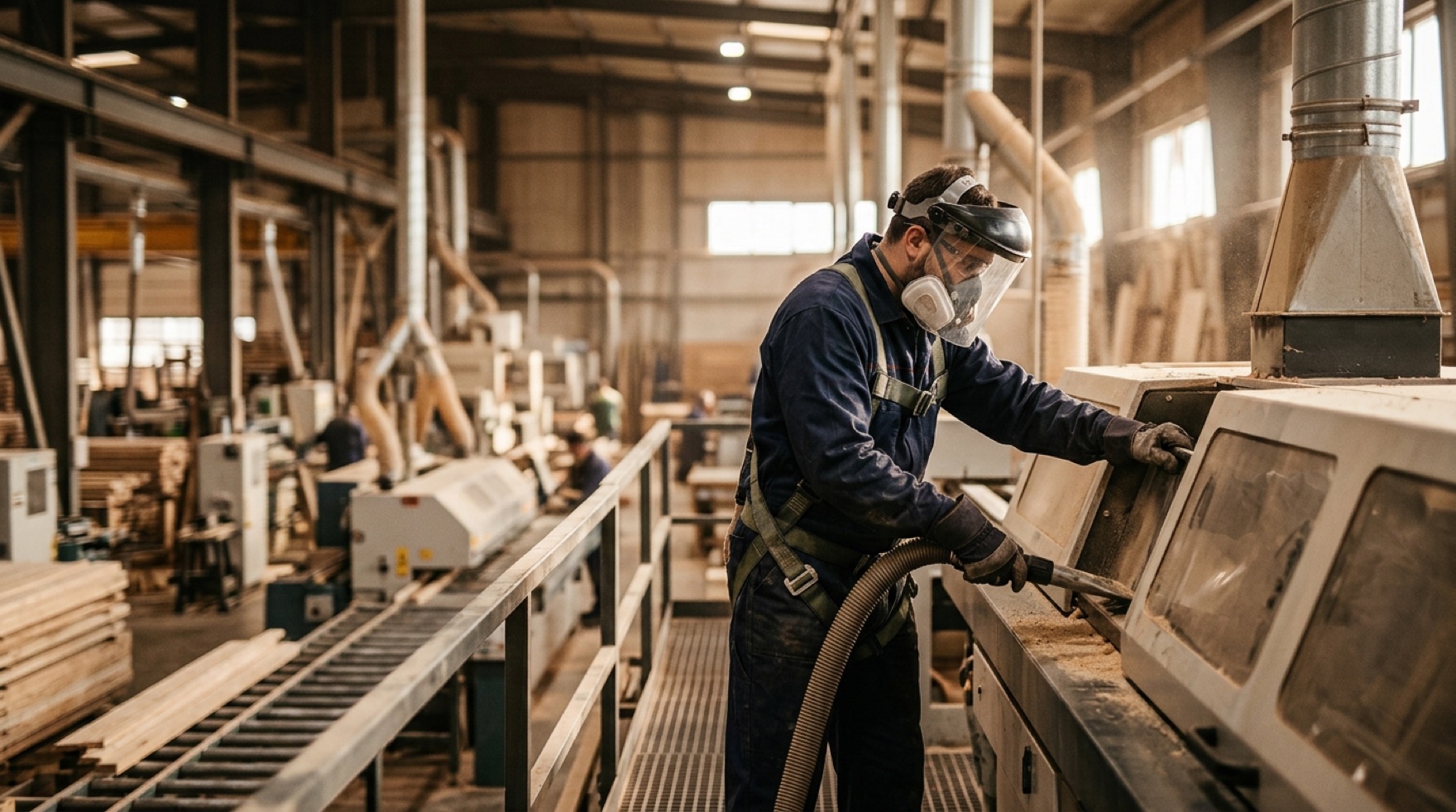
The short answer: Finely divided wood dust suspended in air can deflagrate, and the danger is rarely the first ignition. It is the secondary explosion, when the pressure wave from a small primary event lifts settled dust off beams and ledges into a cloud that ignites across the whole room. NFPA 664 is the consensus standard for fire and explosion prevention in wood processing and woodworking facilities, and NFPA 652 is the fundamentals standard that requires a Dust Hazard Analysis. OSHA has no single combustible dust standard, so it enforces the hazard through its Combustible Dust National Emphasis Program and existing rules such as 29 CFR 1910.22 housekeeping and 1910.307 for hazardous locations. Wood dust is also an IARC Group 1 human carcinogen, so the same dust control protects lungs and the building at once.
What makes wood dust an explosion hazard, not just a mess?
Wood dust becomes explosible when it is fine enough, dry enough, suspended in air at the right concentration, confined, and given an ignition source. Remove any one of those and a cloud will not deflagrate, which is why control focuses on keeping dust out of the air and ignition sources away from it. A pile of shavings on the floor burns; the same mass as an airborne cloud in a duct or a room releases its energy almost all at once, and that pressure is what injures people and collapses structures.
The mechanism that makes wood dust so dangerous is the two-stage explosion. A primary event, often small and contained, generates a pressure wave. That wave disturbs dust that has settled on horizontal surfaces overhead, and the dust that was lying inert a second earlier is now a fuel-air cloud. The secondary explosion that follows is typically far larger than the primary, because it draws on years of accumulated housekeeping debris rather than the small charge that started it. Understanding that sequence changes how you read a shop: the risk is not only at the machine, it is on every ledge, joist, and cable tray above head height.
An Oregon FACE investigation shows the sequence end to end. In report OR 2003-21-1, a 50-year-old production worker at a wood-flour mill started the plant one morning and switched on a dust-collection fan. A makeshift fuse, a spent cartridge with a fuse link taped to the outside, arced against a loose holder and ignited wood dust that had drifted into the fuse panel through a hole cut in the wall for an I-beam. The investigators recorded what happened next: the concussion from that first blast lifted dust off surrounding surfaces, "creating a rapid succession of at least three explosions." The blast reached the storage area where the worker stood alone; he suffered burns over half his body and died five days later. OR-FACE recommended that current-protection devices never be altered or bypassed and that good housekeeping keep the environment dust-free. The transferable point is that the fatal energy came not from the fuse but from the settled dust the fuse ignited, which is exactly what a housekeeping program exists to remove.
How much accumulated dust is too much?
NFPA 664 treats a thin, widespread layer as a deflagration hazard, not a cosmetic problem. The standard sets the trigger at a layer of fugitive wood dust thicker than 1/8 inch (3.2 mm) covering more than 5 percent of a compartment's floor area, or 1,000 square feet, whichever is smaller. That is a deliberately low bar: an eighth of an inch is roughly the diameter of a pen tip, and 5 percent of a modest shop is a small footprint. If you can write your name in the dust on a beam or a duct run, you are at or past the threshold that the standard uses to define a hazardous accumulation.
The practical implication is that housekeeping has to reach the surfaces nobody looks at. Floors and benches usually get swept; the dust that drives a secondary explosion is on the overhead steel, the tops of cabinets, the light fixtures, and the exterior of the ductwork. Cleaning has to be done in a way that does not itself create a cloud, which means vacuuming with appropriate equipment or gentle sweeping rather than blowing surfaces down with compressed air. NFPA 664 and NFPA 652 are consensus standards published by NFPA and sit behind a paywall, so the exact edition text should be obtained directly, but the accumulation threshold above is consistently reported from the standard and is the number inspectors and dust-hazard analysts work to.
What does NFPA 652 require, and does it apply to a small shop?
NFPA 652 is the fundamentals standard for combustible dust, and its central requirement is a Dust Hazard Analysis, a documented study of where combustible dust is generated, handled, and accumulated, what could ignite it, and which controls are in place or needed. The owner or operator of a facility with combustible dust was required to complete the DHA by September 7, 2020, and to review and update it at least every five years. The obligation does not turn on company size: it turns on whether the process generates or handles a combustible dust, which nearly all wood processing does.
NFPA 652 and NFPA 664 work as a pair. NFPA 652 sets the baseline that applies across all combustible dusts, and NFPA 664 is the commodity-specific standard for wood, adding the accumulation threshold, dust-collection, and explosion-protection detail that fits sawdust and wood flour. Where a commodity-specific standard like 664 addresses a topic, it governs for that material, with 652 filling the gaps. For a millwork or cabinet shop, the honest reading is that both apply: 652 requires you to analyze the hazard, and 664 tells you what good looks like for wood.
Which OSHA rules actually enforce combustible dust?
OSHA has no comprehensive combustible dust standard, so it enforces the hazard through a National Emphasis Program and a set of existing general-industry rules. The Combustible Dust NEP, directive CPL 03-00-008, was reissued on January 30, 2023, and it directs inspections of workplaces that generate or handle combustible dust to determine whether fire, flash fire, deflagration, and explosion hazards have been addressed. An inspection under the NEP is where a wood shop's housekeeping and equipment meet federal enforcement.
The citations come from standards that were not written for dust explosions but reach the conditions that cause them. 29 CFR 1910.22(a) requires walking-working surfaces to be kept clean, orderly, and free of hazards, which is the housekeeping hook for accumulated dust. 1910.307 governs electrical equipment in hazardous (classified) locations, the exact rule the Oregon mill violated when a fuse panel sat in a dust-laden room. 1910.1200, Hazard Communication, covers wood dust as a hazardous chemical on the container and the safety data sheet. And where no specific standard fits, OSHA cites Section 5(a)(1) of the OSH Act, the General Duty Clause, to require abatement of a recognized combustible dust hazard. For a safety leader, compliance with these is the floor; the DHA and NFPA 664 are what actually engineer the risk down.
Is wood dust also a health hazard on its own?
Yes, and the same collection system that prevents an explosion also protects the people breathing near the machine. The International Agency for Research on Cancer classifies wood dust as Group 1, carcinogenic to humans, with sufficient evidence that it causes cancer of the nasal cavity and paranasal sinuses and of the nasopharynx, and the evidence is strongest for sinonasal adenocarcinoma, particularly with hardwood dust. That is not a long-term abstraction for an operator standing at a sander or a table saw eight hours a day; it is a chronic inhalation exposure that source capture is meant to control.
This is why dust control in a woodshop should be read as one program with two payoffs. Effective source capture at each machine, well-designed ductwork, and disciplined housekeeping reduce the airborne respirable fraction workers inhale and strip out the fugitive accumulation that feeds a secondary explosion. Treating the collection system as a health control and a fire control at the same time is what keeps both the workforce and the building intact, and it is the argument that usually justifies the investment to operations leadership.
Putting the controls in the right order
Start by keeping dust out of the air and off the overhead steel, then remove ignition sources, then add protection for the equipment that still holds dust. In order, that means source capture and a properly designed dust-collection system at each machine; a housekeeping program that reaches beams, ducts, and fixtures using vacuuming rather than compressed air; ignition control through bonded and grounded equipment, electrical gear rated for the location under 1910.307, and hot-work discipline; and engineered explosion protection on collectors and ductwork, such as venting or suppression, following NFPA 664 and the supporting NFPA guidance. A Dust Hazard Analysis under NFPA 652 is what tells you which of these your specific shop needs and in what sequence. The Oregon case is the reminder underneath all of it: the settled layer is the fuel, the ignition source is only the trigger, and the shop that keeps the layer below the threshold has already removed most of the danger.