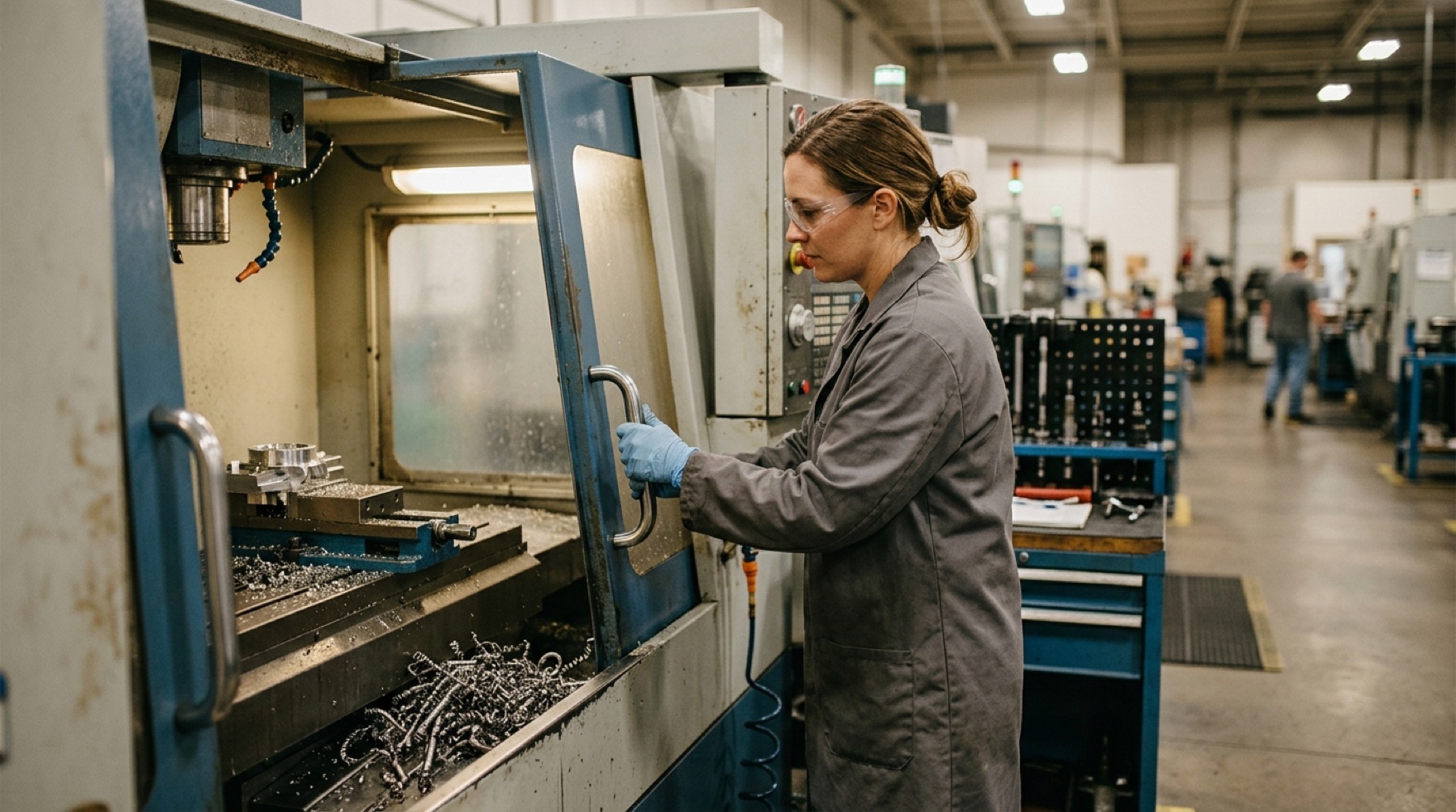
The short answer: A CNC machine must be guarded so a worker cannot reach the rotating chuck, workpiece, and cutting tool while it runs. In Canada that duty comes from provincial and territorial OHS regulations (federally regulated workplaces follow the Canada Labour Code Part II and the COHSR), and the recognized national reference for how to safeguard the machine is CSA Z432, "Safeguarding of machinery." Swarf and chips add a second hazard set: hot, very sharp material that CCOHS says to remove with a vacuum, brush, or rake, never by hand and never with the machine running. Reaching inside the guard to clear a jam or do maintenance is a lockout task under the province's hazardous-energy rules, referenced to CSA Z460.
What does Canadian law require for guarding a CNC machine?
The enforceable duty sits in the OHS regulation that governs the workplace, not in one national rule. Provincial regulations generally require that dangerous moving parts of machinery, such as a lathe or mill spindle, chuck, and cutting tool, be guarded so a worker cannot contact them during operation. In Ontario that duty is in Regulation 851 (Industrial Establishments); in British Columbia it is in the WorkSafeBC OHS Regulation Part 12 (Tools, Machinery and Equipment). Federally regulated employers carry the equivalent duty under the Canada Labour Code Part II and the COHSR.
The recognized national reference for how to meet that duty is CSA Z432, "Safeguarding of machinery." It frames safeguard selection around a risk assessment and sets out the range of options: fixed guards, interlocked guards, presence-sensing devices, and other safeguards matched to the hazard. CCOHS describes the same toolkit, from fixed guards kept in place by fasteners or welding to interlocked guards monitored by the control system that stop the machine when opened, along with presence-sensing devices, two-hand controls, and pullback devices. On a CNC turning center this typically means a full enclosure with an interlocked door that stops the cycle when the door is opened. CSA Z432 is a consensus standard rather than legislation, so it is applied through each province's machine-guarding regulation.
How does CCOHS say to handle chips and swarf?
CCOHS is direct about the mechanical hazards of metalworking machines: entanglement and pinch or crush points from moving parts, being struck by materials, chips, or swarf, burns from hot metal, plus noise, vibration, and the chemical exposure from fluids. Chips and swarf injure operators mainly during clearing and handling, not cutting, because they come off hardened, often hot, and sharp enough to cut a hand or forearm.
The handling rules CCOHS gives are specific. Use a vacuum, brush, or rake to remove cuttings, and do not handle cuttings by hand because they are very sharp. Stop the machine before measuring, cleaning, or making any adjustments. Do not free a stalled cutter without turning the power off first. And make sure guards are in position and in good working condition before operating, without bypassing them. Eye and face protection belongs in this list by design, since a machining operation produces flying particles continuously; the specific PPE requirement is set by the province's OHS regulation and, for eye and face protection, generally references CSA Z94.3.
| Task | Canada (per CCOHS guidance) | Standard / duty |
|---|---|---|
| Guarding the running machine | Enclose the cutting zone; fixed or interlocked guards so the operator cannot reach rotating parts | Provincial OHS reg (e.g. Ont. Reg. 851; WorkSafeBC Part 12); CSA Z432 |
| Removing chips and swarf | Vacuum, brush, or rake; never by hand (very sharp); stop the machine first | CCOHS metalworking guidance |
| Clearing a jam or stalled cutter | Turn off the power first; for reaching inside the guard, lock out | Provincial hazardous-energy rules; CSA Z460 |
| Eye/face protection | Required for the flying particles a machining operation produces | Provincial OHS reg; CSA Z94.3 |
When does clearing swarf become a lockout task?
An interlocked guard protects the operator during the automatic cycle, but it does nothing for the worker who opens the door to change a tool, clear a chip nest, or free a jammed conveyor, because at that moment the guard is intentionally defeated and the person is inside the danger zone. That gap is what lockout closes. Where servicing or maintenance exposes a worker to unexpected startup or stored energy, including reaching into the enclosure to clear swarf or work on the spindle, coolant drive, or chip conveyor, the machine is locked out rather than left paused at a stopped cycle.
The recognized national reference for that program is CSA Z460, "Control of hazardous energy - lockout and other methods," applied through each province's hazardous-energy provisions. Two rules keep a guarding program honest. First, interlocks are never bypassed to run the machine with the door open, because that removes the only barrier between the operator and the rotating stock the enclosure exists to contain. Second, any task that puts a hand past the guard moves from the interlock regime to the lockout regime. A chip conveyor moving under power has its own in-running nip points and is guarded and locked out under the same logic as the spindle.
The practical takeaway for a Canadian employer is to safeguard the machine to CSA Z432, handle swarf the way CCOHS sets out, lock out under CSA Z460 for anything reaching past the guard, and confirm the enforceable guarding, PPE, and hazardous-energy requirements with the OHS regulator that governs the workplace. The rotating chuck and workpiece behind a closed door are the hazard the whole program exists to keep hands away from.