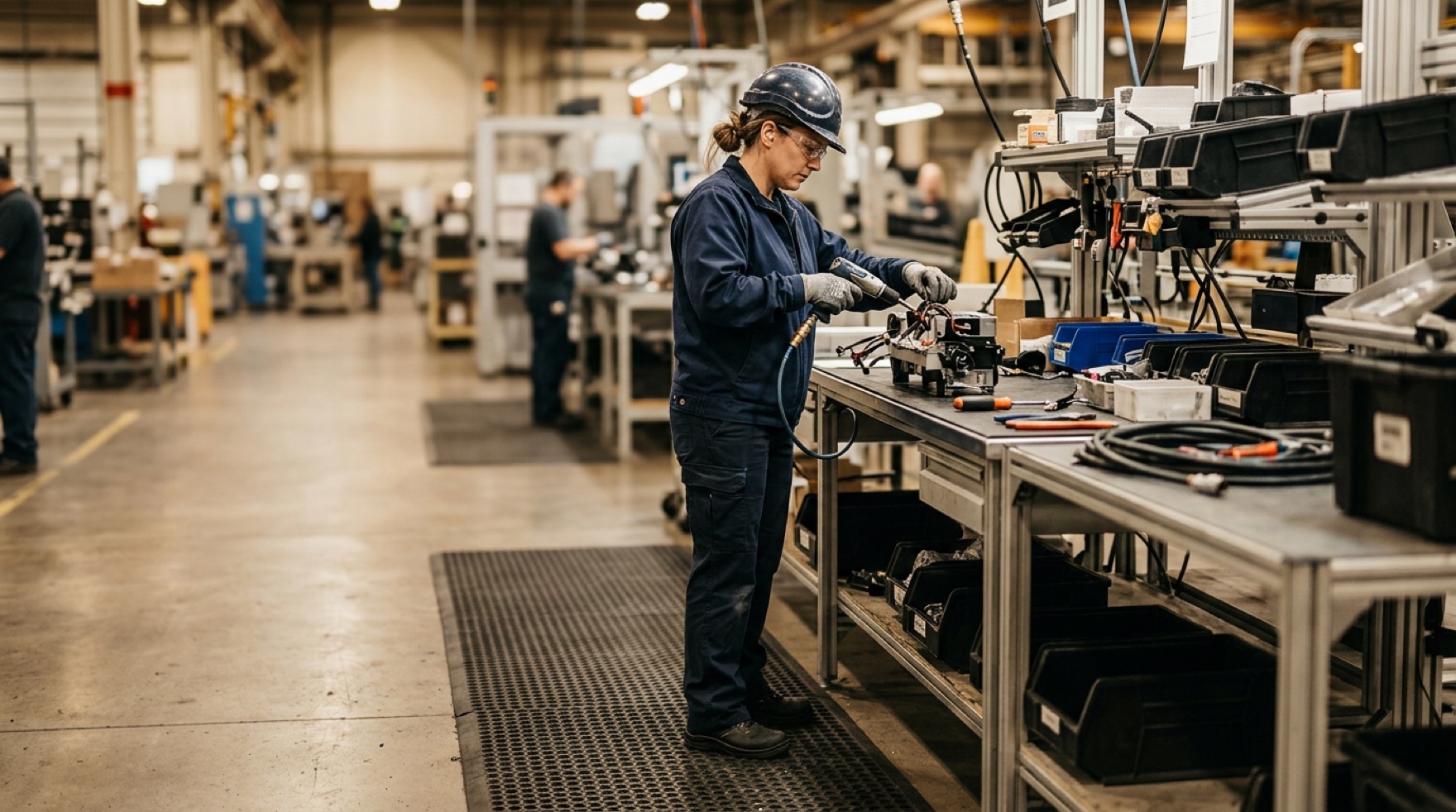
The short answer: An anti-fatigue mat cushions the shock of standing on a hard floor and reduces foot fatigue, but it is one control among several, not the answer to standing all day at an assembly station. CCOHS is explicit that providing a mat may not solve the whole problem, because discomfort after long hours of standing is the combined effect of the design of the work, the worker's footwear, and the flooring. That places matting below the stronger controls: removing the static standing through sit-stand options and job rotation, and designing the workstation so the operator is not locked in one posture. Used in that order, a mat is a useful final layer. Used as the only control, it treats a symptom while the cause stays in place.
Do anti-fatigue mats fix the problem of standing all day on the line?
No. A mat reduces the fatigue of standing on a hard surface, but it does not remove the static standing that causes the fatigue in the first place. CCOHS states plainly that discomfort, tiredness, and sore feet, legs, knees, or hips after long hours of standing are the combined effect of several factors, namely the design of the work, the worker's footwear, and the flooring material, in its guidance on anti-fatigue mats. A mat addresses one of those three.
That is the reason to place matting inside a hierarchy rather than reaching for it first. The strongest control is to break up the static standing itself: where the task allows it, giving the operator a seat so the job can be done either sitting or standing removes the continuous load, and rotating workers between standing and non-standing tasks spreads it across the shift. Redesigning the station so the operator shifts weight and changes posture comes next. Footwear, flooring, and a mat are the layers that make the remaining standing more comfortable, and they matter most once the stronger controls are in place.
How do anti-fatigue mats actually work?
An anti-fatigue mat works by absorbing some of the shock of standing and encouraging the small postural movements that keep blood moving. CCOHS describes the mechanism simply: anti-fatigue mats absorb the shock due to walking, and this cushioning effect reduces foot fatigue. The slight instability of a resilient surface also prompts subtle shifts in leg-muscle activity, which counteracts the blood pooling that static standing on concrete produces.
Because the mechanism is cushioning, the material and thickness matter, and more is not automatically better. CCOHS cautions that softer and thicker may not always be better, and recommends choosing a mat with some elasticity that is not so soft that a person feels unable to stand comfortably or stably. A mat that is too soft makes the legs work harder to stabilize, which can add fatigue rather than remove it, so the selection target is controlled resilience, not maximum plushness.
Anti-fatigue mats versus the alternatives: which control belongs where?
Rank the options by whether they remove the static standing or only cushion it, because that ranking decides where each belongs. The mat is worth having, but it earns its place after the controls above it, not instead of them. The table sets the options against what each one actually does.
| Control | What it addresses | Where it sits | Limitation |
|---|---|---|---|
| Sit-stand seating / job rotation | Removes or interrupts the static standing itself | First: the strongest control | Needs the task and line balance to allow a change of posture |
| Workstation redesign (height, reach, foot rail) | Lets the operator change posture and shift weight | Second: engineering the station | Requires adjustable or task-matched benches to do well |
| Resilient flooring (wood, cork, rubber) | Adds elasticity across the whole standing area | Third: the floor as a base layer | A fixed cost, harder to change than a mat once installed |
| Supportive footwear | Cushions and supports the foot the worker brings | Third: travels with the worker | Depends on the individual selecting and wearing suitable shoes |
| Anti-fatigue mat | Cushions shock at a fixed standing point | Final layer, once the above are set | Does not remove static standing; poor selection or edges add risk |
Read down the "where it sits" column and the logic is clear: the controls that remove the exposure come first, and the mat is the point-of-use comfort layer at the end. For an assembly station where the operator genuinely must stand in one spot, resilient flooring and a mat are reasonable, but they belong alongside sit-stand options and a well-set bench, which our piece on assembly-line ergonomics covers in full.
How do you choose and place a mat so it helps and does not become a trip hazard?
Choose a mat with controlled elasticity and sloped edges, and place it so it stays put and clears the traffic around the station. CCOHS advises that mats should not slip or create a trip hazard, and that they should have sloped edges, because sloped edges are less of a trip hazard and let carts roll over them more easily. A mat that solves foot fatigue but adds a fall risk has moved the hazard rather than reduced it.
Three practical criteria follow from that. First, match the resilience to the task, firm enough to stand and pivot on without wobble, soft enough to cushion, since CCOHS warns that softer and thicker is not always better. Second, size the mat to the operator's working area so they are not stepping on and off an edge on every cycle, and keep it clear of pedals and foot controls. Third, specify beveled, sloped edges and a non-slip underside, and inspect mats for curling or wear, because a lifted corner is the trip hazard the guidance warns about. Chosen and placed that way, a mat supports the standing worker without introducing a same-level fall risk.
Matting as part of the system
Anti-fatigue matting is a genuine comfort control, and on a station where standing cannot be designed out it is worth specifying well. What it is not is a substitute for the controls above it. The value comes from treating the mat as the last layer over a station that already lets the operator change posture, sit when the task allows, and stand on a floor and in footwear that support them. That is the combination CCOHS points to, and it is what protects the worker while keeping the line staffed by people who are not nursing sore feet and aching backs at the end of every shift.