The short answer: There is no OSHA standard that caps how much a worker may lift, so back-injury prevention in manual material handling is driven by risk assessment, not a single weight number. The recognized tool is the NIOSH Lifting Equation, which calculates a Recommended Weight Limit (RWL) for a specific lift by taking a 51-pound load constant and reducing it for the geometry of the task, then expresses the result as a Lifting Index (LI), the actual load divided by the RWL. An LI above 1.0 means the lift exceeds the recommended limit; an LI at or above 3.0 means it exceeds what most healthy workers can safely handle. Because those figures are advisory, employers still address heavy-lifting hazards under the General Duty Clause, Section 5(a)(1) of the OSH Act.
Does OSHA set a maximum weight a worker can lift?
No. OSHA has stated plainly that it "does not have a standard which sets limits on how much a person may lift or carry," in interpretation letters issued both in March 2004 and again in June 2013. That absence is often misread as the hazard being unregulated. It is not. The same letters explain that employee exposure to heavy-lifting and back-injury hazards may be addressed under Section 5(a)(1) of the OSH Act, the General Duty Clause, which requires each employer to furnish a workplace free from recognized hazards likely to cause death or serious physical harm.
That means a manual-handling program cannot hide behind the lack of a numeric limit. The operational implication is that the employer has to identify the recognized hazard, usually with a task assessment, and control it. OSHA's own guidance points to the NIOSH criteria as the accepted way to do that assessment, while noting the NIOSH numbers are advisory rather than mandatory. In other words, the method is optional but having some defensible method is not.
What is the NIOSH Lifting Equation, and what does it calculate?
The NIOSH Lifting Equation estimates the heaviest load a specific two-handed lift should carry, and it does so by starting from an ideal lift and penalizing every way the real task departs from it. As reproduced in the OSHA Technical Manual, Section VII, Chapter 1, the Recommended Weight Limit is calculated as RWL = LC x HM x VM x DM x AM x FM x CM. The load constant (LC) is 51 pounds, the weight NIOSH treats as acceptable under otherwise ideal conditions, and each multiplier is a fraction between 0 and 1 that pulls that 51 pounds downward.
The point the equation makes, and the reason it is worth the trouble, is that weight is only one factor. A load held far from the body, lifted from the floor, or twisted to the side is far more punishing than the same weight lifted close and upright. The multipliers put numbers on exactly those geometry penalties.
| Term | What it accounts for | Value or formula |
|---|---|---|
| LC | Load constant: acceptable weight under ideal conditions | 51 lb |
| HM | Horizontal multiplier: how far the hands are from the body (H, inches) | 10 / H |
| VM | Vertical multiplier: hand height at the start of the lift (V, inches) | 1 - (0.0075 x |V - 30|) |
| DM | Distance multiplier: vertical travel of the load (D, inches) | 0.82 + (1.8 / D) |
| AM | Asymmetric multiplier: twisting angle of the lift (A, degrees) | 1 - (0.0032 x A) |
| FM | Frequency multiplier: lifts per minute and how long the work lasts | NIOSH lookup table |
| CM | Coupling multiplier: quality of the grip or handholds | NIOSH lookup table |
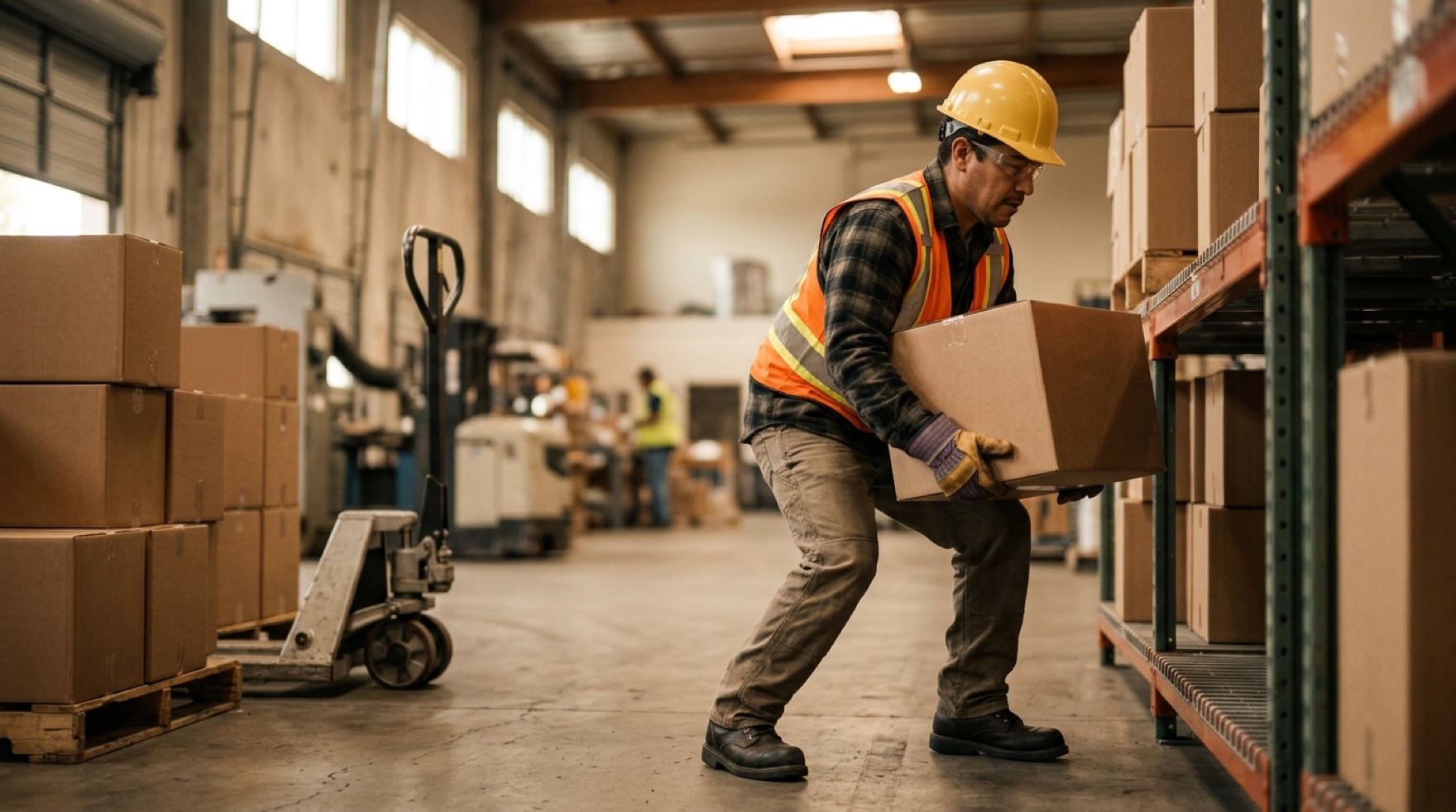
Reading the table top to bottom is a decent hazard checklist on its own. A carton with no handholds, pulled from a low pallet at arm's length and swung onto a bench behind the worker, fails on the horizontal, vertical, asymmetry, and coupling terms at once, and the RWL collapses accordingly.
It helps to know what the equation does not cover, so it is applied where it fits. The method is built for two-handed lifting of a load in reasonably controlled conditions, and it does not evaluate one-handed lifts, carrying, pushing, pulling, or lifting done in high heat or on unstable footing. Those tasks carry real back risk too; they simply need a different assessment. Running the equation is a measurement exercise, not a guess: someone observes the task and records the hand distance, the start and end heights, the twist angle, the lift frequency and duration, and the grip quality, then reads the multipliers and computes the RWL. That discipline is what makes the result defensible if an inspector or a workers' compensation claim later asks how the task was judged.
How do you read the Lifting Index?
The Lifting Index turns the RWL into a single risk signal by dividing the weight actually lifted by the RWL for that task. An LI of 1.0 or below means the lift sits within the recommended limit for nearly all healthy workers; the OSHA Technical Manual notes that a value greater than one indicates the lifted weight exceeded the RWL, and a value greater than three indicates the weight exceeds the capacity to safely lift for most of the working population. The 2004 interpretation letter puts the upper end more bluntly: a lifting index greater than 3.0 can clearly be linked to an increased risk of back and other injuries.
A worked example shows why a "light" box can still fail. Picture a 35-pound carton lifted from a low pallet: hands about 12 inches from the body (HM = 10 / 12 = 0.83), starting height about 15 inches off the floor (VM = 1 - 0.0075 x 15 = 0.89), traveling roughly 45 inches up to a shelf (DM = 0.82 + 1.8 / 45 = 0.86), no twist (AM = 1.0), lifted only occasionally with good handholds (FM and CM near 1.0). The RWL works out to about 51 x 0.83 x 0.89 x 0.86, or roughly 32 pounds. The Lifting Index is 35 divided by 32, about 1.1. The load is only 35 pounds, well under the 51-pound constant, yet the task still exceeds its recommended limit because it is fought from the floor and away from the body. That is the insight a raw weight limit would miss entirely.
Which factors actually drive back injuries in manual handling?
Back disorders in manual handling are cumulative, and they track the same task factors the equation penalizes. The OSHA Technical Manual lists the conditions associated with back injuries directly: heavy lifting, reaching while lifting, bending while lifting, twisting while lifting, repetitive lifting, and poor posture or body mechanics. None of those is a one-time event. They are exposures that accumulate across a shift and across months, which is why a back injury usually has no single dramatic cause to investigate, only a task that was loaded past what the tissue could tolerate over time.
That cumulative character is also why the highest-volume back-injury risk lives in ordinary freight work: replenishment, case picking, palletizing, and unloading, where the same reach and the same twist repeat thousands of times. The operational implication is that you find these hazards by watching the task frequency and geometry, not by waiting for an incident report. A pick face where every carton is dragged from the bottom of a pallet is generating risk on every lift, whether or not anyone has been hurt yet.
How do you design manual handling to protect backs?
The reliable fix is to change the task so the RWL rises and the LI falls, because that removes the exposure rather than asking the worker to tolerate it. Work down the same multipliers that created the risk: raise the load's origin so the worker is not lifting from the floor, bring the load closer to reduce the horizontal reach, cut the vertical travel, and remove the twist by repositioning where the load lands. Each of those is an engineering change that improves a term in the equation, and together they move an over-limit task back under an LI of 1.0.
Where the geometry cannot be fixed, take the lift away from the spine. Pallet positioners and lift tables keep the load near waist height as a pallet is built down, powered stackers and vacuum or hoist assists carry the weight, and better packaging with real handholds improves the coupling term. Reducing lift frequency, through rotation or by cutting the number of touches in the process, improves the frequency term. Administrative measures such as team lifting and lifting technique have a place, but they sit at the bottom of the hierarchy because they depend on a tired worker doing the right thing on every repetition. The goal is a workplace where the equation, not the worker's willpower, keeps the load within limits.