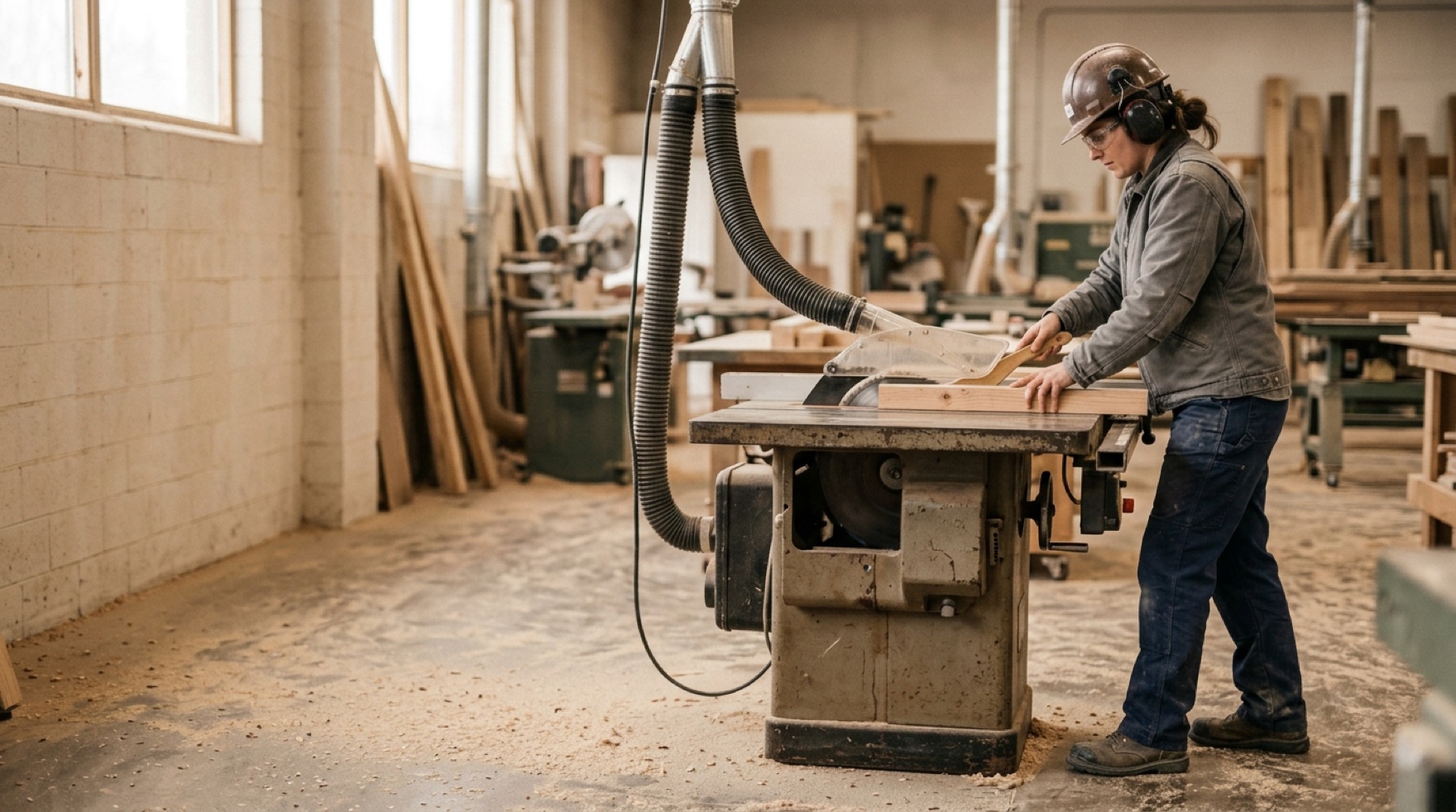
The short answer: Woodworking machine guarding in Canada is set by each province's or territory's OHS regulation, with federally regulated workplaces covered by the Canada Labour Code Part II and the COHSR. Those regulations require that any exposed blade, cutterhead, or pinch point that could injure a worker be guarded, and that a machine not run with a guard removed or defeated. The recognized national reference for how to safeguard a machine is CSA Z432 Safeguarding of machinery (current edition Z432:23), and the companion standard for controlling energy during service is CSA Z460 Control of hazardous energy - Lockout and other methods (current edition Z460-20). CCOHS provides the practical guidance for saws, jointers, and kickback. The rule underneath all of it is the same everywhere: the guard is on and working before the blade turns.
Who sets machine-guarding rules for woodworking in Canada?
The duty comes from the jurisdiction that governs the workplace, not from one national standard. Provincial and territorial OHS regulations require that machinery with an exposed moving part capable of injuring a worker be equipped with a guard, and that guards stay in place while the machine operates. Ontario Regulation 851 (Industrial Establishments) and the WorkSafeBC OHS Regulation Part 12 (Tools, Machinery and Equipment) are typical examples of the provincial rules that reach saws, jointers, and other woodworking machinery. Federally regulated employers carry an equivalent duty under the Canada Labour Code Part II and the COHSR. Confirm the specific guarding and lockout provisions with the regulator that governs your site, because the wording and the detail differ from one jurisdiction to the next.
What does CSA Z432 require?
CSA Z432 Safeguarding of machinery is the standard employers map their guarding to when they need to show the "adequately guarded" condition a provincial regulator expects. It sets out a risk-assessment method and then the selection and application of guards and protective devices. CCOHS describes the guard types that Z432 recognizes: a fixed guard held in place permanently or with fasteners; an adjustable guard that can be set as a whole or in part; an interlocked guard that stops the hazardous motion when it is opened; and a self-adjusting guard that lets the workpiece pass and then returns to the closed position. The last of these is exactly what a table-saw blade hood does.
Guard selection follows the hierarchy of controls: elimination, substitution, engineering controls (which is where guards and interlocks sit), administrative controls, and personal protective equipment. The point, in CCOHS's words, is to "protect workers from contact with moving parts or other similar unsafe conditions." Mapping a machine to CSA Z432 gives an employer a defensible record that the guard chosen was the right type for the hazard, which is what a regulator looks for after an incident.
How does Canada guard against saw kickback?
Kickback is the saw seizing the stock and hurling it back toward the operator, and it is one of the most common serious injuries in the trade. CCOHS guidance for table saws is concrete: use "a guard with a spreader (riving knife) and anti-kickback fingers for all ripping or cross cutting operations," and keep "the body and face to one side of the saw blade out of the line of a possible kickback." The three devices do different jobs. The blade guard limits contact and confines flying pieces. The spreader, or riving knife, holds the cut open so the wood cannot pinch the blade and be launched. The anti-kickback fingers bite down to resist stock being picked up and thrown.
CCOHS also targets the conditions that cause a bind in the first place: keep blades clean, sharp, and correctly set so they cut freely without the operator forcing the workpiece, and do not cut stock with loose knots, splits, or embedded foreign objects. For radial arm saws, CCOHS advises against ripping unless the spreader and anti-kickback devices are fitted and properly adjusted. The guarding does not prevent every bind, but it limits the outcome when one happens, which is why the standard treats these devices as required rather than optional. Removing one for a clearer view of the cut line is precisely the configuration that turns a bind into an amputation.
What about lockout during blade changes and maintenance?
Guarding stops contact while a machine runs; lockout stops the machine from starting while a worker's hands are in it. Provincial OHS regulations require the control of hazardous energy during servicing, blade changes, and clearing jams, and the recognized national reference is CSA Z460 Control of hazardous energy - Lockout and other methods. CCOHS, citing CSA Z460-20, describes hazardous energy as "any electrical, mechanical, hydraulic, pneumatic, chemical, nuclear, thermal, gravitational, or other energy that can harm personnel," and points to the standard's risk-assessment process for deciding when a full zero-energy lockout is required and when other controls apply. Lockout is generally the most reliable method where a zero-energy state is achievable, which covers most blade and cutterhead work on woodworking machines. The enforceable lockout duty and the required written procedures are set by each jurisdiction, so confirm them with your regulator.
| Element | Canada (most workplaces) | Source of the duty |
|---|---|---|
| Governing law | Provincial/territorial OHS regulation (e.g. Ontario Reg. 851; WorkSafeBC OHS Regulation Part 12); federal = Canada Labour Code Part II + COHSR | Provincial OHS regulator / ESDC Labour Program |
| Safeguarding reference | CSA Z432:23 Safeguarding of machinery: risk assessment, guard selection, fixed/adjustable/interlocked/self-adjusting guards | CSA Group; described by CCOHS |
| Saw kickback controls | Blade guard, spreader (riving knife), and anti-kickback fingers for ripping and crosscutting; stand out of the line of kickback | CCOHS woodworking machines guidance |
| Energy control for service | Lockout for blade changes and jam clearing, built around CSA Z460-20 | Provincial OHS regulation; CCOHS; CSA Z460 |
| Core duty | Guard in place and working before the machine runs; not removed for convenience | Provincial OHS regulation |
The practical takeaway for a Canadian employer is to build the guarding program to CSA Z432, wire in lockout under CSA Z460 for every blade change and jam, and follow CCOHS's concrete rules for spreaders, anti-kickback fingers, and operator position on saws. Then confirm the enforceable guarding and lockout provisions with the provincial, territorial, or federal OHS regulator that governs the workplace. After an incident, that is what a regulator will look for: evidence that the machine was adequately guarded, that the guard was in place when the blade turned, and that energy was locked out before anyone reached in.