The short answer: Collision prep exposes a technician to respirable sanding dust and to high noise, and Canada regulates the two on separate tracks, both split between provincial and federal jurisdiction. For noise, CCOHS reports the criterion level for a full 8-hour shift is 85 dBA in most jurisdictions with a 3 dB exchange rate (the permitted time halves for every 3 dBA increase); the federal jurisdiction is the main exception at 87 dBA. That is stricter than the US limit of 90 dBA with a 5 dB exchange rate. For sanding dust, provincial and federal OHS rules on hazardous substances require exposure to airborne dust from filler, primer and paint to be controlled, with the exposure limit set jurisdiction by jurisdiction. The same controls, dust extraction at the tool and quieter work practices, push down both exposures at once.
Treat the prep bay as one workspace with two exposure clocks running. The table below sets the noise and dust hazards side by side so a shop can see which track each answers to, what the common Canadian figures are, and where the controls overlap.
| Noise | Sanding & filler dust | |
|---|---|---|
| Shop sources | Orbital and DA sanders, grinders, air tools, panel hammering, the compressor | DA sanding body filler and primer, block sanding, grinding, dry sanding on the prep deck |
| Governing rules | Provincial OHS noise regulations (e.g. Ontario Reg. 381/15; WorkSafeBC OHS Reg. Part 7; Alberta OHS Code Part 16); COHSR Part VII for federal workplaces | Provincial OHS regulations on hazardous substances/dust; COHSR for federal workplaces |
| Common Canadian figure | 85 dBA criterion for an 8-hour shift, 3 dB exchange rate (most jurisdictions); 87 dBA in the federal jurisdiction | Exposure limit set by each jurisdiction, generally based on ACGIH TLVs; no single national number |
| Lead control | Quieter tools, distance and shorter runs; hearing protection where exposure cannot be brought down | Capture dust at the source with on-tool extraction or local exhaust; respirator where dust is not adequately controlled |
How does Canada regulate noise, and how much does collision work make?
Grinders, orbital sanders and air tools in a body shop can push daily noise exposure past the level at which Canadian OHS rules bite. CCOHS reports that in most Canadian jurisdictions the criterion level for a full 8-hour shift is 85 dBA with a 3 dB exchange rate, meaning the permitted exposure time halves for every 3 dBA increase above the criterion. The federal jurisdiction is the main exception, with a criterion of 87 dBA and the same 3 dB exchange rate. Because the exact figure and the recordkeeping duties are set by each province and territory, examples of the governing rules include Ontario Regulation 381/15 (Noise), the WorkSafeBC OHS Regulation Part 7, and Alberta OHS Code Part 16, with COHSR Part VII covering federal workplaces. The employer's duty in each case is to assess the noise, apply engineering and administrative controls, and provide hearing protection where exposure cannot be brought below the limit.
One point is worth stating plainly for a shop that works from US material. The common Canadian criterion of 85 dBA with a 3 dB exchange rate is more protective than the US permissible exposure limit of 90 dBA with a 5 dB exchange rate. A 3 dB exchange rate reflects that doubling the sound energy should halve the allowed time, so daily doses add up faster than the US 5 dB rule would suggest. A tech leaning on a grinder or DA sander for much of a shift can cross the 85 dBA criterion without it feeling remarkable, which is why the exposure has to be measured rather than judged by ear.
How is the noise exposure measured?
CCOHS calls measuring noise levels and workers' exposures the most important part of a hearing conservation and noise control program, and it points to two instruments. A sound level meter gives an instantaneous reading, taken on the SLOW response setting with the A-weighting filter, and a Type 2 meter is accurate enough for industrial field evaluations. A noise dosimeter is worn by the worker and averages the exposure over the shift, which suits a body shop where noise varies in duration and intensity as tools start and stop. The dosimeter is set to the criterion level and exchange rate in the governing regulation, which CCOHS gives as 85 dBA for all jurisdictions except 87 dBA for the federal jurisdiction, with a 3 dB exchange rate or as specified in the noise regulation. The result is compared against the criterion to decide whether hearing protection and a hearing conservation program are required.
What is in collision sanding dust, and what limit applies?
Cured body filler, primer surfacer and clearcoat sanded dry generate fine respirable dust, and provincial and federal OHS rules on hazardous substances require exposure to that airborne dust to be controlled. As with chemical agents generally, the exposure limit for the dust is set jurisdiction by jurisdiction and is generally based on the ACGIH TLV the regulation adopts, so this article does not state a single national number. Read the applicable dust limit from the OHS regulation that governs your shop. CCOHS frames the response as a hierarchy of controls: cut the dust at the source with tools that have built-in extraction or local exhaust ventilation, keep the shop clean, and use suitable respiratory protection where dust is not adequately controlled.
What is in the coating can change the picture. Some body filler dusts and hardeners are skin irritants or sensitisers, so gloves and skin protection matter alongside respiratory controls, and the WHMIS 2015 safety data sheet for the product is where those hazards are set out. Sanding a repaint that contains lead, or a primer built on a chromate pigment, releases a separately regulated substance with its own lower limit and controls, which is another reason to read the SDS and paint history before dry-sanding a panel. Capturing the dust at the tool protects the tech either way, which is why the control comes before the classification.
Which controls handle both the dust and the noise?
The efficient move for a body shop is to pick controls that cut dust and noise together, then add PPE for what is left. Engineering and work practice come first for both hazards, because a respirator and a set of earmuffs are the last layer, not the plan.
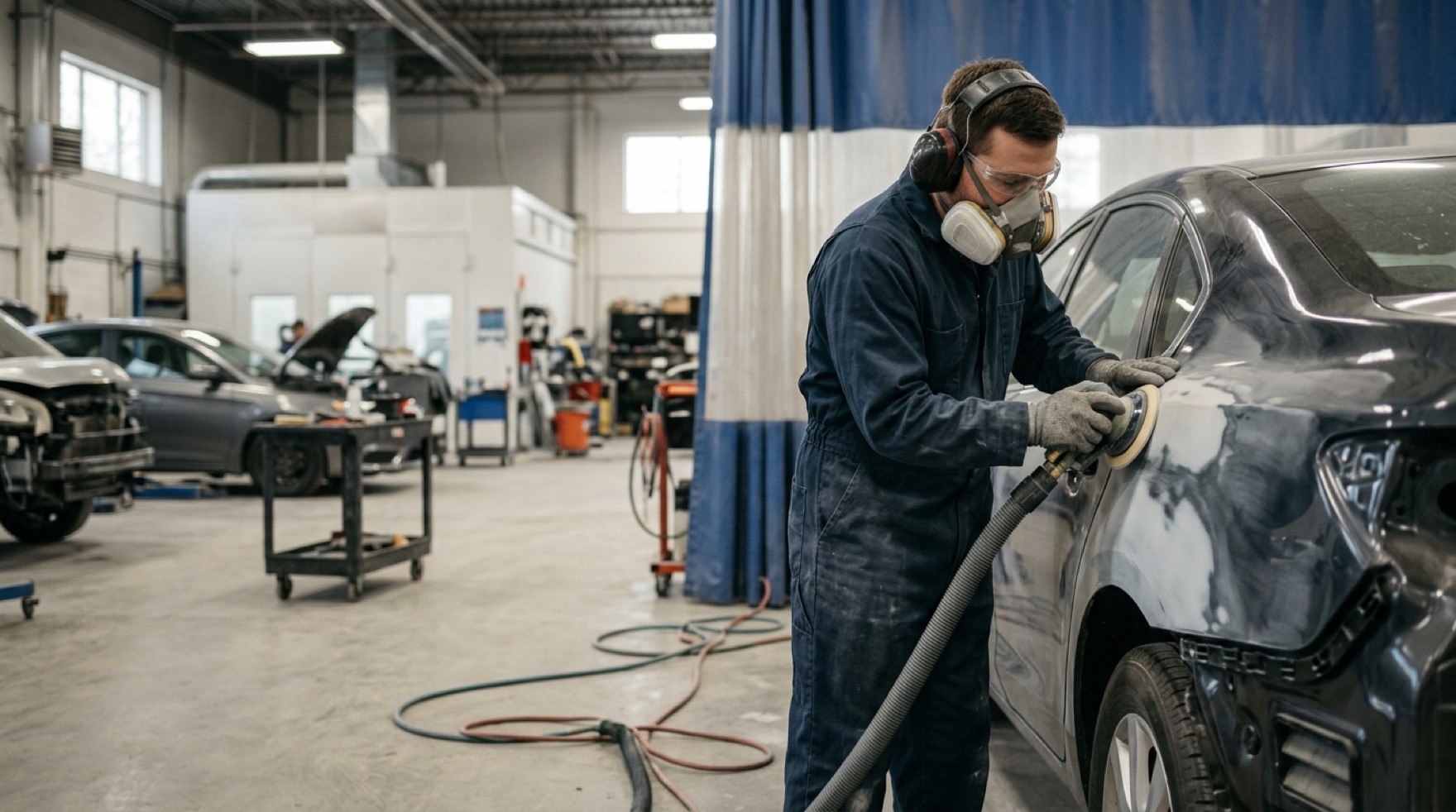
- Capture the dust at the tool. Sanders and grinders with built-in (on-tool) extraction connected to a suitable dust extractor pull respirable dust off the panel before it reaches the breathing zone, and a ventilated prep station or downdraft prep deck carries away what escapes. This is the control that most directly reduces the airborne dust the exposure limit is measured against.
- Lower the noise at the source. Well-maintained and quieter air tools, sharp abrasives that cut faster with less dwell time, isolating the compressor, and not running a grinder longer than the job needs all reduce the dose that feeds the 85 dBA criterion. Distance helps too, since noise falls off quickly as a tech steps away from another running tool.
- Fit the right respirator. Where dust controls are not enough, a properly selected particulate respirator worn inside a program with fit testing and training protects against the respirable dust. A dust respirator does nothing for isocyanate spraying, which requires an air-supplied respirator in its own program.
- Protect hearing and verify it. Hearing protectors with a noise reduction rating matched to the measured exposure, plus the audiometric testing the jurisdiction's hearing conservation requirements call for, catch a hearing threshold shift early. The audiogram is the signal that the controls or the protectors are not keeping up.
Run that way, the prep bay answers both tracks with mostly the same equipment. Dust extraction and a ventilated station carry the respirable fraction below the applicable limit, quieter tools and shorter runs pull the noise dose toward the criterion, and the respirator and hearing protectors backstop whatever the engineering controls miss. Because the exact noise criterion, exchange-rate details and dust-control duties are set province by province, confirm the figures and recordkeeping rules with the OHS regulator that governs your workplace. These are not two programs competing for budget; they are one prep-bay upgrade that protects a tech's lungs and hearing across a full career of collision work.