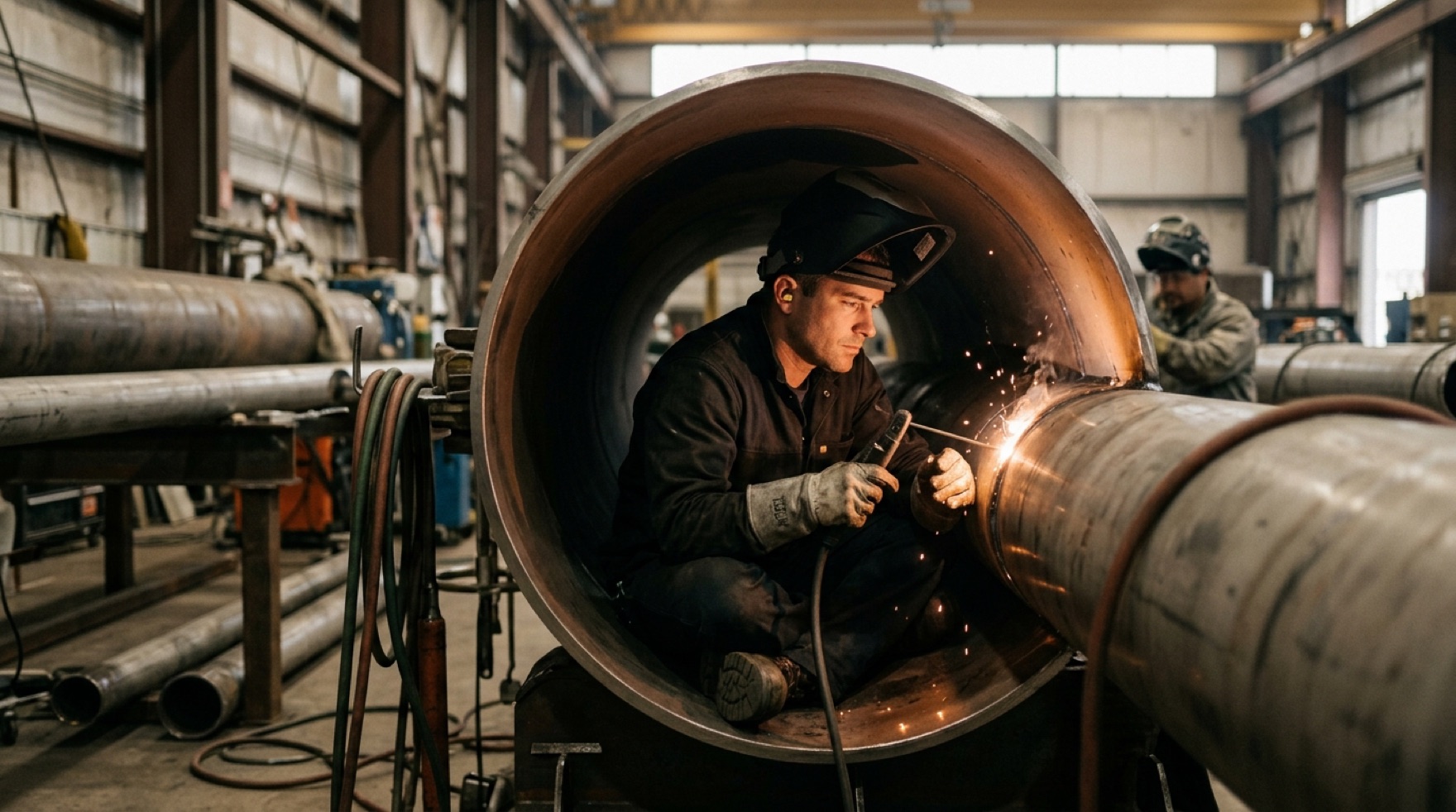
The short answer: Brazing, soldering, cutting, and welding pipe are all hot work, and doing that work inside a vault, tank, vessel, boiler, or manhole combines an ignition source with a confined space that can hold flammable vapour, too little or too much oxygen, or a toxic atmosphere. Canada splits this by jurisdiction: most workplaces follow their province's or territory's OHS act and confined-space regulation (for example WorkSafeBC OHS Regulation Part 9, or Ontario Regulation 632/05), while federally regulated workplaces follow the Canada Labour Code Part II and COHSR Part XI. CSA Z1006, "Management of work in confined spaces," is the recognized national reference for the entry program, and hot work adds a permit and fire watch on top of it. Test and control the atmosphere before any flame or arc goes in, and run both permits together.
Who sets the rules for pipefitting hot work in a confined space in Canada?
The duty comes from the jurisdiction that governs the workplace, not from one national standard. Most employers fall under their province's or territory's OHS act and its confined-space regulation, and the details differ from one jurisdiction to the next. British Columbia sets its confined-space duties in the WorkSafeBC OHS Regulation Part 9; Ontario sets them in Regulation 632/05 (Confined Spaces) under the Occupational Health and Safety Act. Federally regulated workplaces, such as interprovincial pipelines, rail, and marine terminals, fall instead under the Canada Labour Code Part II and the Canada Occupational Health and Safety Regulations (COHSR) Part XI, Confined Spaces.
Sitting across all of them is CSA Z1006, "Management of work in confined spaces," which sets out how to build the program that these regulations require: hazard assessment, the entry-permit system, atmospheric testing and ventilation, the attendant and entry roles, and rescue. Regulators generally expect a confined-space program without prescribing every element themselves, so employers map their program to CSA Z1006 to show the work was planned and controlled. CCOHS provides plain-language guidance on confined spaces and hot work, but CCOHS is guidance, not law: the enforceable requirement is whatever your regulator sets. Confirm the permit, testing, and recordkeeping duties with the OHS regulator that governs your site.
When does a pipefitting job become a confined space?
A space is a confined space when it is fully or partially enclosed, has limited or restricted entry or exit, is not designed for continuous human occupancy, and can create a hazard from its atmosphere, its contents, or the work being done. CCOHS advises treating every confined space as hazardous until a competent person has determined otherwise through a risk assessment. On a pipefitting job, mechanical vaults, boilers, digesters, wet wells, sumps, pits, tanks, and large-diameter pipe routinely meet that definition, and introducing hot work raises a flammable-atmosphere hazard on its own.
Before anyone enters, the space has to be assessed by a competent person and the atmosphere tested from outside for oxygen content, flammable gas or vapour, and toxic contaminants, sampling side to side and top to bottom because gases stratify. Natural ventilation is not reliable, so mechanical ventilation is usually needed and its use is noted on the entry permit. A trained attendant stays outside and keeps contact with the workers inside, and rescue arrangements have to be ready before entry, not improvised after an alarm. WorkSafeBC Part 9 requires that pre-entry testing be completed not more than 20 minutes before a worker enters, and repeated when workers have been out of the space for more than 20 minutes; other provinces set their own timing, so check the regulation that applies to you.
What does the hot-work side require before you strike an arc or light a torch?
Hot work adds an ignition source, so the fire hazard has to be removed or controlled, the work authorized under a permit, and a fire watch posted. CCOHS bases its hot-work guidance on NFPA 51B, "Fire Prevention During Welding, Cutting, and Other Hot Work," and points to a permit program that moves flammable and combustible materials away from the work area, confirms equipment is in good order, and eliminates explosive atmospheres or does not allow the work to proceed. The permit is the checkpoint where someone other than the person holding the torch confirms conditions are safe. In Canada the welding process itself is governed by the CSA W117.2 series on safety in welding, cutting, and allied processes, and the general fire-safety backdrop is the National Fire Code of Canada as adopted and amended by each province.
The fire watch is the control that catches what the permit cannot predict. CCOHS advises posting a trained fire watcher in the work area and keeping the watch for at least 60 minutes after the work has stopped, and depending on the work up to three or more hours, because slag and heated metal keep smouldering fuel alive well past the last spark. The watcher needs fire-extinguishing equipment on hand and training to use it. On a pipefitting job the fire zone reaches farther than it looks: sparks fall through floor penetrations and pipe chases into the level below, so the combustibles to clear and watch include the ones out of sight beneath the work.
How do the confined-space and hot-work controls combine?
They are two programs that have to be reconciled before entry, not one document standing in for the other. The confined-space entry permit confirms the atmosphere is acceptable and stays monitored while people are inside; the hot-work permit confirms the fire hazard is controlled and a fire watch is posted. Neither is valid on its own when both hazards are present, which is why pipefitting hot work inside a confined space in practice triggers both a confined-space entry permit and a hot-work permit that run together.
Sequence and ventilation tie them together. The atmosphere is tested and made acceptable first, the space is ventilated continuously while the work runs, and the flammable reading is re-checked because hot work itself changes the atmosphere, burning off coatings, driving vapour out of scale and residue, and consuming oxygen. Provincial rules tighten the flammable-atmosphere control that hot work depends on. Under WorkSafeBC OHS Regulation Part 9, flammable gases and vapours must be kept below 20 percent of the lower explosive limit and all ignition sources eliminated or adequately controlled (section 9.28), only non-sparking tools may be used where flammable or explosive gases, vapours, or liquids are present (section 9.51), and torches and hoses used for welding, brazing, or cutting must, when practicable, be removed from the space when not in use and when the space is vacated (section 9.49). Those exact numbers are British Columbia's; other jurisdictions set their own, so confirm the flammable-limit threshold and tool rules with your own regulator.
| Control | Canada (most workplaces) | Source of the duty |
|---|---|---|
| Governing law | Provincial/territorial OHS act + confined-space regulation (e.g. WorkSafeBC OHS Reg. Part 9; Ontario Reg. 632/05); federal = Canada Labour Code Part II + COHSR Part XI | Provincial OHS regulator / ESDC Labour Program |
| Program reference | CSA Z1006, "Management of work in confined spaces" | CSA Group; referenced by CCOHS |
| Atmospheric testing | Test oxygen, flammable gas, and toxics before entry; keep flammable vapour below 20% LEL (BC s.9.28); re-test on re-entry | Provincial OHS regulation; CCOHS |
| Hot-work fire watch | Trained watcher held at least 60 minutes after work stops, longer where fire could still develop | CCOHS, based on NFPA 51B |
| Two permits | Confined-space entry permit and hot-work permit run together, not one instead of the other | Provincial OHS regulation; CCOHS |
The durable protection for a Canadian pipefitting crew is a written procedure that treats hot work and confined-space entry as a single planned operation: isolate and clean the line or vessel so no flammable material is present, assess and test the atmosphere before anyone enters, ventilate continuously and re-test as the work changes the air, clear and watch the fire zone including the level below, and keep the fire watch running until the metal is cold. Build that program to CSA Z1006, then confirm the specific permit, atmospheric-limit, and fire-watch rules with the provincial, territorial, or federal OHS regulator that governs the workplace. That is what a regulator will look for after an incident: evidence the atmosphere was proven and the ignition source was controlled before the two were ever in the same space.