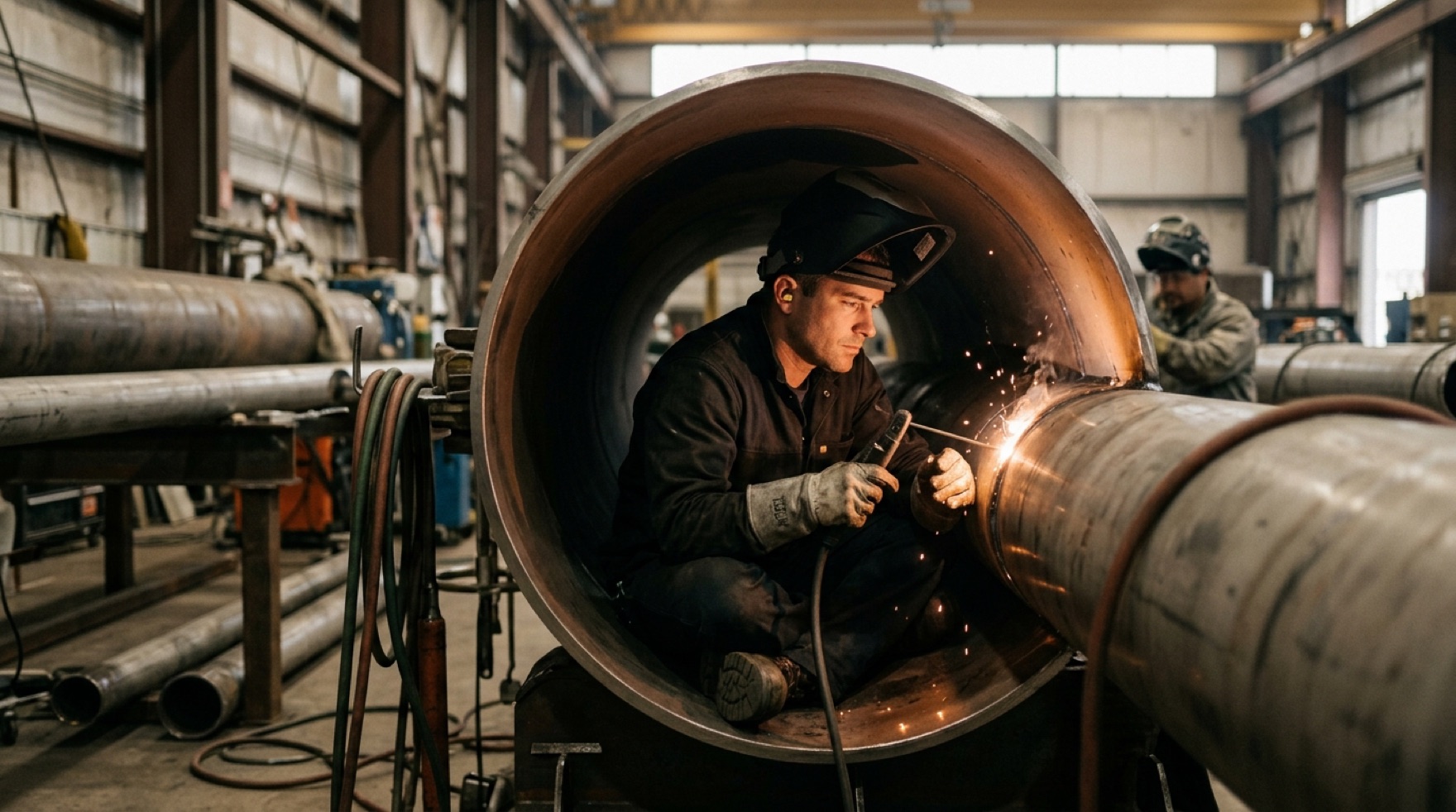
The short answer: Brazing, soldering, cutting, and welding pipe are all hot work, and when that work happens in or on a vault, tank, vessel, or manhole, two hazards converge: an ignition source and a confined space that can hold a flammable, toxic, or oxygen-deficient atmosphere. NFPA 51B and OSHA 29 CFR 1910.252(a) govern the fire side through a hot work permit, a cleared 35-foot zone, and a fire watch. 29 CFR 1910.146 governs the confined-space side through atmospheric testing, an attendant, and an entry permit. On a pipefitting job that involves both, you need both permits, and the atmosphere has to be tested and controlled before any flame or arc is introduced.
Why is hot work in pipefitting so dangerous around confined spaces?
Because the same job routinely supplies both halves of an explosion: a source of ignition and a space that can accumulate fuel. Pipefitting is hot work by nature. Sweating a copper joint, brazing a refrigerant line, cutting cast iron with a torch, or welding a steel riser all produce open flame, sparks, slag, and surfaces hot enough to ignite a vapor long after the tool is set down. Move that work into a mechanical vault, a boiler, a process vessel, a sump, or a manhole, and the second half is waiting: a confined space that is not designed for continuous occupancy and can hold flammable vapor, displace oxygen, or carry a toxic atmosphere from whatever the line last moved.
The reason this combination is so lethal is that each control assumes the other hazard is handled. A fire watch assumes the atmosphere is breathable. Atmospheric testing assumes no one is about to add an ignition source that changes the space faster than the meter can react. When a pipefitter carries a torch into a space that was never gas-freed, both assumptions fail at once, which is exactly the scenario the two governing standards are written to keep from happening.
What does OSHA require before you strike an arc or light a torch?
Before hot work starts, the fire hazard has to be removed or controlled, the work authorized, and a fire watch put in place. 29 CFR 1910.252(a)(2)(iv) requires that the area be inspected by the individual responsible for authorizing cutting and welding operations, with authorization to proceed preferably in the form of a written permit. That written permit is the practical form of the NFPA 51B system, in which a designated permit authorizing individual confirms the area is safe before hot work begins and again after it ends. The permit is not paperwork for its own sake: it is the checkpoint where someone other than the person holding the torch confirms the conditions.
The standard then sets the fire-watch rules. Under 1910.252(a)(2)(iii)(A), a fire watch is required wherever combustible material is closer than 35 feet to the point of the work, or where combustibles farther away could be ignited by sparks. Under 1910.252(a)(2)(iii)(B), the fire watcher must have fire-extinguishing equipment ready, be trained in its use, and maintain the watch for at least a half hour after the work is finished, because slag and heated metal keep smoldering fuel alive well past the last spark. On a pipefitting job the 35-foot rule reaches farther than it looks: sparks fall through floor penetrations and pipe chases into the level below, which is where an unwatched combustible often sits.
Hot work on pipe that has carried flammable product carries its own rule. 1910.252(a)(3)(i) prohibits welding, cutting, or other hot work on used drums, barrels, tanks, or other containers until they have been cleaned so thoroughly as to make certain no flammable materials are present, and it requires pipe connections to be disconnected or blanked. 1910.252(a)(3)(ii) requires hollow spaces, cavities, and containers to be vented before preheating, cutting, or welding, and recommends purging with inert gas. In plumbing and pipefitting terms, that means a line or vessel that held fuel, solvent, or process liquid is not ready for a torch until it is cleaned, isolated, and vented, no matter how empty it looks.
When does a pipefitting job become a permit-required confined space?
A space becomes a permit-required confined space the moment it is large enough to enter, has limited entry or exit, is not meant for continuous occupancy, and carries a serious atmospheric or physical hazard. 29 CFR 1910.146(b) defines a confined space by those first three characteristics and makes it permit-required when it also contains or can contain a hazardous atmosphere, could engulf an entrant, or has a shape that could trap or asphyxiate. Mechanical vaults, boilers, digesters, wet wells, pits, and large-diameter pipe all routinely meet that definition on a pipefitting job, and adding hot work to any of them raises a flammable-atmosphere hazard on its own.
When the space is permit-required, the atmosphere has to be tested before entry and in a fixed order. 1910.146(d)(5)(iii) requires testing first for oxygen, then for combustible gases and vapors, and then for toxic gases and vapors, because a meter reads oxygen accurately only before combustibles are confirmed, and the flammable check is what stands between the crew and the torch. 1910.146(b) sets the hazardous-atmosphere thresholds, including an oxygen concentration below 19.5 percent or above 23.5 percent. The entry then runs under an attendant who stays outside and monitors the space under 1910.146(i), and under an entry permit that documents the hazards, the test results, isolation, and rescue arrangements per 1910.146(f).
A Michigan FACE (MIFACE) investigation shows what happens when the atmospheric side is treated as an afterthought to the welding. In MIFACE report 06MI188, a 27-year-old welder with at least five years of experience was killed while making welding repairs inside a four-compartment cargo tank that had held diesel fuel. The tank had been rinsed with steam and cooled, and he ran a blower into one compartment at a time, but he did not open or ventilate two of the compartments, and investigators noted it was unknown whether he conducted any air monitoring. Vapor from an adjacent compartment ignited during welding and the tank exploded; he died at the scene. MIOSHA found the company's confined-space program insufficient, and MIFACE recommended atmospheric monitoring and forced-air ventilation in adjacent spaces during hot work, plus a hot work permit for confined spaces. The occupation was tank welding rather than plumbing, but the failure transfers directly: a vessel that held flammable product was never fully gas-freed or tested before a spark went in, which is precisely what 1910.146(d)(5)(iii) and 1910.252(a)(3) exist to prevent.
How do the hot-work permit and the confined-space permit work together?
They are two separate permits that have to be reconciled before entry, not one document standing in for the other. 1910.146(f) lists the contents of a confined-space entry permit and expressly contemplates additional permits, and 1910.146(f)(15) names hot work authorization as one of them. In practice that means the entry supervisor and the hot work permit authorizing individual are confirming different things: the entry permit confirms the atmosphere is acceptable and stays monitored while people are inside, and the hot work permit confirms the fire hazard is controlled and a fire watch is posted. Neither is valid on its own when both hazards are present.
Sequence and ventilation are what tie them together. The atmosphere is tested and made acceptable first, the space is ventilated continuously while the work runs, and the flammable reading is re-checked because hot work itself changes the atmosphere, burning off coatings, driving vapor out of scale and residue, and consuming oxygen. Ventilation here is doing double duty: it keeps the confined-space atmosphere breathable under the requirement in 1910.252(b)(4) for ventilation during welding and cutting in confined spaces, and it clears the flammable vapor that would otherwise reach its lower explosive limit next to the arc. A fire watch that cannot see the far side of a baffle, or an attendant who cannot pull an entrant out quickly, is a sign the two permits were signed without walking the actual space.
Making both controls hold on a real pipefitting job
Every rule in both standards reduces to one instruction: never introduce heat into a space until the fuel is gone and the air is proven. That means isolating and gas-freeing the line or vessel before the torch arrives, testing the atmosphere in the required order and keeping it ventilated, clearing and watching the 35-foot fire zone including the level below, and running the hot work permit and the confined-space entry permit together so neither hazard is left to the other's controls. The MIFACE case is a reminder that experience and a partial precaution are not enough: a steamed, cooled tank still exploded because two compartments went untested and unventilated. For a pipefitting crew, the durable protection is a written procedure that treats hot work and confined-space entry as a single planned operation, tests before it trusts, and keeps ventilating and watching until the metal is cold.