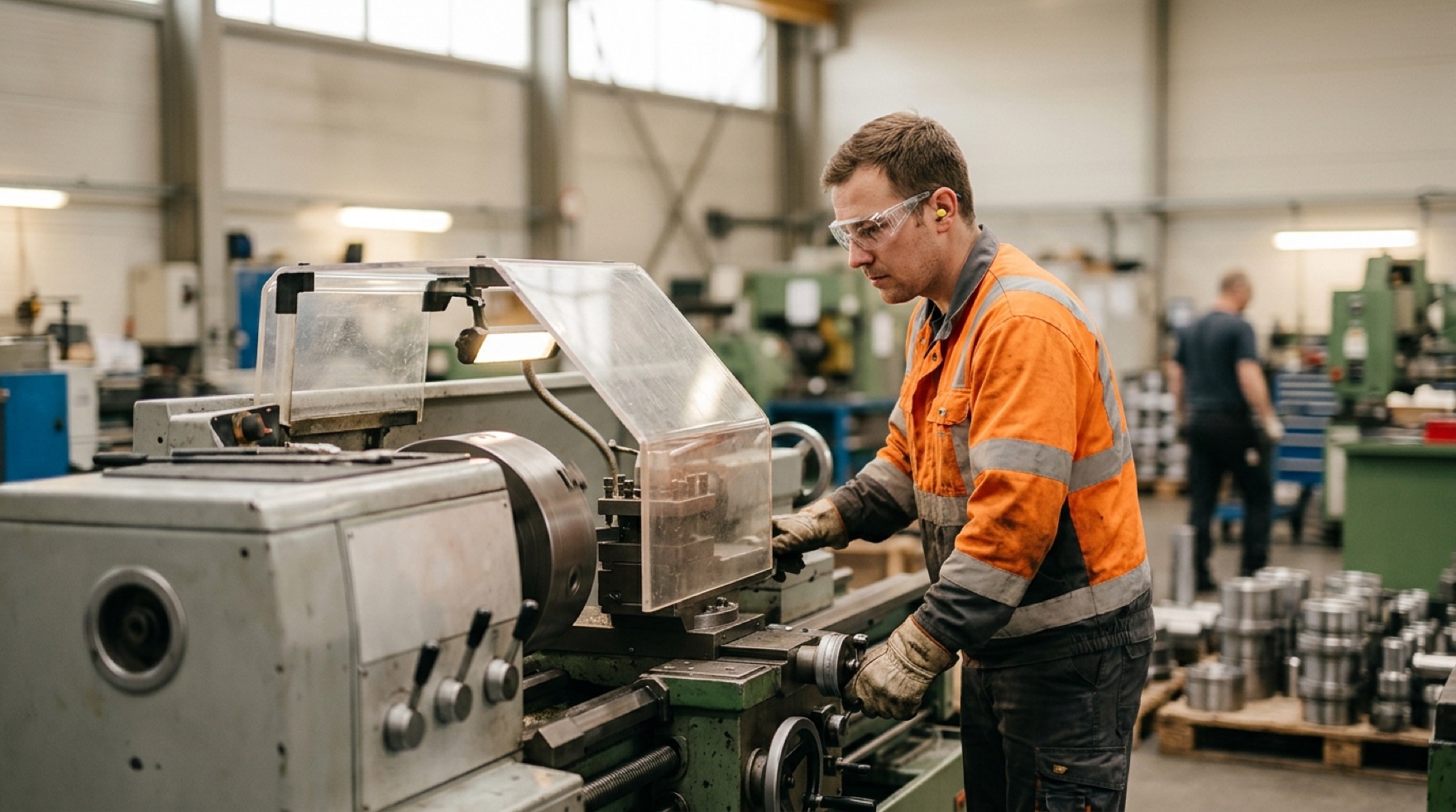
The short answer: Canada has no single national machine-guarding standard the way the US has 29 CFR 1910.212. Occupational health and safety is split by jurisdiction: most employers fall under their province's or territory's OHS act and regulations, while federally regulated workplaces follow the Canada Labour Code Part II and the COHSR. Provincial rules generally require that a machine with an exposed moving part, in-running nip point, or point of operation that can injure a worker be fitted with a guard or other safeguard, and employers commonly build that safeguarding to CSA Z432, "Safeguarding of machinery," the recognized national reference standard.
Is machine guarding legally required in Canada?
Yes, but the duty comes from the jurisdiction that governs the workplace, not from one national rule. Provincial and territorial OHS regulations require employers to safeguard machinery so a worker cannot contact a hazardous moving part or reach the point of operation. In British Columbia the duty is explicit: the WorkSafeBC OHS Regulation Part 12 defines a safeguard as a guard, safety device, shield, or awareness barrier that provides effective protection, and section 12.2 requires machinery to be fitted with safeguards that protect a worker from contact with hazardous power transmission parts, keep a worker out of a hazardous point of operation, and contain material ejected by the process. In Ontario the equivalent duty sits within Regulation 851 (Industrial Establishments), sections 24 to 28, which address guarding and protective devices. Federally regulated employers carry an equivalent duty under the Canada Labour Code Part II and the COHSR. The wording and the specific duties differ by jurisdiction, so confirm the requirement with the OHS regulator that governs your site.
What does CSA Z432 cover, and is it the law?
CSA Z432, "Safeguarding of machinery," is the national reference standard for how to safeguard a machine: it sets out the guard and device options and the principles for selecting them. It is not, on its own, the law. It becomes enforceable where a province, territory, or federal regulation adopts or references it. British Columbia is a clear example: the WorkSafeBC OHS Regulation Part 12 requires that a safeguard meet the applicable CSA Z432 standard for its design and construction. Elsewhere, employers map their guarding to CSA Z432 to show the protection their regulator expects, because most provincial regulations state the outcome, a worker kept away from the hazard, without prescribing every guard detail. Naming the standard is only the start; the guard still has to be affixed, capable of performing its function, and not readily removable without a tool, which is what WorkSafeBC Part 12 requires of a fixed guard.
What hazards does a guard have to protect against?
A guard has to close off the machine motions that can cut, crush, or catch a person. The WorkSafeBC OHS Regulation Part 12 names the three targets directly: hazardous power transmission parts, the point of operation, and material ejected by the work process. The Canadian Centre for Occupational Health and Safety (CCOHS) describes the underlying motions the same way US and international guidance does: rotating parts such as shafts, spindles, and drums can grip a glove or sleeve and pull a limb in; in-running nip points form where two parts move together or one part moves past a fixed object at gears, rollers, and belt drives; and the point of operation, where punching, shearing, bending, or cutting acts on the stock, is where the operator's hands sit closest to the tooling and where the most severe injuries happen. Naming the actual motion on a given machine, a rotating drum, an in-running nip, a punching point of operation, is the first step in choosing a guard that covers it rather than one that merely looks solid.
Which safeguarding methods satisfy the requirement?
The standard does not prescribe one guard; it accepts any method that keeps the body out of the danger zone during the cycle. CCOHS groups the practical options into guards, which are physical barriers, and safeguarding devices, which stop or prevent the hazardous motion when a person is in reach. The table below summarizes the commonly used methods that CCOHS describes and that CSA Z432 sets out.
| Safeguarding method | How it protects | Where it fits | Watch-outs |
|---|---|---|---|
| Fixed guard | A permanent barrier, welded or fastened in place, that admits stock but blocks the worker from reaching a moving part or point of operation | The default for a hazard area that does not change between runs | Should not be readily removable without a tool; servicing behind it needs lockout |
| Adjustable / distance guard | A fixed guard that adjusts to the stock, or that keeps the worker back from a hazard it does not fully enclose | Job shops running varied stock through the same machine | The worker can set it wrong or defeat it; it does not give full protection on its own |
| Interlocked guard | A barrier monitored by the control system that prevents or stops the machine when the guard is opened or removed | Enclosures that must open for loading, cleaning, or minor servicing | The interlock circuit is not a substitute for lockout on all maintenance work |
| Self-adjusting or self-closing guard | A barrier that moves as the stock enters, then returns to the closed position at rest | Saws and similar tools where stock size varies cut to cut | Provides less than full protection and needs regular maintenance |
| Safeguarding devices | Presence-sensing systems (photoelectric, radiofrequency), pullback and restraint devices, safety trip controls, two-hand controls, and interlocked gates that stop or prevent the hazardous cycle | Presses and machines where a fixed barrier is impractical | Must be selected, installed, and tested to the device requirements; not every machine tolerates them |
CCOHS frames the choice within the hierarchy of controls: eliminate or substitute the hazard first, then apply engineering controls such as guards and devices, then administrative controls, then personal protective equipment. A guard is an engineering control, which is why it sits high in that order: it works whether or not the operator is tired, new, or reaching for a part that slipped.
Where does guarding stop and lockout begin?
Guarding and lockout are two different duties that protect against two different moments. A guard keeps a worker out of the machine while it runs in normal production. Lockout, governed in Canada by CSA Z460 and the provincial lockout regulations, protects the person who has to reach past the guard to service, adjust, or unjam the machine, by isolating the energy so it cannot move. Opening a guarded machine to clear a jam or adjust a shield is usually the point where the guard's job ends and energy control begins. That distinction is covered from the other side in our companion piece on lockout/tagout for machine operators in Canada.
Building a defensible guarding program
Every provincial requirement comes back to one idea: put a reliable barrier or device between the worker and the machine motion, and keep it there. The practical path for a Canadian employer is to identify the actual hazard on each machine, match it to a fixed, adjustable, distance, interlocked, or self-adjusting guard, or to a presence-sensing or two-hand device where a barrier will not fit, build the safeguard to CSA Z432, and then confirm the specific guarding, inspection, and recordkeeping duties with the OHS regulator that governs the workplace. That is what a regulator looks for after a caught-in or amputation injury: a safeguard that was present, affixed, suited to the hazard, and not bypassed during the cycle.