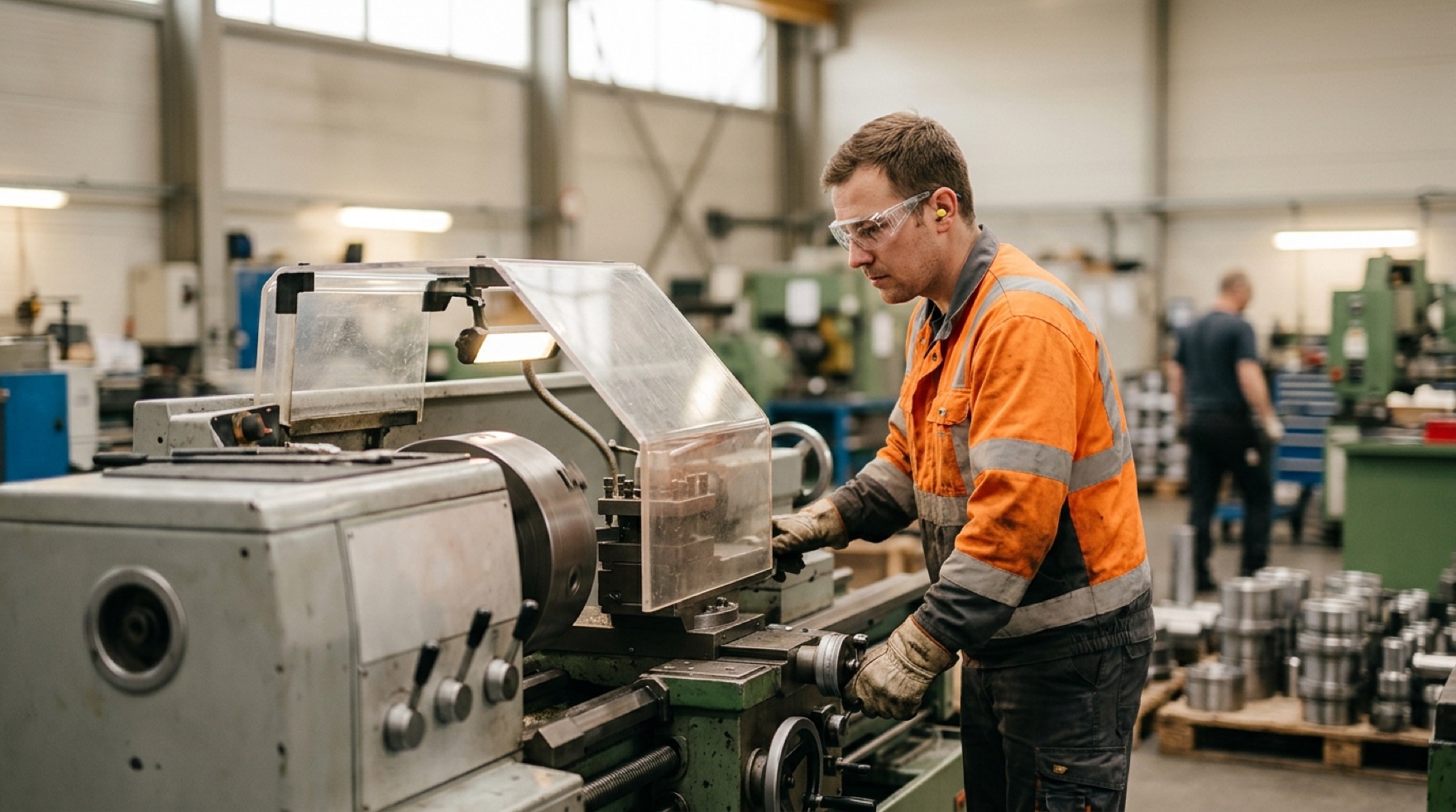
The short answer: Under 29 CFR 1910.212(a)(1), an employer must provide one or more methods of machine guarding to protect operators and other employees from hazards such as the point of operation, ingoing nip points, rotating parts, and flying chips and sparks. For any machine whose operation exposes an employee to injury, 1910.212(a)(3)(ii) requires the point of operation to be guarded so the operator cannot get any part of the body into the danger zone during the operating cycle. Machine guarding is consistently one of OSHA's ten most frequently cited general industry standards, so the guard is the first thing a compliance officer looks for after an amputation or a caught-in injury.
Does OSHA require machine operators to work behind a guard?
Yes. 29 CFR 1910.212(a)(1) requires that one or more methods of machine guarding be provided to protect the operator and other employees in the machine area from hazards, and it names the hazards it has in mind: point of operation, ingoing nip points, rotating parts, and flying chips and sparks. The duty sits with the employer and it attaches to the machine, not to the operator's attention. That is the point of the standard. A guard works whether or not the operator is tired, distracted, new, or reaching for a part that slipped, which is exactly when hands find moving machinery.
Machine guarding under 1910.212 was the tenth most frequently cited standard in OSHA's fiscal year 2025 top ten, and it holds a place on that list nearly every year, as OSHA's most-cited standards data shows. That ranking is worth reading operationally rather than as trivia. It means unguarded and inadequately guarded machines remain common enough, and dangerous enough, that inspectors keep writing the same citation. If a machine on your floor exposes an operator to a moving part, the absence of a guard is not a gray area, it is the single most predictable finding on an inspection.
What hazards does a guard have to protect against?
A guard has to close off the machine motions that can cut, crush, or catch a person: the point of operation where the work happens, and the moving parts that drive it. 1910.212(a)(1) lists point of operation, ingoing nip points, rotating parts, and flying chips and sparks, and OSHA's amputation guidance breaks those into the mechanical motions behind them. Rotating motion from collars, shafts, spindles, and drums can grip clothing or a glove and pull a body part in, even when the surface looks smooth. Reciprocating and transverse motion can strike or trap a person between a moving part and a fixed object. In-running nip points, the pinch points formed where two parts move together or one part moves past a fixed object, develop at gears, rollers, and belt drives, as OSHA describes in Safeguarding Equipment and Protecting Employees from Amputations (OSHA 3170).
The point of operation is where the highest-severity injuries happen, because that is where punching, shearing, bending, and cutting act on the stock and where the operator's hands are closest to the tooling. OSHA 3170 makes the pattern explicit: on presses, shears, and press brakes the hazard occurs at the point of operation, where the employee typically inserts, holds, or withdraws the stock by hand. Naming the specific motion on a given machine, a rotating drum, an in-running nip, a punching point of operation, is the first step in choosing a guard that actually covers it rather than one that merely looks substantial.
What happens when the rotating-parts guard is simply missing?
When a rotating part has no guard, ordinary reaching becomes a caught-in fatality, and the machine does the rest. The failure is not a lapse of care but the absence of the barrier the standard requires. A California FACE investigation records the mechanism plainly.
In CA/FACE report 02CA009, a 52-year-old machine operator at a wire-drawing shop, one of the company's experienced operators who trained others, was killed while wire was being spooled onto a rotating drum. The investigators found the drum had no guarding, and a hinged safety stop bar meant to cut power on contact had been disconnected. The operator reached into the area of the rotating drum, his glove caught in the wire, and he was pulled between the drum and the machine housing. CA/FACE recommended, first, that all machines be properly guarded. The transferable point is that a rotating drum is precisely the "rotating part" 1910.212(a)(1) names, and an enclosure interlocked with the drive is what 1910.212(a)(4) requires for a revolving drum, protection that does not depend on the operator keeping clear.
What are the guarding methods that satisfy 1910.212?
The standard does not prescribe one guard; it accepts any method that keeps the body out of the danger zone during the cycle. 1910.212(a)(3)(ii) says the guarding device must conform to any applicable specific standard or, absent one, be designed and constructed to prevent the operator from having any part of the body in the danger zone during the operating cycle. OSHA 3170 and the ANSI B11 series group the practical options into fixed and movable guards and into safeguarding devices. The table below summarizes the commonly used guards and where each one fits, drawn from OSHA 3170 Table 1; performance requirements for these measures sit in ANSI B11.19-2019.
| Safeguarding method | How it protects | Where it fits | Watch-outs |
|---|---|---|---|
| Fixed guard | A permanent barrier that admits stock but blocks the operator from reaching the danger area | The default for a point of operation or hazard area that does not change between runs | Can obstruct changeover; adjustment and repair usually mean removing it, so servicing needs lockout/tagout |
| Adjustable guard | A barrier that adjusts to suit different stock sizes and operations | Job shops running varied stock through the same machine | The operator can set it wrong or defeat it; it does not give maximum protection on its own |
| Self-adjusting guard | A barrier that moves as the stock enters, then closes back when the machine is at rest | Saws and similar tools where stock size varies cut to cut | Provides less than full protection and needs regular maintenance |
| Interlocked guard | Shuts off or disengages power and prevents start-up while the guard is open | Enclosures that must open for loading, cleaning, or minor servicing | The interlock circuit is not a substitute for lockout/tagout on all maintenance work |
| Presence-sensing / two-hand control (devices) | Stop or prevent the hazardous cycle if a hand is in the danger area, or keep both hands away from it | Presses and similar machines where a fixed barrier is impractical | Must be selected, installed, and tested to the device standard; not every machine tolerates them |
Whatever method is chosen, two of the standard's own limits apply to the guard itself. 1910.212(a)(2) requires the guard to be affixed to the machine where possible, secured elsewhere if not, and designed so it does not create a hazard of its own, and 1910.212(b) requires machines designed for a fixed location to be anchored to prevent walking or moving. A guard that rattles loose, pinches, or lets the machine creep across the floor is not protection, it is a second hazard.
Where does guarding stop and lockout/tagout begin?
Guarding and lockout/tagout are two different duties that protect against two different moments. A guard under 1910.212 stops routine contact while the machine runs in normal production; lockout/tagout under 29 CFR 1910.147 protects the person who has to reach past the guard to service or unjam the machine, by isolating the energy so it cannot move. OSHA 3170 draws the line inside the guard table itself: an interlocked guard "allows access for some minor servicing work, in accordance with the lockout/tagout exception," but its interlock circuit "may not be used for all maintenance and servicing work." In other words, opening a guarded machine to clear a jam or adjust a shield is usually the point where the guard's job ends and energy control begins.
For an operator, the practical rule follows from that split. Keep the guard in place and never reach through, around, or under it during the cycle, which is what 1910.212 exists to prevent, and switch to a full energy-control procedure the moment the task requires getting into the machine, which is what 1910.147 governs. Confusing the two, treating an interlock or a stop button as if it were a lockout, is the failure mode that turns a guarded machine into a fatal one, and it is covered in depth in our companion piece on lockout/tagout for machine operators.
Keeping the guard between the operator and the machine
Every requirement in 1910.212 comes back to one idea: put a reliable barrier between the operator and the machine motion, and keep it there. Identifying the actual hazard on each machine, a rotating drum, an in-running nip, a punching point of operation, then matching it to a fixed, adjustable, self-adjusting, or interlocked guard, or to a presence-sensing or two-hand device where a barrier will not fit, is what turns the standard into real protection on the floor. The CA/FACE wire-drawing case is the reminder of the alternative: an experienced operator, a rotating part with no guard, and a disconnected backup, ending the way an unguarded machine reliably does. A guard that is present, affixed, and never bypassed during the cycle is the control that holds when attention does not.