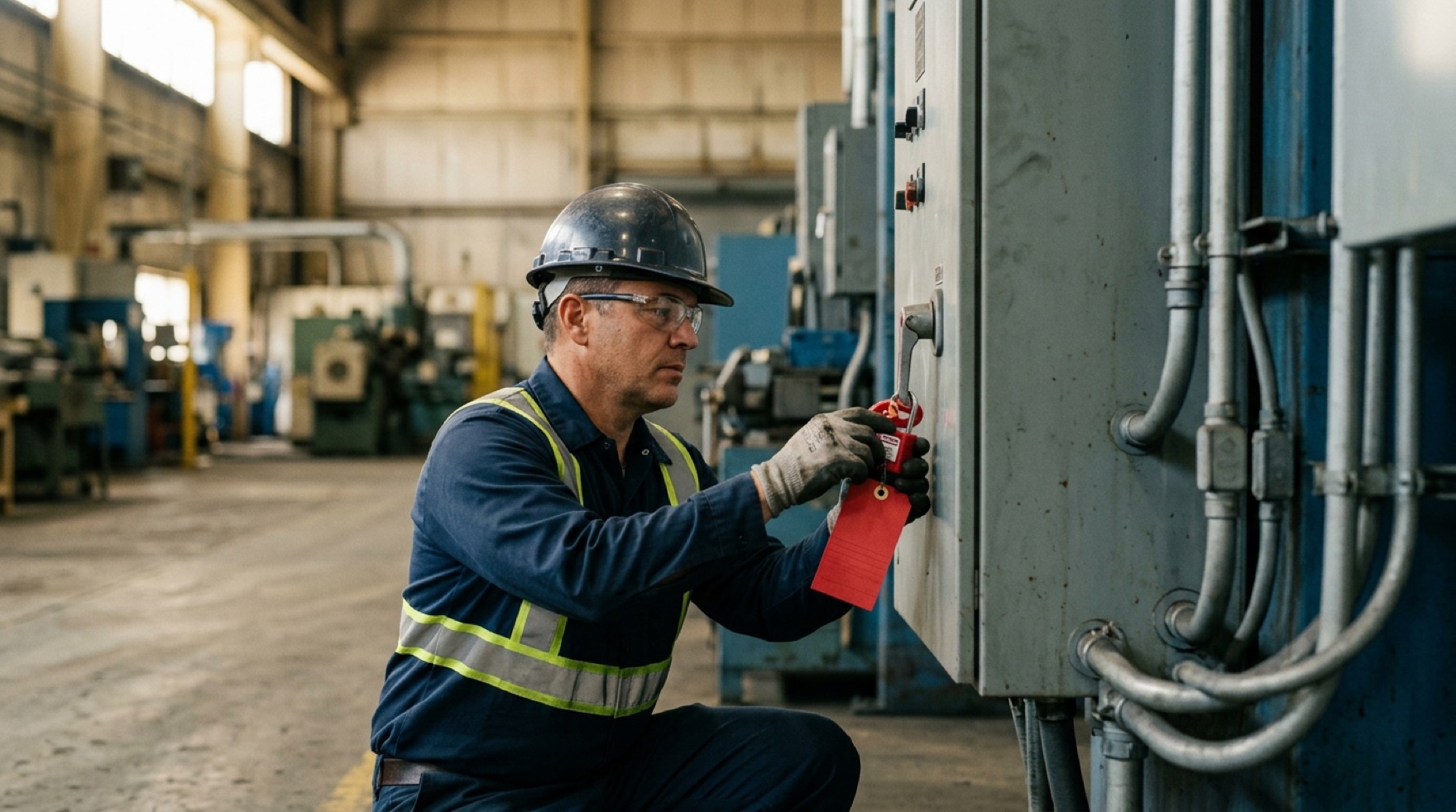
The short answer: Canada does not have one national lockout standard the way the US has 29 CFR 1910.147. Occupational health and safety is split by jurisdiction: most facilities follow the OHS act and regulation of the province or territory they operate in, while federally regulated workplaces follow the Canada Labour Code Part II and the Canada Occupational Health and Safety Regulations (COHSR, SOR/86-304). The shared technical reference across the country is CSA Z460-20, Control of Hazardous Energy - Lockout and Other Methods. In practice a facilities team isolates the energy at an energy-isolating device, locks that device in the off position, releases any stored or residual energy, and verifies a zero-energy state before work begins, applied the same way whether the job is a five-minute belt change or a two-day rebuild.
Does Canadian law require lockout for facilities maintenance work?
Yes, but the duty comes from the jurisdiction that governs the workplace, not from one national rule. Provincial and territorial OHS regulations require that a worker be protected from the unexpected startup or release of hazardous energy while cleaning, oiling, adjusting, repairing, or maintaining equipment. In Ontario that duty sits within Regulation 851 (Industrial Establishments), whose sections 75 and 76 address locking out and blocking machinery before a worker is exposed. In British Columbia it sits within the WorkSafeBC OHS Regulation Part 10 (De-energization and Lockout). Federally regulated employers carry an equivalent duty under the Canada Labour Code Part II and the COHSR. CCOHS describes lockout plainly as placing a lock on an energy-isolating device under an established procedure so the equipment cannot be started while someone is working on it.
The reason the requirement bites harder in facilities than on a fixed production line is variety. A line operator locks out the same machine every shift; a maintenance technician meets a new machine and a new energy profile on nearly every work order. That is the condition under which a generic, one-size procedure fails, which is why the strongest Canadian programs keep a written, machine-specific procedure tied to each significant piece of equipment. The technical reference for building that program is CSA Z460, which many jurisdictions cite or expect employers to follow.
What is the lockout sequence in Canada?
CCOHS sets out a nine-step sequence for lockout, and the order is not optional because each step depends on the one before it. Skipping straight to hanging a lock, without identifying the energy sources or releasing stored energy, is where the sequence breaks. Work the steps in order on every job.
- Prepare for shutdown. Identify the machine, its energy sources, the hazards, and the lockout devices required. On an unfamiliar machine this is the step that decides whether the isolation will actually be complete.
- Notify all affected personnel. Tell people what is being locked out, why, for how long, and who is responsible.
- Shut down the equipment. Turn it off using its established procedure and confirm all moving parts have stopped.
- Isolate the system. Operate every energy-isolating device needed to cut the machine off from its source. A start/stop button or selector switch is a control, not an isolating device, because it does not physically break the energy path.
- Dissipate stored or residual energy. Discharge, block, bleed down, or restrain trapped hydraulic or pneumatic pressure, a raised ram or platform, a charged capacitor, or a compressed spring. This is the step facilities work skips most often, and the one that injures people after the power is already off.
- Apply lockout and tagout devices. Affix a lock that holds each isolating device in the safe position, with a tag identifying who applied it.
- Verify isolation. Confirm the zero-energy state before work starts by testing controls (then returning them to off), testing for voltage, or checking gauges.
- Perform the maintenance or service work.
- Remove the devices and re-energize. Inspect the area, confirm everyone is clear, and remove locks in the correct order before restoring energy.
The distinction between an energy-isolating device and a control, and the separate step for stored energy, are the two points a Canadian facilities program cannot afford to blur. A conveyor that is switched off at the panel but still holds a raised, unblocked counterweight is not at a zero-energy state, and CSA Z460 and the CCOHS sequence both treat that residual energy as something to be released or restrained before anyone reaches in.
Who applies the locks, and how does group lockout work?
Each worker exposed to the hazard applies their own personal lock. CCOHS states the principle directly: if a maintenance job needs three workers, three locks are present, and each individual places their own lock. WorkSafeBC Part 10 frames the same duty, making each worker who works on the equipment responsible for locking out the energy-isolating devices before starting, and providing personal locks operable only by that worker's key. This is what stops one person's protection from depending on another trade remembering they are still inside the machine.
When a crew works together, a group lockout procedure keeps every worker independently protected. The common method is a group lockout box: each energy source is locked, the keys go into the box, and every authorized worker hangs a personal lock on the box when they start and removes it only when they personally leave. This matters in facilities work because the electrician, the millwright, and the controls technician often converge on the same rooftop unit or pump skid, and a single lock hung by the first trade to arrive protects that person and no one else. Confirm the exact written-procedure and group-lockout duties in the regulation that governs your site, because the trigger and the recordkeeping vary between jurisdictions.
| Element | Canada (most workplaces) | Source of the duty |
|---|---|---|
| Governing law | Provincial or territorial OHS act and regulation; federal = Canada Labour Code Part II + COHSR | Provincial OHS regulator / ESDC Labour Program |
| Technical reference | CSA Z460-20, Control of Hazardous Energy - Lockout and Other Methods | CSA Group; cited by CCOHS |
| Provincial examples | Ontario Reg. 851 s.75-76 (Industrial Establishments); WorkSafeBC OHS Regulation Part 10 | ontario.ca/laws; worksafebc.com |
| Who applies locks | Each exposed worker applies their own personal lock; group lockout box for crews | CCOHS; WorkSafeBC Part 10 |
The practical takeaway for a Canadian facilities employer is to build the energy-control program to CSA Z460, keep a machine-specific procedure for every significant energy source in the building, and then confirm the written-procedure, verification, and periodic-review duties with the provincial or territorial OHS regulator that governs the workplace. That is what a regulator will look for after an incident: evidence that the energy was isolated, the stored energy released, and the zero-energy state verified before the work began.