The short answer: Canada has no single national lockout rule like US 29 CFR 1910.147. Control of hazardous energy is split by jurisdiction: most workplaces fall under a province's or territory's OHS regulation, while federally regulated workplaces follow the Canada Labour Code Part II and the COHSR. The rules generally require that machinery be shut down, isolated, and locked out before a worker services, cleans, adjusts, or clears a jam where an unexpected start or a release of stored energy could cause injury. The recognized national reference is CSA Z460, "Control of Hazardous Energy - Lockout and Other Methods."
Is lockout legally required in Canada, and does it apply to operators?
Yes, and it applies to any worker who services or maintains a machine, operators included. The duty comes from the jurisdiction that governs the workplace. In British Columbia the WorkSafeBC OHS Regulation Part 10 sets it out plainly: before machinery is serviced, section 10.3 requires that all parts be secured against inadvertent movement and that the energy-isolating devices be locked out; section 10.4 requires those devices to be secured in the safe position using locks, and states that combination locks must not be used for lockout; and section 10.6 requires a worker to verify that all energy sources have been effectively locked out before starting work. In Ontario the equivalent duty sits within Regulation 851 (Industrial Establishments), sections 75 and 76, which require machinery to be stopped and locked out or blocked before certain work. Federally regulated employers carry an equivalent duty under the Canada Labour Code Part II and the COHSR. The detail differs by jurisdiction, so confirm the rule with your regulator.
What is CSA Z460, and what energy does it cover?
CSA Z460, "Control of Hazardous Energy - Lockout and Other Methods," is the national reference standard, and CCOHS builds its guidance on it. CSA Z460 defines lockout as the placement of a lockout device, an individually keyed lock, on an energy-isolating device so the machine cannot be energized. Just as important, it defines the energy that has to be controlled broadly: any electrical, mechanical, hydraulic, pneumatic, chemical, thermal, gravitational, or other energy that can harm personnel. That breadth is the point. The hazard is not only the electrical supply. It includes hydraulic and pneumatic pressure held in a line, gravity on a raised ram or plate, a compressed spring, and residual motion, any of which can move a machine part after the power switch is off. CSA Z460 frames lockout as one method within a larger hazardous-energy-control program, and CCOHS lists that program's elements: identify the energy sources, assess the risk, implement controls and procedures, train workers, and inspect and audit the program.
When must a machine operator lock out?
You have to lock out whenever you service or maintain a machine in a way that could expose you to an unexpected start or to stored energy. That is the line between two different controls. Running the machine behind a guard during normal production is guarding territory; reaching past the guard to clear a jam, adjust a fouled part, or clean inside the machine is energy-control territory, and only isolating and locking the energy protects you there. Operators are often the people closest to a jam or a fouled part, which is exactly the moment CSA Z460 and the provincial regulations are written for. Being trained and authorized to lock out, and doing it rather than trusting a stop button, is what separates a routine clearance from a fatal one. The other side of that line, keeping the guard in place during production, is covered in our companion piece on machine guarding for operators in Canada.
What are the steps of a lockout?
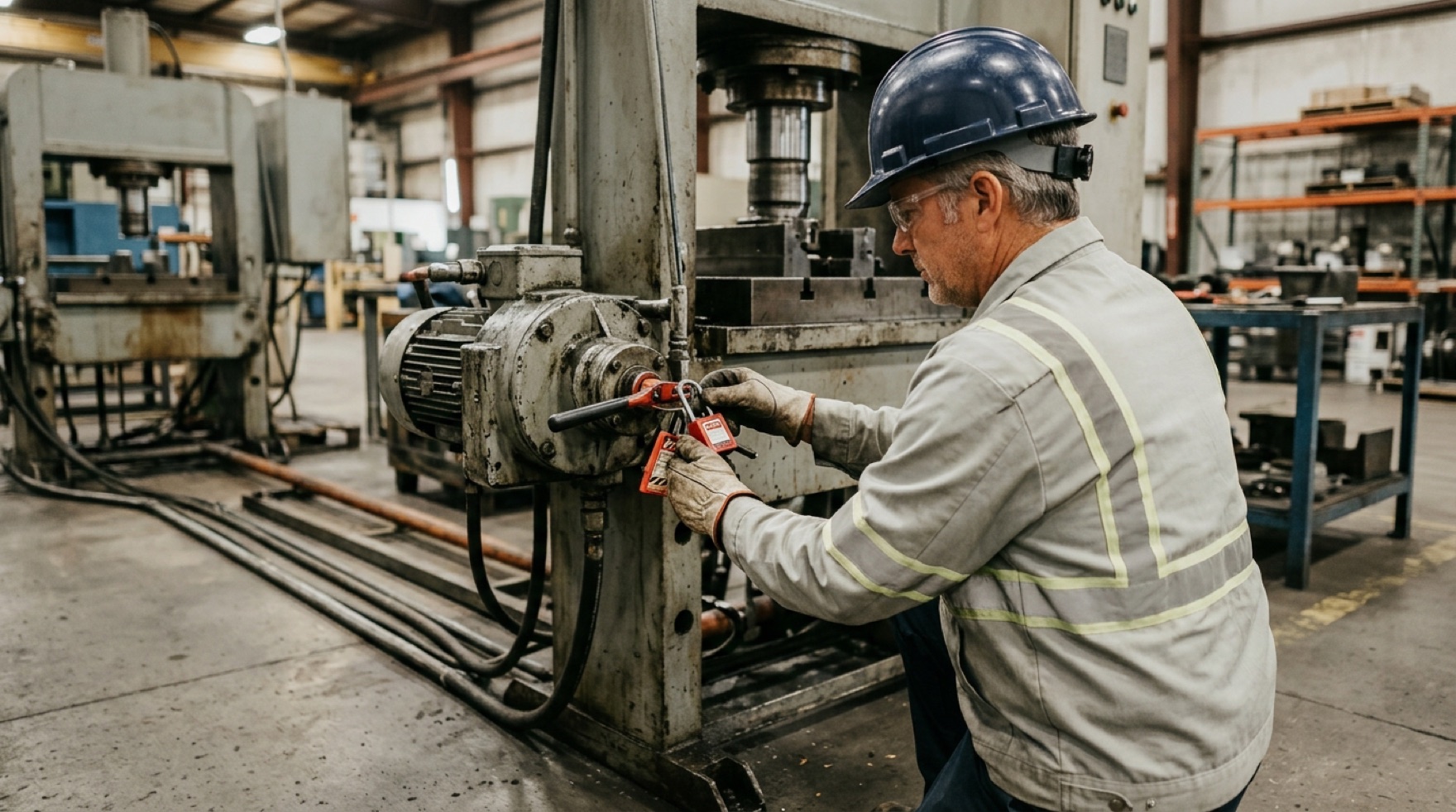
A compliant lockout is a fixed sequence, not a single click of a switch. CCOHS sets out the sequence based on CSA Z460, and the order matters because each step removes a source of movement the previous one did not. Skipping straight to "the power is off" is how residual hydraulic pressure, a gravity-loaded plate, or a second energy source still injures the person inside.
| Step | What the worker does |
|---|---|
| 1. Prepare for shutdown | Identify the machine, its energy sources and magnitudes, the hazards, and the lockout devices needed, using the machine's specific procedure |
| 2. Notify affected workers | Tell affected personnel what is being locked out, why, for how long, and who is responsible |
| 3. Shut down | Turn the machine off using its normal stopping procedure and confirm all movement has stopped |
| 4. Isolate | Operate every energy-isolating device, the electrical disconnect and the hydraulic and pneumatic valves, so the machine is separated from each energy source |
| 5. Dissipate stored energy | Release, restrain, or render safe all residual energy: bleed hydraulic and pneumatic pressure, block a raised ram or plate, discharge capacitors, relieve spring tension |
| 6. Apply lock and tag | Affix an individually keyed lock, and a tag, to each isolating device; there should be as many locks on the system as there are people working on it |
| 7. Verify isolation | Confirm the machine is de-energized, including by trying the normal start controls to be sure nothing moves, then return them to off |
After the work is done, the devices are removed in order, the area is checked, and workers are notified before the machine is restored. The verification step, sometimes called the try step, is the one operators skip and the one that catches the machine that was isolated on paper but not in fact. It is the last check before a body part enters the danger zone.
Why isn't a stop button or a tag on its own enough?
A stop button pauses the machine but does not isolate its energy, and a tag warns but does not physically restrain anything. A machine paused on a stop button can restart on a timer, a signal, a second worker, or a stored-energy release; a machine held only by a tag will move if anyone operates the switch the tag hangs on. Neither addresses the hydraulic pressure, the gravity load, or the pneumatic charge still sitting in the system. That is why CSA Z460 and the provincial regulations require a physical lock on an energy-isolating device plus verified relief of stored energy, and why WorkSafeBC Part 10 requires the isolating devices to be secured with a lock and the lockout to be verified before work begins. An interlock or a control-circuit stop belongs to normal production; once the task requires reaching in, only the lockout sequence keeps the energy from returning while a worker's hands are inside.
What the employer's program has to stand behind
An operator's lockout only holds up because a program stands behind it. CCOHS, following CSA Z460, describes that program as identifying the hazardous energy sources, assessing the risk, implementing energy controls and machine-specific procedures, training workers, and inspecting and auditing the controls. For a machine operator, that training is what makes lockout a task they are authorized and equipped to perform, not a rule they are told to respect. Build the program to CSA Z460, then confirm the specific lockout, group-lockout, and recordkeeping duties with the OHS regulator that governs the workplace, because those details are set province by province.