The short answer: Loading dock injuries concentrate at the dock-to-trailer gap, and Canada controls them through provincial and territorial OHS regulations rather than one national dock rule. Occupational health and safety is split by jurisdiction: most employers fall under their province's or territory's OHS act and regulations on materials handling, powered mobile equipment, and workplace traffic, while federally regulated workplaces follow the Canada Labour Code Part II and the COHSR. Across every jurisdiction the sequence is the same: immobilize the vehicle before anyone crosses (brakes set, wheels chocked, and a trailer restraint where fitted), bridge the gap with a dock plate or leveller that is positioned, secured, and rated for the combined weight, and keep watching so work stops the moment the trailer or the bridge moves.
Who sets loading dock safety rules in Canada?
The duty comes from the jurisdiction that governs the workplace, not from a single national standard the way the US relies on 29 CFR 1910.176, 1910.26, and 1910.178(k). Provincial and territorial OHS regulations on materials handling, powered mobile equipment, and workplace traffic carry the enforceable requirements, and federally regulated employers carry an equivalent duty under the Canada Labour Code Part II and the COHSR. In British Columbia those duties sit in the WorkSafeBC OHS Regulation, with general workplace conditions in Part 4 and mobile equipment in Part 16; in Ontario, industrial workplaces fall under Regulation 851 (Industrial Establishments). Because there is no dedicated dock standard, the controls come from the employer's hazard assessment plus the general duty to keep the workplace and its equipment in safe condition. CCOHS provides the practical dock guidance, but it is guidance, not law: the enforceable requirement is whatever your provincial, territorial, or federal regulator sets.
That jurisdictional split matters because the specifics differ. WorkSafeBC Part 16, for example, does not list dock boards or wheel chocks as dedicated topics; it instead requires that mobile equipment left unattended be secured against movement, that loads be loaded, secured, and unloaded so they do not endanger persons, and that pedestrians be separated from equipment where practicable. Another province may address the same hazards through different sections or a different regulation entirely. The reliable approach is to build the dock procedure from the hazards you can see at the gap, then confirm the exact wording with the OHS regulator that governs your site.
How do you secure the vehicle before anyone crosses the gap?
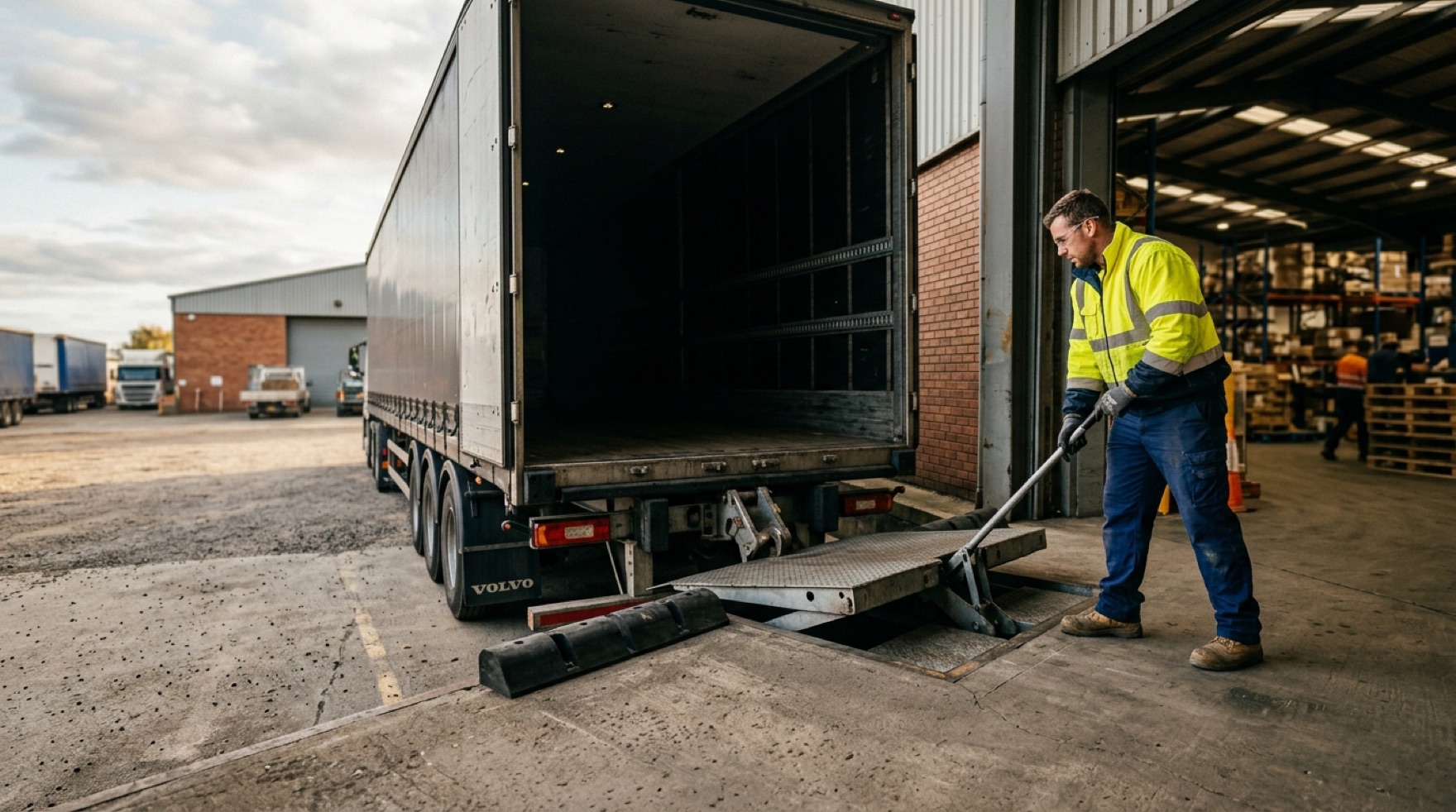
Immobilize the trailer or railcar first, every time, and confirm it before the first wheel of a truck touches the bridge. Trailer creep and early pull-away are the recurring mechanism behind serious dock incidents: the trailer separates from the dock while a forklift is part-way across, and the bridge and the truck drop into the gap. CCOHS sets out the baseline controls for preventing that.
- Engage the transport vehicle's brakes before loading or unloading begins.
- Chock the vehicle's wheels so the trailer cannot roll away from the dock.
- Engage a trailer restraint system where one is fitted, because the restraint helps prevent the trailer from separating from the loading dock. A powered restraint that captures the rear impact guard is a stronger control than chocks alone.
- Confirm the trailer's landing gear or stabilizer is fully supporting the trailer when it is not coupled to a tractor, so it cannot upend under the weight of a forklift.
- Keep the driver clear. Instruct the driver to stay out of the loading and unloading area while the forklift is in motion, and control the vehicle so it cannot be pulled away while work is still inside it.
WorkSafeBC's Part 16 reinforces the same principle from the equipment side: when a worker leaves mobile equipment unattended it must be secured against movement using at least two effective braking or parking systems, which can include the parking brake, the transmission park position, and chocks for the wheels. The through-line is that the vehicle has to be positively held, not assumed to be stationary, before a load crosses the gap.
How do you choose and use dock plates and levellers safely?
The bridge between the dock and the trailer has to carry the heaviest thing that will cross it and stay put while it does. CCOHS gives clear rules for the dock plate or leveller itself, and the load rating is the number that governs everything else.
- Position and secure the plate. Before a forklift drives over it, the dock plate or leveller must be properly positioned, levelled, and secured so it cannot shift under traffic.
- Match the rating to the load. The plate must be able to support the combined weight of the truck and its load, and its load capacity should be clearly marked. Know the loaded weight of the forklift plus its heaviest load, and never exceed the marked capacity.
- Keep the plate and dock in good condition. Docks and plates should be in good working order, clear of obstructions, and not oily or wet, because a slick or damaged surface undoes a correctly rated plate.
- Mark the edges. Dock edges should be clearly marked so operators and workers on foot can see where the drop begins.
Because the dock plate, the trailer, and pedestrians all share the same tight space, the plate is only as safe as the vehicle under it and the traffic around it. That is why the securing steps above and the plate steps here are one procedure, not two: a well-rated plate on an unsecured trailer still drops a forklift into the gap, and a secured trailer under a cracked or unmarked plate still injures the operator or a worker on foot.
When should you stop loading or unloading?
Treat the load as a live operation, not a one-time setup, and stop the moment the gap starts to open. CCOHS advises operators to continuously evaluate the status of the trailer, the dock plate, and the forklift during the work, and to stop loading or unloading if conditions become unsafe. The specific warning signs it names are concrete: the trailer tilts, a gap forms between the trailer and the dock, or the forklift becomes difficult to steer. Any one of those means the vehicle or the bridge is moving, and continuing across the gap is how a near miss becomes a fall or a crush.
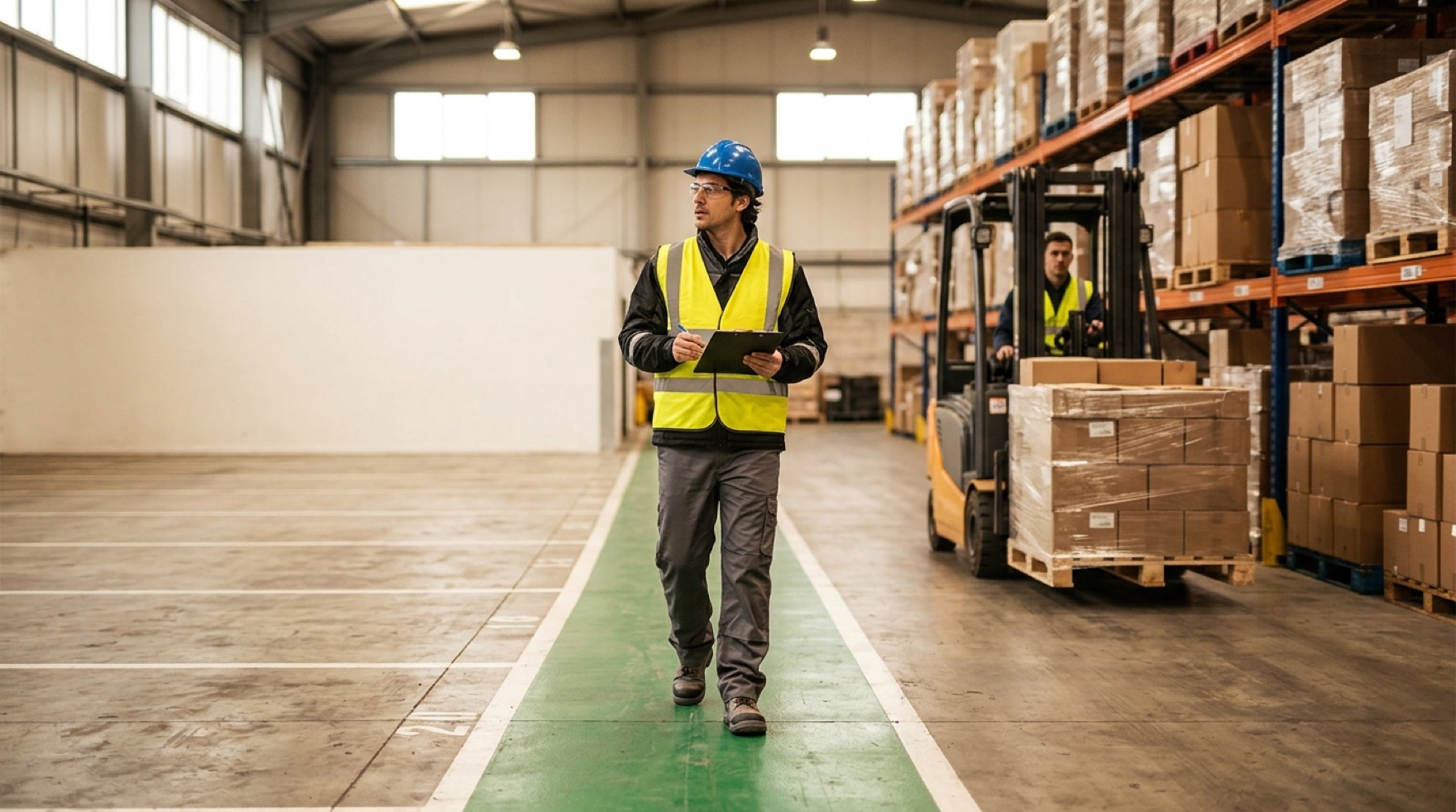
Pedestrian traffic deserves the same live attention. WorkSafeBC Part 16 requires pedestrians to be separated from mobile equipment by designated walkways where practicable, and where that is not practicable, to be protected by other effective means such as posted speed limits or a mutual acknowledgment between the operator and workers on foot before either proceeds. At a busy dock, the driver, other forklift operators, and workers on foot all converge on the same edge, so keeping unauthorized people out of the active area and confirming who has right of way is part of the same job as securing the trailer.
| Control | Canada (most workplaces) | Source of the duty |
|---|---|---|
| Governing law | Provincial/territorial OHS regs on materials handling, mobile equipment, and traffic; federal = Canada Labour Code Part II + COHSR | Provincial OHS regulator / ESDC Labour Program |
| Secure the vehicle | Brakes engaged, wheels chocked, trailer restraint where fitted, landing gear supporting an uncoupled trailer | CCOHS guidance; WorkSafeBC OHS Reg. Part 16 (unattended equipment) |
| Dock plate / leveller | Positioned, levelled, secured, rated for the combined truck-and-load weight, capacity marked, surface clean and clear | CCOHS guidance; employer hazard assessment |
| Stop-work triggers | Trailer tilts, gap opens between trailer and dock, or forklift becomes hard to steer | CCOHS guidance |
| Pedestrian traffic | Designated walkways where practicable; otherwise speed limits or mutual acknowledgment; dock edges marked | WorkSafeBC OHS Reg. Part 16; CCOHS guidance |
Read as one procedure, the steps say the same thing in order: secure the vehicle, rate and fix the bridge, guard and mark the edge, watch for the trailer moving, and keep people on foot out of the path, before freight crosses the gap. The gap between the dock and the trailer is the job. Build the dock procedure around it, then confirm the enforceable traffic, guarding, and fall-protection details with the provincial, territorial, or federal OHS regulator that governs your workplace.