The short answer: The catalyst in a two-part (2K) polyurethane primer, basecoat or clearcoat is an isocyanate, and isocyanates are respiratory sensitisers. Once a painter is sensitised, further exposure to even very small amounts can trigger asthma-like reactions, and there is no cure. Canada has no single national isocyanate standard. Occupational health and safety is split: most auto body shops fall under their province's or territory's OHS act and regulations, while federally regulated workplaces follow the Canada Labour Code Part II and the COHSR. Exposure limits are set jurisdiction by jurisdiction and most track the ACGIH TLVs, so the applicable number should be read from the regulation that governs the shop. CCOHS is direct on the controls: spray isocyanate paint only in a booth, wearing an air-supplied respirator, never a cartridge respirator.
Why are isocyanates in refinishing so hazardous?
Isocyanates are hazardous because they sensitise the respiratory tract, which means the danger grows with a worker's exposure history rather than staying fixed. Two-part polyurethane paints, primers and hardeners give off unreacted airborne isocyanate during spraying, and CCOHS lists the effects of inhaling it as coughing, chest tightness, fever, fatigue and sensitisation. The mechanism that matters for a refinish tech is that last one. Once a worker is sensitised, CCOHS states that further exposure to even very small amounts of isocyanate will cause distressing asthma-like reactions, and there is no proven way to predict who will become sensitised.
Read operationally, that means there is no reliably safe exposure for a painter who has already been sensitised, so the control cannot aim for a comfortable number. It has to aim for keeping the isocyanate out of the airway on every spray. Sensitisation is not only an inhalation story either. Skin contact with isocyanate during mixing, spraying or gun cleanup can contribute to sensitisation, so covering skin with the right gloves and coveralls is part of preventing the respiratory disease, not a separate housekeeping step.
Is there one national exposure limit for isocyanates in Canada?
No. This is the point that separates the Canadian picture from the US one. There is no single federal isocyanate number that applies across the country. Occupational exposure limits are set by each province and territory, and most jurisdictions base their limits on the ACGIH threshold limit values. Federally regulated workplaces use the exposure limits in the COHSR. Because the applicable value depends entirely on which regulator governs the workplace, a shop cannot assume a uniform national figure, and this article does not state a single number as if it were one. Read the limit from the OHS regulation that governs your shop, generally its table of occupational exposure limits or the ACGIH TLV it adopts.
What is consistent across Canada is the duty behind the number. Provincial and federal OHS regulations on hazardous substances require the employer to control a worker's exposure to a chemical agent such as isocyanate, using engineering controls and work practices first and respiratory protection where those are not enough. Examples of the governing rules include Ontario Regulation 833 (Control of Exposure to Biological or Chemical Agents), the WorkSafeBC OHS Regulation Parts 5 and 6, and Alberta OHS Code Part 4, with the Canada Labour Code Part II and COHSR Part X covering federal workplaces. Confirm the enforceable limit and the exposure-control duty with the regulator named for your jurisdiction rather than importing a foreign figure.
How does WHMIS 2015 fit in?
WHMIS 2015 is Canada's hazard-communication system, built on the Hazardous Products Act and the Hazardous Products Regulations, and it is the regime that governs the labels and safety data sheets on the paint and hardener a shop buys. This is the Canadian counterpart to the US Hazard Communication Standard, and it is worth naming correctly because the classifications and the SDS format follow the Globally Harmonized System as adopted into Canadian law. CCOHS advises checking the safety data sheet and label for information about the products you are using before spraying, and confirming that workers have received WHMIS training. On a 2K product the SDS is where the isocyanate content, the sensitiser hazard statement and the manufacturer's respiratory-protection advice are set out, so it is the starting document for building the spray-booth program, not an afterthought.
What respirator and booth does spraying 2K paint require?
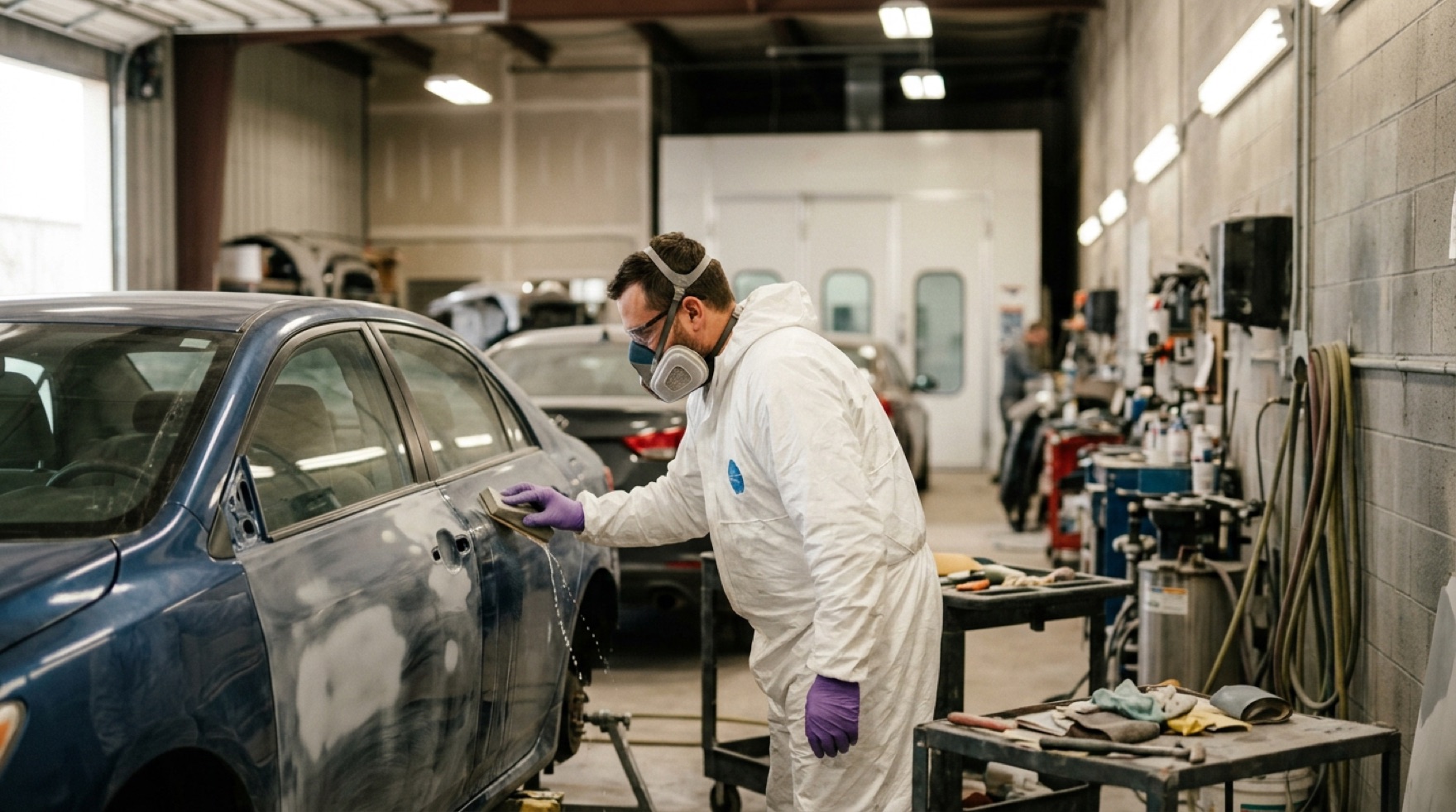
CCOHS guidance for spraying isocyanate paints and primers is specific, and it is the practical floor a Canadian shop should build to. All spraying of isocyanate paints must take place in a paint booth. During spraying the worker must wear an air-supplied respirator approved by the US National Institute for Occupational Safety and Health (NIOSH) as Type C, constant flow or pressure demand. Filtering (cartridge) respirators are not accepted for isocyanate spraying, because the isocyanate mist has poor warning properties and a painter cannot tell when a cartridge is saturated. The supplied breathing air must itself be clean, so the air source has to be uncontaminated and free of carbon monoxide, which is why shop compressed air needs the right filtration and monitoring before it feeds a hood.
Priming deserves the same caution as topcoat spraying. CCOHS testing found that even priming jobs of less than three minutes carried out in the open shop produced enough airborne isocyanate to present a risk, so priming should be done in a booth or in an area separated from other workers with ventilation sufficient to keep isocyanate from spreading. The booth also has to keep working: CCOHS advises making sure the ventilation system is operational and the filters are not blocked, and letting the ventilation run for several minutes before starting. A downdraft booth carries overspray away from the breathing zone, but only while it moves its rated volume of air, so filter changes and airflow checks are what keep the engineering control doing its job.
| Element | Canada (most workplaces) | Source of the duty |
|---|---|---|
| Governing law | Provincial/territorial OHS act + hazardous-substance regulations; federal = Canada Labour Code Part II + COHSR Part X | Provincial OHS regulator / ESDC Labour Program |
| Exposure limit | Set by each jurisdiction, generally based on ACGIH TLVs; no single national number | Provincial OEL table / ACGIH TLV adopted in the regulation |
| Hazard communication | WHMIS 2015 label and SDS on the paint and hardener; worker WHMIS training | Hazardous Products Act + Regulations; CCOHS |
| Spraying control | Spray in a paint booth; air-supplied respirator (NIOSH Type C, constant flow or pressure demand); no cartridge respirators | CCOHS alert on isocyanate paint spraying |
What has to be in place before a shop sprays isocyanate paint?
A refinishing shop should treat isocyanate work as a defined program rather than a task, because the hazard is chronic and the injury is often permanent. Sensitisation ends careers: once a painter reacts, the protective step is usually removal from further isocyanate exposure, which is a workforce and continuity problem as much as a medical one. The program rests on a few points that follow directly from the CCOHS guidance and the governing OHS regulation. Spraying and priming happen in a booth kept in working order with unblocked filters. The painter wears a NIOSH Type C air-supplied respirator in constant-flow or pressure-demand mode during spraying and while the coating off-gasses, backed by clean breathing air. Skin is covered, because dermal contact contributes to sensitisation. Mixing and cleanup follow the WHMIS 2015 safety data sheet. And anyone reporting new wheeze, chest tightness or shortness of breath is evaluated promptly, since early symptoms are the warning that sensitisation is underway.
The practical takeaway for a Canadian employer is to build the spray-booth program to the CCOHS guidance, read the applicable exposure limit and exposure-control duty from the OHS regulation that governs the workplace, and confirm the recordkeeping and health-monitoring rules with that regulator. Handled that way, the isocyanate stays in the coating and out of the painter, which is the only outcome that protects both the worker and the shop's capacity to keep refinishing cars.