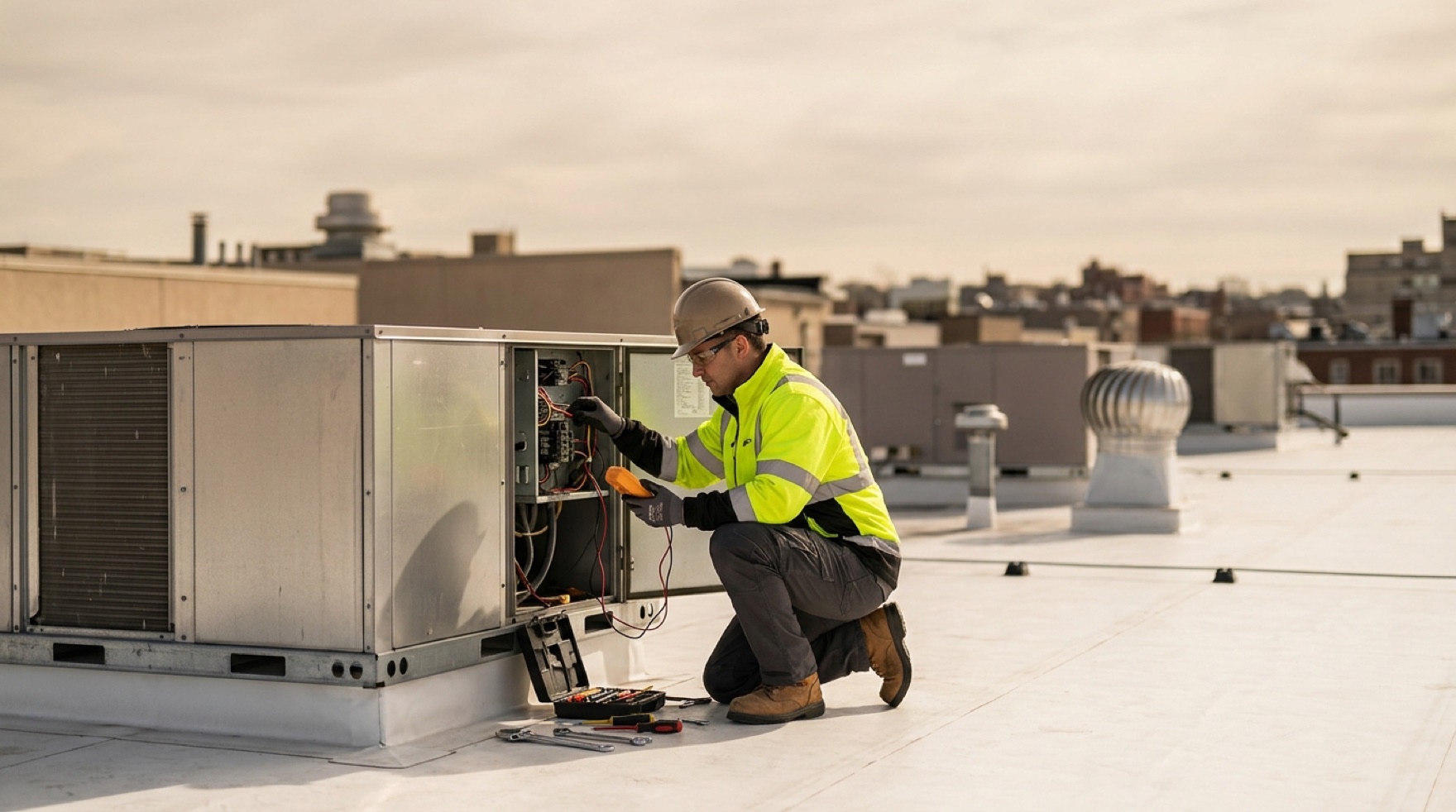
The short answer: Falls and electrocution are the two hazards that kill HVAC technicians on rooftop service calls, and both are controlled before the work starts. Canada has no single national rule: most workplaces fall under a province's or territory's OHS regulation, while federally regulated workplaces follow the Canada Labour Code Part II and the COHSR. CCOHS reports that fall protection is generally required once a worker could fall about 3 metres (10 feet), but the trigger is lower in some jurisdictions, for example more than 1.2 metres in certain Alberta situations, and applies at any height over hazardous equipment. Electrical work engages the Canadian Electrical Code for the wiring and CSA Z462 plus provincial lockout rules for energized work. Confirm the numbers with the regulator for your site.
A rooftop unit sits in the middle of two hazard families at once: an open roof with edges, skylights and other fragile surfaces, and energized equipment fed from a disconnect that may be out of sight. The checks below are grouped so a technician can run them before carrying tools onto the roof. Anything that fails is a stop, not a note for later.
Who sets rooftop fall-protection rules in Canada?
The duty comes from the jurisdiction that governs the workplace, not from one national standard. Provincial and territorial OHS regulations set the fall-protection requirement for most employers, and federally regulated employers carry an equivalent duty under the Canada Labour Code Part II and the COHSR. There is no single Canadian trigger height. CCOHS advises that OHS laws generally require fall protection once a worker could fall about 3 metres, that the threshold is lower in some jurisdictions, and that protection can be required at any height where the surface below carries a heightened risk, such as machinery, a hazardous substance, or water.
The expected method is a hierarchy of control: remove the need to work at height where possible, then use passive protection such as guardrails, then travel restraint that keeps the worker away from the edge, and only then a personal fall-arrest system with an anchor, harness and a rescue plan. The following checks apply that hierarchy to a rooftop HVAC call, and they cover the whole path to the unit rather than just the spot the technician stands to work, because the fatal fall is often on the walk to and from the access point.
- Identify the roof edge and every skylight, hatch, roof opening and fragile surface between the access point and the unit, and treat each skylight as an unguarded hole until proven otherwise
- Confirm the fall-protection method for the work zone against the hierarchy: guardrail or a raised parapet first, then travel restraint, then personal fall arrest, matched to how close the work is to the edge
- Verify skylights and fragile surfaces are guarded with a screen, cover or guardrail, or that the work is kept clear of them, and never use a skylight dome as a work surface or a place to set weight
- Inspect any personal fall-arrest system before use: harness, lanyard or self-retracting lifeline, and a rated anchorage, with connectors intact, and confirm a rescue plan is in place before anyone ties off
- Plan the route to and from the roof access so the walk does not cross an unguarded edge or skylight
- Account for weather: wet, iced or wind-loaded roofs raise the fall risk and can defer non-urgent work
- Confirm every worker exposed to the fall hazard has been trained on the equipment and the plan before entering the area
What are the fall-protection trigger heights across Canada?
Because the threshold is set jurisdiction by jurisdiction, the number that governs your rooftop depends on where the building is. The table gathers what CCOHS reports as the general pattern. The general trigger is about 3 metres in most jurisdictions, Alberta adds a lower band, and every jurisdiction can require protection below the general height when the landing surface is dangerous. Rooftop HVAC work routinely puts a technician near an edge or a skylight, so the practical rule is to protect the hazard rather than measure whether it just clears the threshold.
| Situation | What CCOHS reports | Note |
|---|---|---|
| General trigger, most jurisdictions | Fall protection generally required at about 3 metres (10 feet) | Federal and most provinces and territories |
| Alberta lower band | Protection can be required for a fall of more than 1.2 metres and less than 3 metres in certain situations | Confirm the specific case in the Alberta OHS Code |
| Over dangerous equipment or surfaces | Protection can be required at any height where machinery, a hazardous substance or water is below | Applies regardless of the general trigger |
| Skylights and roof openings | Treated as fall hazards to be guarded or covered, not walked on | Guard or avoid regardless of distance from the edge |
Two cautions sit on top of that table. The general 3-metre figure is a starting point, not a permission to work unprotected below it, because the dangerous-surface rule and the lower provincial bands override it. And a skylight is a hole in the roof for the entire shift, guarded or avoided no matter where it sits relative to the edge, which is precisely the gap through which routine rooftop movement becomes a fatal fall.
How do you make a rooftop unit electrically safe?
Electrical work on a rooftop unit engages both the wiring rules and the worker-safety rules. Installation follows the Canadian Electrical Code, Part I (CSA C22.1), adopted with amendments by every province and territory, which CCOHS identifies as the standard for the safe installation of electrical equipment across Canada. For working on or near energized equipment, CCOHS advises de-energizing and locking out before maintenance and restricting the work to qualified persons; CSA Z462, Workplace electrical safety, is the Canadian standard for energized-work justification, arc-flash risk assessment and PPE, and it is closely aligned with the US NFPA 70E. The enforceable lockout duty itself comes from the provincial or federal OHS regulation for your site.
On a rooftop unit the trap is a disconnect that is remote, mislabeled, or feeding more than one circuit, so de-energize and verify before any part of your body or a tool enters the unit.
- Locate the unit's disconnect and confirm it actually feeds this unit, not an adjacent one, before relying on it
- Open the disconnect, apply your own lock and tag, and keep the key, so the circuit cannot be re-energized by anyone else, following the lockout procedure required by your OHS regulator
- Account for every source of energy, including separate circuits for controls, crankcase heaters or economizers, and stored energy in capacitors
- Test for absence of voltage with a meter proven on a known live source first, then re-prove the meter after, so a dead meter never reads as a dead circuit
- Where a task genuinely cannot be done de-energized, treat it as justified energized work under CSA Z462, with the shock and arc-flash risk assessment, PPE and permit that requires, rather than as normal practice
- Keep the panel closed to the weather and confirm the unit is dry before working on energized-adjacent components
- Restrict the electrical work to a qualified person as the regulator and CCOHS direct
Discharging capacitors and confirming zero voltage is the step technicians skip when a call feels routine, and it is the step that turns a service visit into an electrocution. Verifying the de-energized state with a tested meter is the difference between assuming the disconnect worked and knowing it did.
Running both checklists before you open the unit
The two rooftop hazards are controlled the same way: before the work, not during it. Confirm the fall hazard on the whole path to the unit against the trigger height that governs your jurisdiction and the dangerous-surface rule that can override it, and guard or avoid every skylight regardless of where it sits. Then isolate the unit, lock out the disconnect under your OHS regulation, and prove absence of voltage before anything enters the cabinet. The Canadian Electrical Code covers the installation, CSA Z462 covers energized work and arc flash, and the provincial or federal OHS regulator sets the fall-protection and lockout duties that make the plan enforceable on your site. Confirm the specific heights and lockout rules with that regulator rather than carrying a single number from job to job.