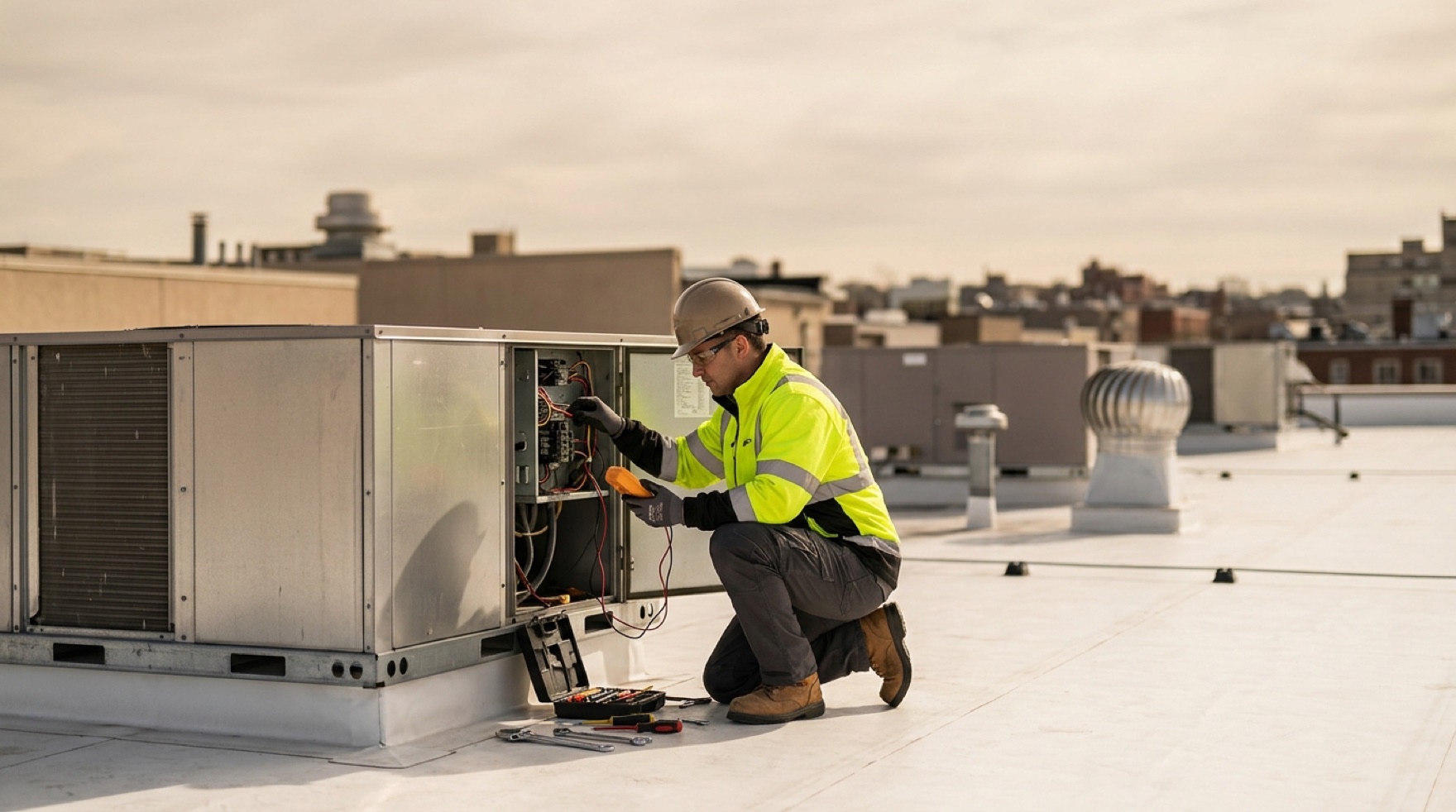
The short answer: The two hazards that kill HVAC technicians on rooftop service calls are falls and electrocution, and both are controlled before the work starts. 29 CFR 1910.28 requires fall protection at 4 feet or more in general industry and sets specific distance-based rules for low-slope roofs and for skylights, which count as holes. 29 CFR 1910.333 requires de-energizing equipment before working on or near it unless that is infeasible or introduces a greater hazard, with lockout/tagout applied to the disconnect. Work the checklists below before you open the unit, not after.
A rooftop unit sits in the middle of two hazard families at once: an open roof with edges and skylights, and energized equipment fed from a disconnect that may be out of sight. The items below are grouped so a technician can run them as a pre-work check. Anything that fails is a stop, not a note for later.
What fall-protection checks come before rooftop HVAC work?
Before anyone carries tools onto the roof, confirm that every fall hazard within reach of the work has a control in place. 1910.28(b)(13) governs low-slope roofs and 1910.28(b)(3)(i) treats a skylight as a hole requiring protection at 4 feet or more above the level below. The check is about the whole path to the unit, not just the spot the technician stands to work, because the fatal fall is often on the walk to and from the van.
- Identify the roof edge and every skylight, hatch, and roof opening between the access point and the unit, and treat each skylight as an unguarded hole until proven otherwise
- Confirm the fall-protection method for the work zone: guardrail, travel restraint, personal fall arrest, or a safety net, matched to how close the work is to the edge
- Verify skylights are guarded with a screen, cover, or guardrail, or that the work is kept clear of them, and never use a skylight dome as a work surface or a place to set weight
- Inspect any personal fall arrest system before use: harness, lanyard or self-retracting lifeline, and a certified anchorage, with connectors intact
- Plan the route to and from the roof access so the walk to the van does not cross an unguarded edge or skylight
- Account for weather: wet, iced, or wind-loaded roofs raise the fall risk and can defer non-urgent work
A Washington State FACE investigation shows how ordinary the fatal moment is. In SHARP report 71-124-2013, a 44-year-old HVAC technician had spent about four hours changing belts on rooftop units on a flat commercial roof that had unguarded skylights. Going back to the van for another belt, he tripped on the lip of a skylight, fell through it, and landed about 26 feet below on a concrete floor. The crew was not using fall protection. Washington investigators recommended a hazard assessment before rooftop work and guarding skylights with screens or guardrails. The transferable point is that the skylight was a hole in the roof the entire shift, which is why 1910.28(b)(3)(i) treats it as one, and the fall happened during routine movement rather than the task itself.
How do you make a rooftop unit electrically safe before servicing?
De-energize the unit and verify it before any part of your body or a tool enters it. 1910.333(a)(1) requires that live parts an employee may be exposed to be de-energized before work on or near them, unless the employer can demonstrate that de-energizing is infeasible or introduces a greater hazard; 1910.333(b) and 1910.147 set the lockout/tagout that holds it de-energized, and NFPA 70E frames the same idea as establishing an electrically safe work condition. On a rooftop unit the trap is a disconnect that is remote, mislabeled, or feeding more than one circuit.
- Locate the unit's disconnect and confirm it actually feeds this unit, not an adjacent one, before relying on it
- Open the disconnect, apply your own lock and tag, and keep the key, so the circuit cannot be re-energized by anyone else
- Account for every source of energy, including separate circuits for controls, crankcase heaters, or economizers, and stored energy in capacitors
- Test for absence of voltage with a meter you have proven on a known live source first, then re-prove it after, so a dead meter never reads as a dead circuit
- Where a task genuinely cannot be done de-energized, treat it as justified energized work under NFPA 70E, with the shock and arc-flash protective measures and permit that requires, rather than as normal practice
- Keep the panel closed to the weather and confirm the unit is dry before working on energized-adjacent components
Discharging capacitors and confirming zero voltage is the step technicians skip when a call feels routine, and it is the step that turns a service visit into an electrocution. Verifying the de-energized state with a tested meter is the difference between assuming the disconnect worked and knowing it did.
What are the low-slope roof fall-protection distances?
On a low-slope roof, the required control depends on how close the work is to the edge, and 1910.28(b)(13) sets three zones. The closer to the edge, the fewer options the standard allows, and the "infrequent and temporary" allowances only apply farther in. Rooftop HVAC work often lands in the middle and outer zones, so knowing which one the unit sits in decides the control.
| Distance from roof edge | What 1910.28(b)(13) requires | Clause |
|---|---|---|
| Less than 6 feet | Guardrail, safety net, travel restraint, or personal fall arrest system | 1910.28(b)(13)(i) |
| 6 to less than 15 feet | Same systems; a designated area is allowed only when the work is both infrequent and temporary | 1910.28(b)(13)(ii) |
| 15 feet or more | No fall protection required if work is both infrequent and temporary, and a work rule keeps employees 15 feet back from the edge | 1910.28(b)(13)(iii) |
Two cautions sit on top of that table. The 15-foot allowance is not a blanket exemption: it applies only to infrequent and temporary work and requires an enforced rule keeping people back from the edge, so a technician who drifts toward the edge to route a line has left the exemption. And the zones govern the edge, not skylights: a skylight anywhere on the roof is still a hole under 1910.28(b)(3)(i), guarded or avoided regardless of its distance from the perimeter, which is precisely the gap the Washington fatality fell through.