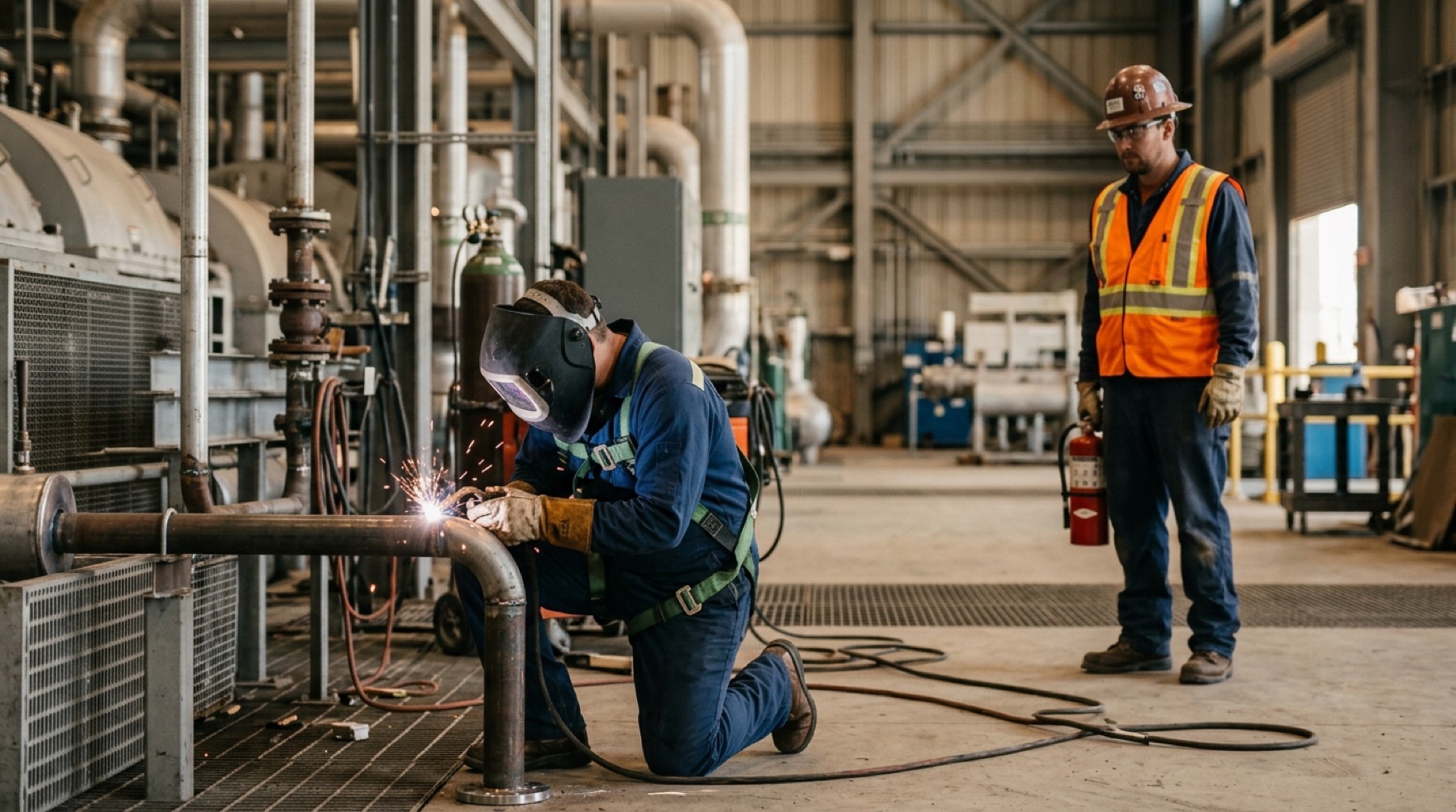
The short answer: Hot work in Canada is governed by a mix of provincial and territorial OHS regulations, provincial fire codes based on the National Fire Code of Canada, and the welding standard CSA W117.2-19 (R2023). There is no single national "hot work permit" statute. CCOHS treats obtaining a hot work permit before the job as the core control, and requires a trained fire watch to be posted in the work area for at least 60 minutes after the work stops, with monitoring "up to 3 or more hours" where the circumstances call for it. Because permit content and retention are set province by province, confirm the exact duties with the OHS regulator and fire authority that govern your workplace.
What counts as hot work, and what does a permit do?
CCOHS defines hot work plainly: "working with ignition sources near flammable materials is referred to as 'hot work,'" and "welding, soldering, and cutting are examples of hot work." Grinding and any other spark- or flame-producing operation carried out near combustibles falls under the same idea. The trigger is the combination of an ignition source and nearby fuel, not the specific tool.
The permit is the control that ties the job to a verified, fire-safe area. CCOHS frames "getting a hot work permit before performing hot work" as "just one of the steps involved in a hot work management program that helps to reduce the risk of starting a fire." A permit is not paperwork for its own sake: it is the record that a named, authorized person inspected the area and set the precautions before the arc was struck, rather than after the risk was created. A complete program, in the CCOHS account, sets policies for where and when hot work may happen and who authorizes it, procedures for assessing and preparing the area, training for each role, and communication through postings and signage.
Which rules govern hot work in Canada?
Three layers apply together, and none of them is a single federal hot-work rule. First, provincial and territorial OHS regulations carry the fire-prevention and hot-work duties that bind most employers, while federally regulated workplaces follow the Canada Labour Code Part II and the COHSR. Second, fire safety is enforced through provincial fire codes, most of which are based on the National Fire Code of Canada and administered by the local fire authority; those codes carry the hot-work provisions on the building and property side. Third, CSA W117.2-19 (R2023), "Safety in welding, cutting, and allied processes," is the consensus welding standard the industry works to, and it addresses the fire-prevention side of the work alongside the personal protection. Because the OHS regulation, the fire code, and the welding standard each contribute, a facility usually runs one permit built to satisfy all of them at once, then confirms the details with the authorities that govern its site.
How do you prepare the area before striking an arc?
The preparation is about removing the fuel and closing the paths sparks travel, then keeping the means to put out a fire within reach. CCOHS sets out the practical steps: move flammable and combustible materials away from the work area, and where they cannot be moved, cover them "with fire-resistant blankets or shields." Sweep combustible debris from the floor, and remove "spilled grease, oil, or other combustible liquid." Keep suppression ready and serviceable, and "make sure that appropriate fire extinguishers (e.g., ABC fire extinguishers) are available and easily accessible."
The part housekeeping alone misses is hidden and adjacent fuel. Sparks and slag travel through floor gaps, roll under walls, and heat conducts through steel to whatever is stacked against the far side of a partition, so the pre-work check has to look past the immediate work surface to openings, concealed spaces, and the opposite sides of walls. This is also where atmosphere matters: hot work on or near tanks and drums that have held flammable substances carries an explosion risk from residual vapour, so those vessels have to be cleaned and, where needed, tested before any spark is made. The permit is where that verification is recorded.
How long must the fire watch stay after the work?
The fire watch is the control for the fires that start after the crew thinks the job is done. CCOHS requires a trained fire watcher to be posted in the work area, and to stay "for at least 60 minutes after work has stopped." It then adds an important qualifier: "depending on the work done, the area may need to be monitored for longer (up to 3 or more hours) after the end of the hot work until fire hazards no longer exist." The waiting period exists because hot-work fires are frequently discovered after the arc goes out, once a smoldering ignition in concealed material has had time to grow. The 60-minute figure is a floor, not a fixed stop: the deciding test is that the fire hazards no longer exist, which for heavy work in a fuel-rich area can mean watching well beyond the first hour.
Canada at a glance: what governs hot work
The table separates the three layers so a facility can see which requirement each duty comes from.
| Element | Canada (most workplaces) | Source of the duty |
|---|---|---|
| OHS duty | Provincial/territorial OHS act + regulations on fire prevention and hot work; federal = Canada Labour Code Part II + COHSR | Provincial OHS regulator / ESDC Labour Program |
| Fire code | Provincial fire codes based on the National Fire Code of Canada, enforced by the local fire authority | National Fire Code of Canada / provincial fire authority |
| Welding standard | CSA W117.2-19 (R2023), "Safety in welding, cutting, and allied processes" | CSA Group; referenced by CCOHS |
| Permit | Obtained before the work; part of a hot work management program with defined roles | CCOHS: Welding - Hot Work |
| Fire watch | Trained watcher in the work area for at least 60 minutes after work stops; up to 3 or more hours as circumstances require | CCOHS: Welding - Hot Work |
Treat the permit as a live control for one job in one place, not a standing pass. Name the specific location and time window, so that when the work moves, the tank changes, or the shift ends, the authorization ends with it and a fresh check is required. Build the program to the CCOHS steps, hold the fire watch to the 60-minute floor and longer where the hazard warrants, and confirm the permit content, retention, and any additional fire-code duties with the OHS regulator and fire authority that govern your workplace.