The short answer: Flour dust is a respiratory sensitizer, and CCOHS lists it among the agents that cause sensitizer-induced occupational asthma in bakers, millers and cooks. There is no single national exposure limit in Canada. Occupational health and safety is split by jurisdiction: most bakeries fall under their province's or territory's OHS act and regulations, while federally regulated workplaces follow the Canada Labour Code Part II and the Canada Occupational Health and Safety Regulations (COHSR). Ontario's Regulation 833, for example, sets wheat flour dust (total dust) at a 3 mg/m3 time-weighted average, but other provinces adopt different values, so the governing number depends on where the bakery operates. Flour and dough-conditioning enzymes are covered by WHMIS 2015, and the control that works is keeping the dust out of the air: enclose the dusty process and extract at the source, rather than relying on a dust mask.
Is flour dust really a serious respiratory hazard?
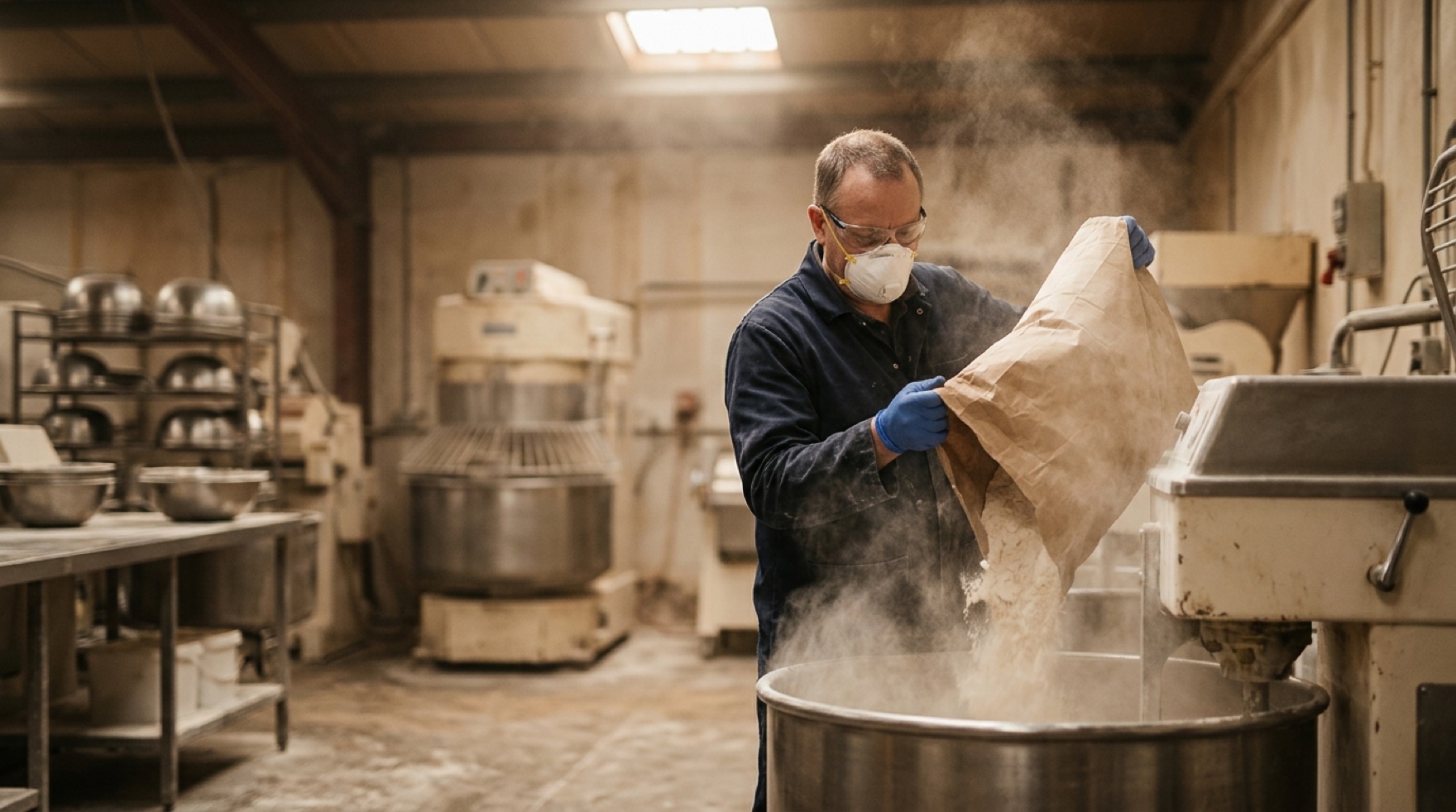
Yes. CCOHS classifies flour as a respiratory sensitizer and names "wheat, flours, grains, nuts, eggs, spices, additives" among the agents that cause sensitizer-induced occupational asthma in bakers, millers and cooks. Sensitization is not the same as ordinary irritation. It is a specific immune response: after a period of exposure, as CCOHS puts it, a worker "may start producing too many of the antibodies called immunoglobulin E (IgE)." Those antibodies attach to cells in the lungs, and on later exposure they trigger the release of chemicals that constrict the airway. Bakeries also add fungal enzymes such as alpha-amylase to improve dough, and those enzymes are themselves potent respiratory sensitizers.
That sequence is why the hazard is easy to underrate. A new hire feels nothing for months or years, so the dusting flour at the make table, the puff from a bulk bag dump, and the haze around the mixer all read as normal bakery conditions while the exposure does its work quietly. By the time work-related wheezing, a blocked or running nose, and asthma attacks appear, the sensitization is often established. CCOHS is blunt about the stakes: "If the exposure to the trigger is not stopped, treatment will be needed continuously and the breathing problems may become permanent." WorkSafeBC likewise describes long-term flour dust exposure as a cause of occupational asthma, also known as baker's asthma. The operational point for a bakery is that the people most at risk are the ones it has already invested in training, so stopping the exposure protects production capacity as much as health.
Who sets the flour-dust exposure limit in Canada?
The limit comes from the jurisdiction that governs the workplace, not from one national rule. Most bakeries answer to a province's or territory's OHS act and its exposure-limit regulation; federally regulated employers answer to the Canada Labour Code Part II and the COHSR. CCOHS provides guidance across all of it, but CCOHS is guidance, not law: the enforceable number is whichever value the governing regulator has adopted.
Ontario is a useful worked example because its figures are published and confirmable. Under Regulation 833, wheat flour dust (total dust) carries an 8-hour time-weighted average of 3 mg/m3, and grain dust (oat, wheat, barley) carries a time-weighted average of 4 mg/m3. Ontario also incorporates the ACGIH table by reference for substances its own table does not list, and requires the more restrictive value to apply. Other provinces handle the same hazard differently. Several adopt the ACGIH threshold limit values directly by reference rather than publishing a made-in-province table, and those values can differ from Ontario's. WorkSafeBC publishes hazard guidance on flour dust that names baker's asthma as the long-term risk but does not state a numeric limit on that page, so a British Columbia employer confirms the governing value in the provincial table of exposure limits rather than assuming Ontario's figure carries over.
The honest summary is that no one flour-dust number applies across Canada. Where this article states a figure, it is tied to a specific regulator's published table; anywhere else, the value is set provincially and must be confirmed with the OHS authority for that jurisdiction. Treating an exposure limit as a national constant is exactly the mistake that leaves a bakery citing the wrong number.
| Element | Canada (varies by jurisdiction) | Source of the duty |
|---|---|---|
| Governing law | Provincial/territorial OHS act + exposure-limit regulation; federal = Canada Labour Code Part II + COHSR | Provincial OHS regulator / ESDC Labour Program |
| Exposure limit, wheat flour dust (Ontario) | 3 mg/m3 total dust, 8-hour TWA | Ontario Regulation 833 table |
| Exposure limit, grain dust oat/wheat/barley (Ontario) | 4 mg/m3, 8-hour TWA | Ontario Regulation 833 table |
| Other provinces | Many adopt ACGIH TLVs by reference; values differ, no national number | Each provincial/territorial regulator |
| Hazard classification of flour | Respiratory sensitizer (WHMIS 2015 health hazard class) | Hazardous Products Act + Hazardous Products Regulations |
How does WHMIS 2015 apply to flour and dough enzymes?
WHMIS 2015 is Canada's hazard communication system, put in place through the federal Hazardous Products Act and the Hazardous Products Regulations and aligned with the Globally Harmonized System. Its four working parts are hazard classification, supplier labels, safety data sheets, and worker education and training. Respiratory sensitization is a recognized health hazard class under WHMIS: CCOHS describes respiratory sensitizers as products that "may cause allergy or asthma symptoms or breathing difficulties if inhaled." That is precisely the hazard flour and alpha-amylase present.
For a bakery this has three practical consequences. First, any product classified as hazardous, which includes many enzyme dough conditioners and can include flour depending on the supplier's classification, must arrive with a WHMIS-compliant supplier label and a safety data sheet, and the SDS must be readily available to workers on shift. Second, workplace containers that flour or an enzyme blend is decanted into carry a workplace label. Third, and most important for a sensitizer, the employer must deliver worker education and training on the hazard and its safe handling before the product is used. Training earns its place here because sensitization is invisible until it is advanced: a baker who knows that a work-related runny nose and wheeze are early warnings, not just a head cold, can be assessed and moved before the asthma becomes fixed. Because flour dust is finely divided organic dust, the same material also carries a dust-explosion hazard, which is a further reason to keep it out of the air rather than let it accumulate.
How do you control flour dust on the bakery floor?
Control the dust the way CCOHS frames every sensitizer, through the hierarchy of control, and the way WorkSafeBC lays it out for flour specifically. A respirator protects one worker for one shift and depends on fit and discipline; controls higher up the list protect everyone in the space every shift, which is why both regulators put respiratory protection last.
- Eliminate or substitute the release. CCOHS calls elimination the ideal way to prevent work-related asthma, and WorkSafeBC asks first whether a process that generates less flour dust can be used. Handle flour in enclosed systems where the recipe allows: pneumatic transfer from bulk storage, enclosed dispensing hoppers, and low-dust or granulated ingredient forms. A dump station open to the room is a dust generator that no downstream control fully catches.
- Engineer the exposure down. Both regulators point to ventilation and enclosure of dusty processes such as tipping, sieving and dusting. Fit a flour dust extraction system with local exhaust (source capture) at dump stations, sifters, mixers and dividers so dust is drawn away before it reaches the breathing zone. For cleanup, WorkSafeBC specifies a HEPA vacuum; never dry sweep or use compressed air, both of which throw settled flour back into the air the whole crew breathes.
- Use administrative controls. CCOHS lists medical screening and a surveillance program for at-risk workers, alongside written procedures. WorkSafeBC points to written exposure control plans, warning signs, and improved cleaning practices. A symptom-reporting route that lets a sensitizing worker be identified and moved early buys time that a fixed asthma diagnosis does not give back.
- Provide respiratory protection last. Where exposures still exceed the target after the controls above, provide proper respirators for cleanup and dusty short-term tasks. WorkSafeBC is explicit that this is the least effective control and must be paired with at least one other measure, run under a respiratory protection program with fit testing and medical evaluation. A dust mask handed out on its own is not a substitute for capturing the dust.
The hierarchy matters because flour dust sensitization is driven by cumulative exposure. Every layer that keeps the dust out of the air lowers the dose a new baker accumulates over their first years, which is the window when sensitization is most preventable.
Designing to the hazard, not to a single number
Flour dust is the defining occupational-health exposure of commercial baking in Canada, and the reason it gets missed is that it does its damage slowly. Because there is no national flour-dust limit, the first job for a Canadian bakery is to identify the exposure limit its own regulator sets, whether that is Ontario's 3 mg/m3 for wheat flour dust, an ACGIH value adopted by reference in another province, or a federal figure under the COHSR. The second job is to build the program CCOHS and WorkSafeBC both describe: enclose the dusty process, extract at the source, clean with a HEPA vacuum instead of a broom, meet the WHMIS 2015 duties for labels, safety data sheets and worker training, and hold a respiratory program for the tasks that still generate dust. Do that, and the bakery protects both its people and the skilled capacity they represent, which is the outcome every one of these controls is finally about.