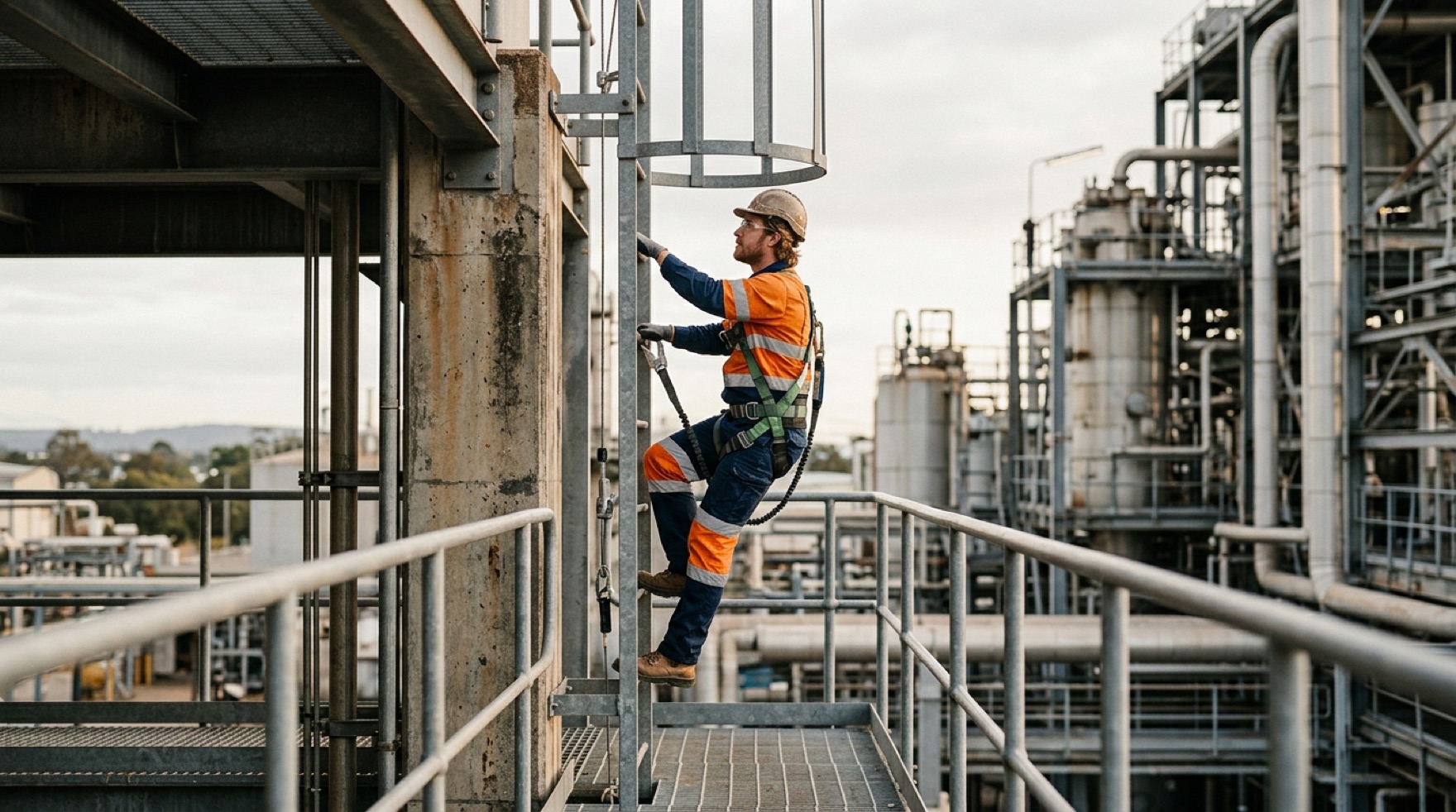
The short answer: Canada regulates fall protection through each province's or territory's OHS regulation, so there is no single national trigger height and no Canadian version of the US 1910.28 fixed-ladder cage phase-out. CCOHS reports that most jurisdictions require fall protection at about 3 metres (10 feet), and that protection can also be required below that height where a fall could cause greater injury; some provinces set lower triggers for specific work, such as 1.2 metres in Alberta for a permanent work area and in Ontario and Manitoba for defined pathways. Fall-protection equipment is specified through the CSA Z259 series, which becomes enforceable when a jurisdiction adopts it into law. Federally regulated sites follow the COHSR Part XII fall-protection provisions.
At what height is fall protection required in Canada?
There is no single national figure. CCOHS reports that most Canadian jurisdictions require fall protection where a worker could fall about 3 metres (10 feet), and that some jurisdictions also require it below that height when a fall onto the surface or objects below could cause greater injury. Several provinces set lower or additional triggers for specific work: Alberta requires protection at a permanent work area above 1.2 metres, and Ontario and Manitoba can require it where a worker could fall more than 1.2 metres along a defined pathway. In British Columbia, the WorkSafeBC OHS Regulation Part 11 (Fall Protection) requires fall protection where a fall of 3 metres (10 feet) or more may occur, and requires a written fall-protection plan where a fall of 7.5 metres (25 feet) or more may occur. The point for a facilities team is to read the trigger height off the regulation that governs the site rather than assuming a common number.
This is the first place a Canadian program diverges from the US one. Under 29 CFR 1910.28 the trigger for fixed-ladder fall protection is 24 feet, and the US rule runs a cage phase-out with a hard 2036 deadline. Neither the 24-foot line nor the cage phase-out is Canadian law. A Canadian facility maps its fixed ladders and elevated work against its own provincial or territorial height trigger, not against the US 1910.28 schedule.
The US cage phase-out and 2036 deadline do not apply here
In the US, 29 CFR 1910.28(b)(9) is phasing the traditional ladder cage out as acceptable fall protection: new fixed ladders need a personal fall arrest system or a ladder safety system, and by November 18, 2036 every US fixed ladder over 24 feet must have one, with cages no longer sufficient on their own. That timeline is specific to OSHA and has no Canadian equivalent. Canadian fixed-ladder and permanent-access requirements are set by the design and guarding provisions of each provincial or territorial regulation, and where a fixed ladder requires fall protection, the equipment is specified through the CSA Z259 series rather than an OSHA phase-in table.
So a Canadian facilities leader should not budget or plan against the 2036 US date. The right reference points are the height trigger in the governing OHS regulation, that regulation's fixed-ladder and guarding design requirements, and the CSA Z259 equipment standards the jurisdiction has adopted. Importing the US cage-conversion schedule would plan for a deadline that does not exist under Canadian law.
What equipment standard applies: the CSA Z259 series
Fall-protection equipment in Canada is specified through the CSA Z259 series, and CCOHS notes those standards become enforceable when a jurisdiction adopts them into law. The series covers the components a facilities team uses for elevated work and fixed-ladder access, including full-body harnesses (Z259.10), personal energy absorbers and lanyards (Z259.11), self-retracting devices (Z259.2.2), manufactured horizontal lifeline systems (Z259.13), anchorage connectors (Z259.15), and the design of active fall-protection systems (Z259.16), among others. Which editions are enforceable depends on what the governing regulation has adopted, so confirm the specific Z259 designations named in your jurisdiction's rule.
Training duties also vary. In Ontario, workers on construction projects who must use a fall-protection method are required to complete a Working at Heights training program approved by the Chief Prevention Officer under O. Reg. 297/13, a construction-project requirement that does not map one-to-one onto general facilities work. Check the height trigger, the fixed-ladder design requirements, the CSA Z259 equipment standard, and any training rule in the regulation that governs your site.
| Point | Canada | Source |
|---|---|---|
| Governing law | Provincial or territorial OHS regulation; federal = COHSR Part XII | Provincial OHS regulator / ESDC Labour Program |
| General height trigger | About 3 m (10 ft) in most jurisdictions; lower in some (e.g. 1.2 m in defined cases) | CCOHS; WorkSafeBC Part 11 (3 m) |
| Equipment standard | CSA Z259 series (harnesses, lanyards, SRDs, lifelines, anchorages, system design) | CSA Group; cited by CCOHS |
| US 1910.28 cage phase-out / 2036 deadline | Does not apply in Canada; no 24 ft trigger and no cage-conversion schedule | US OSHA rule only |
The practical takeaway is to inventory every fixed ladder and elevated work area, record its height above the lower level, and sort it against the trigger height in the governing Canadian regulation, not the US 24-foot line. Specify any fall-protection equipment to the CSA Z259 standards the jurisdiction has adopted, apply the regulation's fixed-ladder and guarding design requirements, and confirm the training rule that applies to the work. That is a Canadian program on Canadian numbers, which is what a provincial or territorial inspector will measure it against.