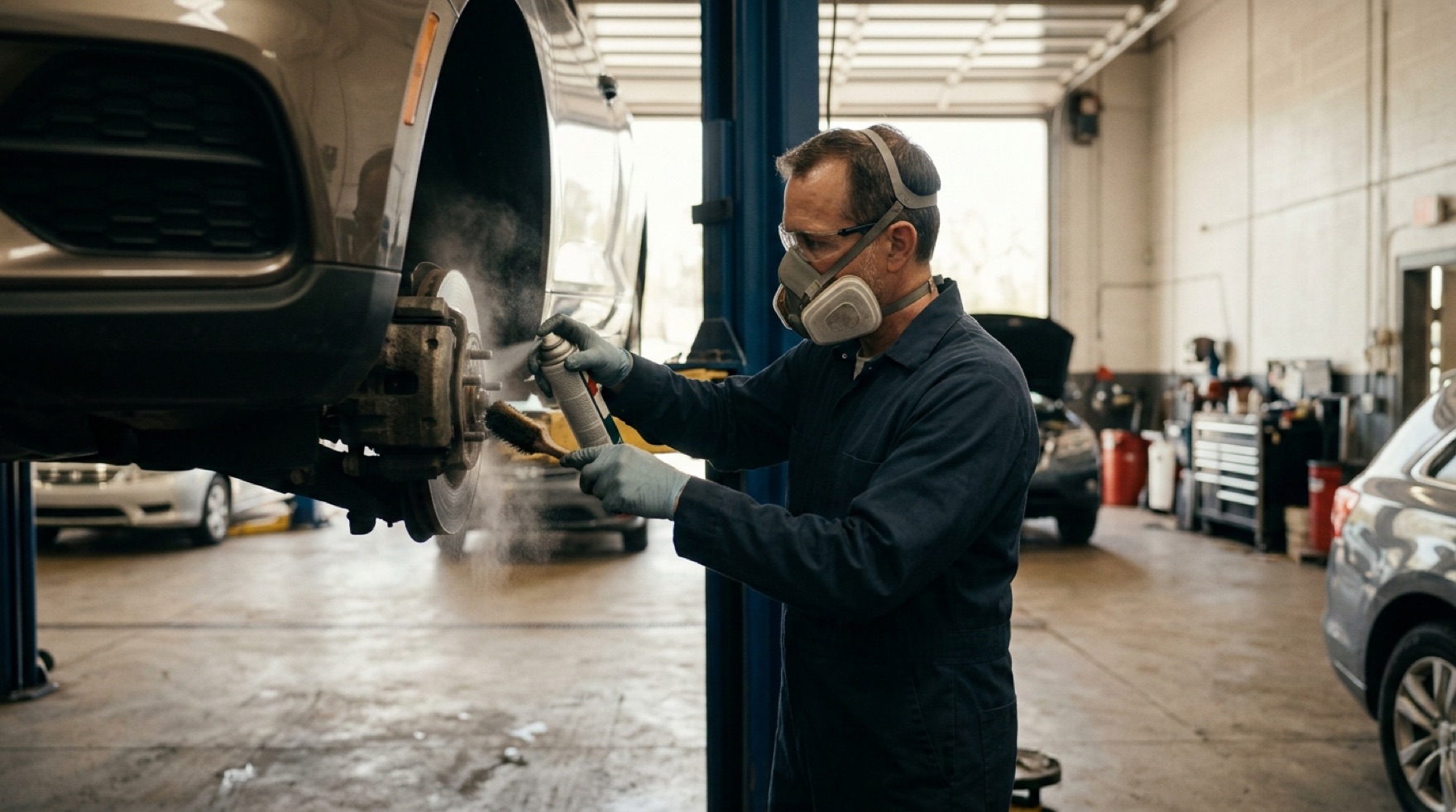
The short answer: You cannot identify asbestos-containing brake material by sight, and CCOHS warns that some brake and clutch pads may still contain it, so the safe method applies to every brake and clutch job. CCOHS's method is to work in a separate area and remove the dust with a HEPA-filtered vacuum, or where no vacuum is available to wet the assembly with low-pressure water and wipe it with a damp cloth. Never use compressed air or a dry brush, and do not bang the drum. Asbestos work is regulated province by province, so the classification and any exposure limit are set by your OHS regulator. The solvents in brake cleaners and parts washers are WHMIS 2015 hazardous products with their own provincial exposure limits.
Do brakes still contain asbestos, and can you tell?
Most friction material sold today is non-asbestos, but the exposure has not disappeared. CCOHS states plainly that some brake and clutch pads may still contain asbestos, that asbestos can cause serious lung disease, and that special regulations may apply. The material that remains a concern is on older vehicles, in the accumulated dust inside older drums, and in friction products of uncertain origin, including some imported or aftermarket parts. Because asbestos-containing and asbestos-free friction material look identical, a technician has no reliable way to know which is on the vehicle in front of them.
That uncertainty is the operational point. Treating an unknown part as safe is a gamble against a fibre that causes mesothelioma and lung cancer with no established safe exposure level. The safe response is to regulate the task rather than the technician's guess about the part, which is exactly what CCOHS's brake-work method does: it applies the same protective practices to every brake and clutch job regardless of what the pads are believed to contain.
Who regulates asbestos brake work in Canada?
Asbestos is regulated by jurisdiction, so the classification, control measures, and any air monitoring for brake and clutch servicing are set by the OHS regulator that governs the shop, with federally regulated workplaces following the Canada Labour Code Part II and the COHSR. Provinces run their own asbestos regulations and designated-substance rules, for example Ontario Regulation 278/05 for asbestos or the asbestos provisions of the WorkSafeBC OHS Regulation, and they differ in how they classify and control the work. CCOHS is direct that requirements vary and that you should check your local jurisdiction for the exact rules and contact your local government agency to confirm the exposure limit in your area.
On the number itself, CCOHS references an exposure limit of 0.1 fibres per cubic centimetre based on the ACGIH threshold limit value, while noting that provincial variations exist. That figure is a reference point, not a single national limit: the enforceable exposure limit and the control tier that applies to a given brake job are whatever the governing province sets. The honest position for a Canadian shop is to use the protective method every time and confirm the applicable limit and monitoring duties with its own regulator rather than assuming one number applies everywhere.
What is the safe cleaning method?
CCOHS sets out a specific method for brake and clutch dust, and it does not depend on knowing whether the pads contain asbestos. Clean and service brakes in a separate work area. Remove the dust with a vacuum equipped with a high-efficiency particulate air (HEPA) filter. Where a vacuum is not available, wet the brake assembly down with low-pressure water or a gentle spray and wipe it clean with a damp cloth. Use approved respiratory protection when necessary. The two methods and the practices that apply to both are compared below.
| Feature | HEPA vacuum method | Low-pressure wet method |
|---|---|---|
| How it controls dust | Removes dust with a vacuum equipped with a HEPA filter | Wets the assembly with low-pressure water or a gentle spray, then wipes with a damp cloth |
| When CCOHS uses it | The primary method for removing brake and clutch dust | When a HEPA vacuum is not available |
| Work area | Separate work area for brake and clutch service | Separate work area for brake and clutch service |
| Never do | No compressed air, no dry brushing, do not bang the drum to shake out dust | No compressed air, no dry brushing, do not bang the drum to shake out dust |
| Respiratory protection | Approved respiratory protection when necessary | Approved respiratory protection when necessary |
Why is compressed air the wrong tool?
Blowing a brake assembly clean with compressed air is the exact practice CCOHS's method exists to replace, because it launches any asbestos fibres straight into the technician's breathing zone. CCOHS is explicit: do not use compressed air or a dry brush to clean the brakes, and do not bang the drum to remove dust. Its broader asbestos guidance carries the same rule, that compressed air must not be used to clean up and remove dust from any surface. Dry, uncontrolled dust is how the fibre gets into the air and the lungs, so the assembly stays wet under the wet method or is captured by the HEPA vacuum, and the residue is collected rather than swept up. That single habit, no dry dust, is what separates a compliant brake job from one that exposes the technician and everyone downwind in the bay.
The habit extends past the wheel to the housekeeping around it. Keeping the brake work in a separate area limits how far the dust travels, and cleaning that area with a HEPA vacuum or a damp wipe rather than a dry broom keeps settled dust from being stirred back into the air. The collected dust, the used filters, and the wet residue are treated as contaminated material rather than ordinary shop waste, and where a job cannot be confirmed asbestos-free the governing province's asbestos rules decide how that material is handled and disposed of. Confirm those disposal duties with your regulator, because they, like the exposure limit, are set jurisdiction by jurisdiction.
What about the solvents in brake cleaners and parts washers?
Brake cleaners and parts-washer fluids introduce a second exposure, and in Canada their solvents are hazardous products under WHMIS 2015. The federal Hazardous Products Act and Hazardous Products Regulations set what a supplier must put on the label and the safety data sheet, and the matching provincial OHS regulations require the employer to keep the safety data sheet available, train workers, and control the exposure. The SDS is where a shop confirms which solvent it is actually using and how to protect against it, and WHMIS 2015, not the US HazCom standard, is the hazard-communication regime that applies.
Exposure limits for those solvents are set by each province and territory, and most jurisdictions base their occupational exposure limits on the ACGIH threshold limit values, with some adopting them as enforceable limits and others using them as guidelines. For that reason this article does not state a single national ppm figure: the limit that applies to a given solvent is whatever your province sets, for example through Ontario Regulation 833, and it should be read from the current provincial table. Control the exposure the way you would any airborne chemical: ventilate the bay so vapour does not accumulate, keep parts washers closed when not in use, wear chemical-resistant gloves so solvent does not contact the skin, and choose lower-toxicity products where the job allows. Confirm the asbestos and solvent exposure limits and monitoring duties with the OHS regulator that governs your workplace.