The short answer: You cannot identify asbestos-containing brake material by sight, so 29 CFR 1910.1001, OSHA's asbestos standard, sets mandatory work practices for brake and clutch work regardless of what the pads are believed to contain. For most shops that means using either the negative-pressure enclosure with a HEPA vacuum or the low-pressure wet cleaning method described in Appendix F to the standard, and never blowing brake assemblies clean with compressed air. Asbestos has an OSHA permissible exposure limit of 0.1 fiber per cubic centimeter as an 8-hour TWA. Separately, the solvents in brake cleaners and parts washers carry their own PELs under 29 CFR 1910.1000 and need ventilation and skin protection.
Do modern brakes still contain asbestos?
Most friction material sold in the United States today is non-asbestos, but asbestos exposure in brake work has not disappeared, and you cannot tell the two apart by looking. Modern original-equipment pads are generally non-asbestos organic, semi-metallic, or ceramic, and the regulatory picture is tightening: the EPA's March 2024 final rule under the Toxic Substances Control Act bans chrysotile asbestos, with the prohibition on aftermarket automotive brakes and linings and other vehicle friction products taking effect six months after the rule's effective date. The exposure that remains is in legacy vehicles, accumulated dust inside older drums, and friction products of uncertain origin, including some imported or aftermarket parts, where asbestos content cannot be ruled out.
That uncertainty is the operational point. Because asbestos-containing and asbestos-free friction material look identical, a technician has no reliable way to know which is on the vehicle in front of them, and treating an unknown part as safe is a gamble against a fiber that causes mesothelioma and lung cancer with no safe exposure threshold. OSHA resolves the uncertainty by regulating the task, not the technician's guess about the part.
What does OSHA require for brake and clutch work?
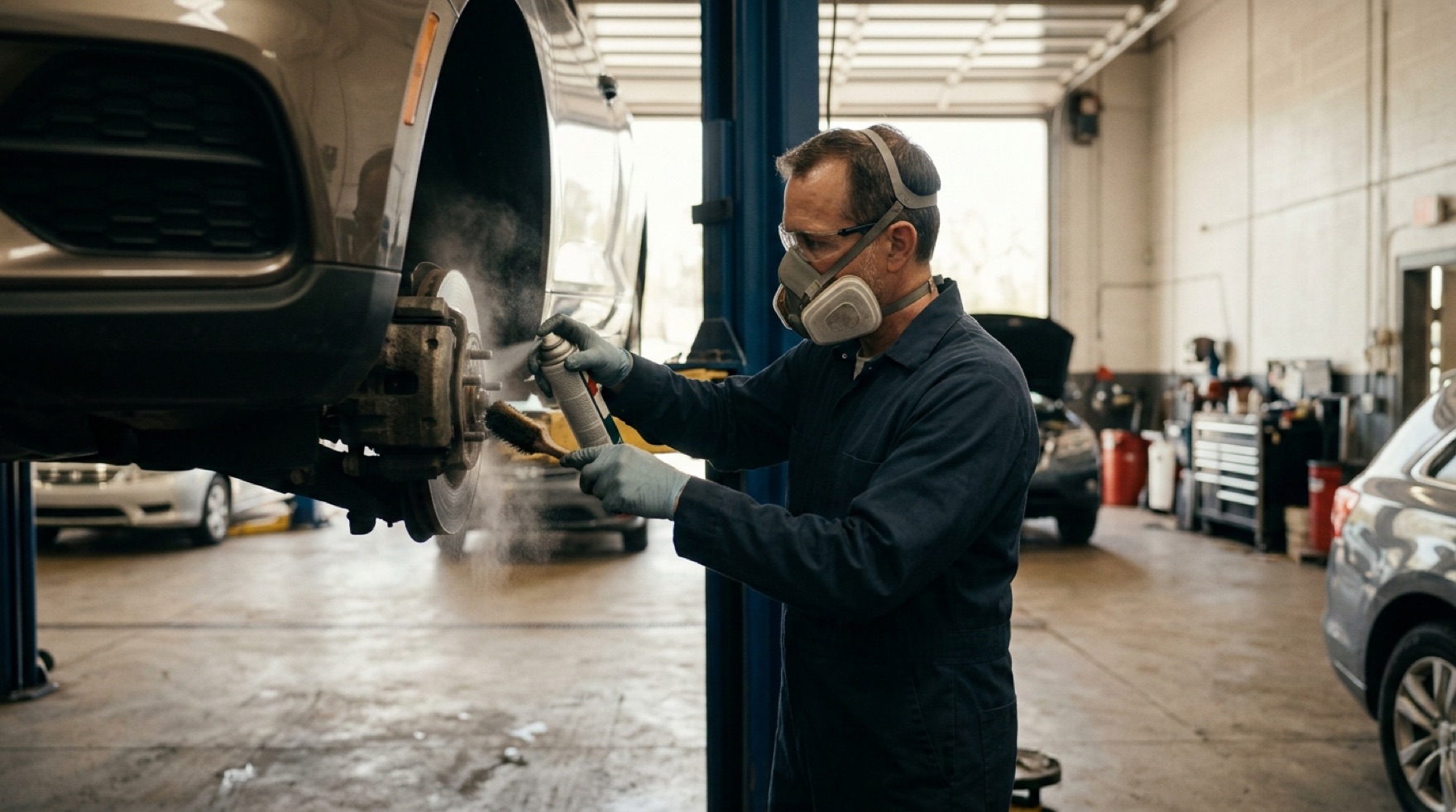
OSHA's asbestos standard sets mandatory work practices for brake and clutch service, and they apply to the job itself rather than depending on a measured exposure. 29 CFR 1910.1001(f)(3) directs employers doing automotive brake and clutch inspection, disassembly, repair, and assembly to follow the methods in Appendix F, which is a mandatory appendix. The two accepted methods are the negative-pressure enclosure with a HEPA vacuum system and the low-pressure wet cleaning method, and a shop uses one of them for this work whether or not it believes the pads contain asbestos.
The exposure limits give the numbers behind the rule. Under 1910.1001(c)(1), the permissible exposure limit for asbestos is 0.1 fiber per cubic centimeter of air as an 8-hour time-weighted average, and under 1910.1001(c)(2) the excursion limit is 1.0 fiber per cubic centimeter averaged over a 30-minute sampling period. These are OSHA enforceable limits, and they are extremely low precisely because the disease outcomes are severe and there is no established safe level. Using the prescribed methods is how a service bay keeps brake work below them.
How do the two OSHA brake-cleaning methods compare?
Both mandatory methods stop dry asbestos dust from becoming airborne, and a shop picks the one that fits its volume and setup. The negative-pressure enclosure captures the dust inside a sealed enclosure and pulls it into a HEPA vacuum, while the low-pressure wet method floods the assembly with a controlled stream of water or a solvent-and-wetting-agent solution so the dust never lifts. The table compares them as described in Appendix F to 1910.1001.
| Feature | Negative-pressure enclosure / HEPA vacuum | Low-pressure / wet cleaning |
|---|---|---|
| How it controls dust | Seals the brake assembly in an enclosure held under negative pressure by a HEPA-filtered vacuum | Wets the wheel hub, backing plate, brake shoes, and drum with a low-pressure stream before and during work |
| Access to the work | Impermeable sleeves and a clear window let the technician work inside the sealed enclosure | Open work, with the assembly kept wet so dust cannot become airborne |
| Best suited to | Higher-volume brake work where a fixed enclosure earns its place | Lower-volume or varied work where a wet catch basin is practical |
| Waste handling | Filter is wetted, removed, and placed immediately in an impermeable, labeled container | Wetted residue and filters are containerized the same way for disposal |
| Compressed air | Permitted only to remove fibers inside the sealed enclosure | Not used; dry brushing during the wet method is prohibited |
Why is compressed air the wrong tool for brake dust?
Blowing a brake assembly clean with compressed air is the exact practice OSHA's brake-work methods exist to replace, because it launches any asbestos fibers straight into the technician's breathing zone. Appendix F to 1910.1001 permits compressed air only to remove fibers inside the sealed negative-pressure enclosure, and it prohibits dry brushing during wet cleaning, both for the same reason: dry, uncontrolled dust is how the fiber gets into the air and the lungs. An open-air blast with a shop air gun does the opposite of what the standard requires.
The rule is straightforward on the floor: keep brake dust wet or contained, and never dry. Dry brushing, sweeping, or air-blowing a brake or clutch assembly outside an enclosure defeats the control, so the assembly stays wet under the low-pressure method or stays inside the enclosure under the HEPA method, and the residue is collected wet and containerized rather than swept up. That single habit, no dry dust, is what separates a compliant brake job from one that exposes the technician and everyone downwind in the bay.
What about the solvents in brake cleaners and parts washers?
Brake cleaners and parts washers introduce a second exposure, and their solvents carry their own OSHA limits under 29 CFR 1910.1000. Aerosol brake cleaners and parts-washer fluids are built on volatile solvents, and Table Z-2 of the air contaminants standard sets enforceable PELs for several of them: tetrachloroethylene, also called perchloroethylene, has an 8-hour TWA PEL of 100 ppm with an acceptable ceiling of 200 ppm, and toluene has an 8-hour TWA PEL of 200 ppm with a 300 ppm ceiling. A technician spraying solvent in an enclosed bay, or leaning over an open parts washer, can build exposure quickly, and some of these solvents are absorbed through the skin as well as inhaled.
Control the solvent exposure the way you would any airborne chemical: ventilate the bay so vapor does not accumulate, keep parts washers closed when not in use, wear chemical-resistant gloves rather than letting solvent contact the skin, and choose lower-toxicity products where the job allows. The hazard communication program under 29 CFR 1910.1200 requires the safety data sheet for each product to be available, and the SDS is where a shop confirms which solvent it is actually using and how to protect against it. Reducing solvent exposure protects the technician and keeps the bay's air within the limits the standard sets.