The short answer: Table-service staff face three recurring hazards: same-level falls on floors that go wet or greasy during service, musculoskeletal strain from carrying loaded trays and reaching across tables, and burns from hot plates and dishes. 29 CFR 1910.22(a)(2) requires the employer to keep floors clean and, to the extent feasible, dry, and to maintain drainage and dry standing places where wet processes are used, while 1910.22(d) requires walking-working surfaces to be inspected and hazards corrected before a worker uses the surface again. There is no OSHA standard that sets a numeric tray weight or serving-posture limit, so carrying and burn hazards are addressed through the employer's general duty under Section 5(a)(1) of the OSH Act and the safe-practice guidance in OSHA's restaurant serving eTool.
What are the main safety hazards for table-service staff?
The hazards that put servers on the injury log cluster into three groups: same-level falls, musculoskeletal strain, and thermal burns. Each one is predictable, each is tied to a specific moment in the service cycle, and each responds to controls that can be designed in before the shift rather than reacted to after an incident. Front-of-house work looks lighter than the cook line, but the exposure is real: a server covers miles of floor in a shift, carries loaded trays through swinging doors, and handles plates that came straight off the flat top or out of the salamander.
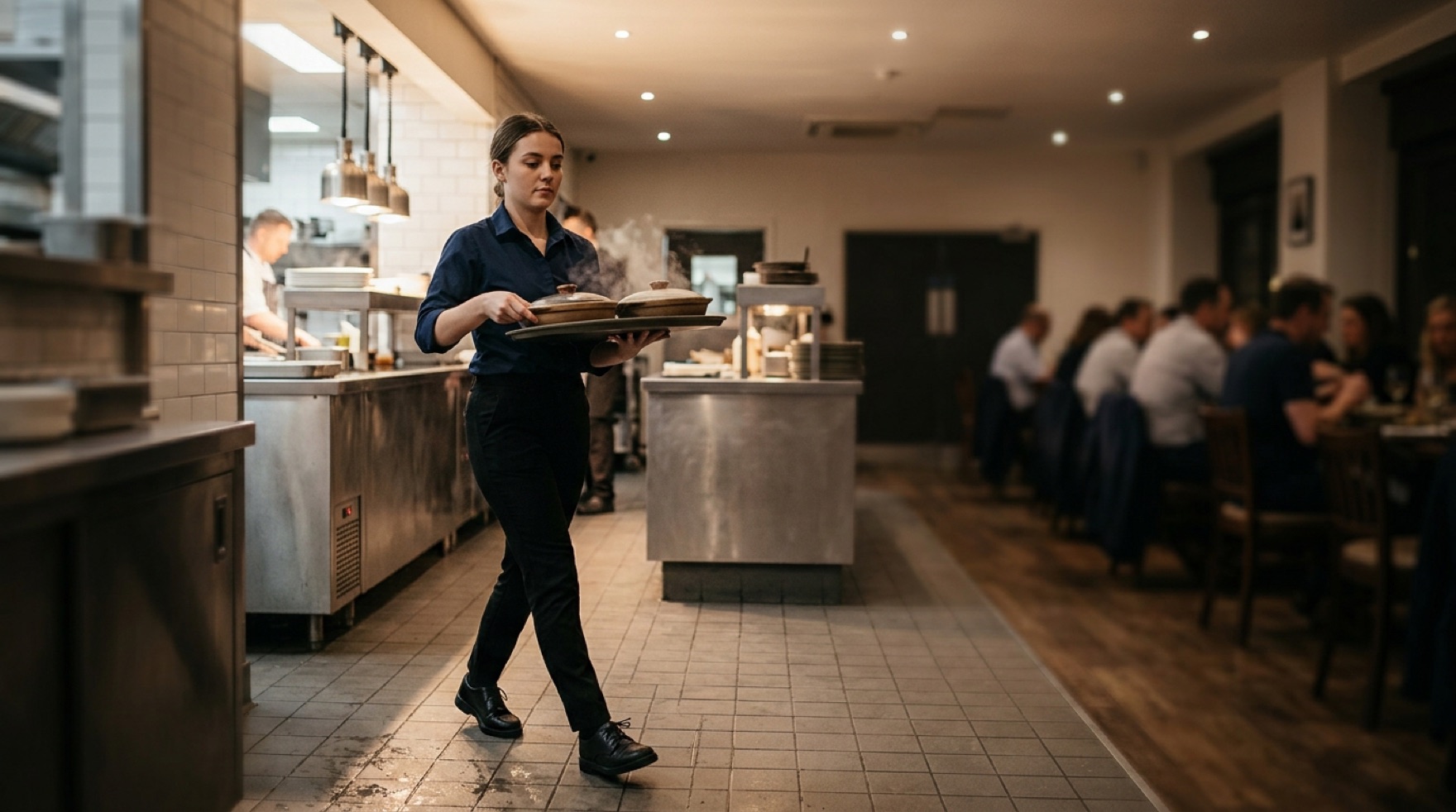
What separates table service from the kitchen line is where the hazard lives. The line cook's risk is concentrated at the station; the server's risk is spread across the whole path between the pass and the table, through the transition point at the kitchen door where a dry dining-room floor meets a wet or greasy back-of-house floor. That transition, the loaded tray held away from the body, and the hot plate ferried in a bare hand are the three exposures worth engineering around, and the sections below take each in turn.
Does OSHA require restaurants to keep dining-room floors dry and slip-safe?
Yes. 29 CFR 1910.22(a)(2) requires that "the floor of each workroom is maintained in a clean and, to the extent feasible, in a dry condition," and adds that "when wet processes are used, drainage must be maintained and, to the extent feasible, dry standing places, such as false floors, platforms, and mats must be provided." A dining room and a service well are workrooms under that rule, so spilled water at the beverage station, dropped ice by the ice maker, and tracked-in grease at the kitchen door are all conditions the standard reaches. The general housekeeping duty in 1910.22(a)(1) reinforces it, requiring places of employment and walking-working surfaces to be kept "in a clean, orderly, and sanitary condition."
The rule does not stop at keeping the floor clean. 1910.22(d)(1) requires walking-working surfaces to be "inspected, regularly and as necessary, and maintained in a safe condition," and 1910.22(d)(2) requires hazardous conditions to be "corrected or repaired before an employee uses the walking-working surface again," guarding the area if the fix cannot be immediate. Operationally, that means a same-level fall hazard is not a clean-it-when-you-get-to-it item. A spill at a table turn, ice by the machine, or a leaking bus tub is a stop-and-address item, backed by a wet floor sign until the floor is dry. The most reliable controls are the ones that remove the water before anyone walks through it: prompt spill response, drainage and mats at the wet points the standard names, and slip-resistant footwear as the last layer rather than the first.
How should servers carry trays and plates without injuring their back and shoulders?
Carry loads close to the body, limit what goes on the tray, and get help for anything awkward, because the strain builds from the lever arm between the load and the spine, not from a single heavy lift. OSHA does not set a numeric weight limit for a serving tray, so the control is technique and staffing rather than a posted number, and OSHA's restaurant serving guidance is explicit about what good technique looks like. A tray held out at arm's length multiplies the force on the shoulder and lower back; the same tray carried with the elbow tucked in and the weight balanced over the forearm cuts that force substantially.
OSHA's Young Workers Restaurant Safety eTool gives serving staff concrete direction: "avoid awkward postures if you must carry trays, plates, or beverages," "limit the number of plates or items you will carry," "carry plates with your elbows close into your body to lessen the strain on your arms and back," and "balance the load evenly, placing heavier items in the center." For furniture and bulk moves it advises workers to "get help to move tables and chairs, rather than lifting alone." Reaching is its own exposure: the same guidance tells servers to "stand by the person you are serving if possible, rather than reaching across tables and over people," because repetitive reaching across a table loads the shoulder in an extended, unsupported posture that repeats dozens of times a shift.
For a safety leader, the takeaway is that server ergonomics is a design problem, not a willpower problem. Sizing trays so a full one stays manageable, positioning side stations and bus stations to shorten carries, staffing a busser so plates leave in one trip instead of three, and training the elbows-in carry as the house standard all reduce the cumulative load that turns into a shoulder or lower-back complaint over a season. Those are the controls that hold up when the dining room is slammed and the server is tired, which is exactly when the awkward reach and the overloaded tray happen.
How do you prevent burns from hot plates and dishes?
Put a barrier between the hand and the plate, and take the reach out of the serving motion. Burns in table service come from bare-hand contact with plates that leave the pass at serving temperature and from reaching across open flame at the table. OSHA's serving eTool addresses both directly: "use a waiter's cloth or hot pads or oven mitts to protect your arms or hands when carrying hot plates or trays," "use trays to carry hot plates," and do not "reach over table candles while serving or removing food from tables." A side towel is not a garnish; on a hot-plate service it is the barrier that keeps a contact burn off the forearm.
There is no OSHA standard written specifically for restaurant burns, which is why the enforceable duty runs through Section 5(a)(1) of the OSH Act, the General Duty Clause, requiring each employer to furnish "a place of employment which are free from recognized hazards that are causing or are likely to cause death or serious physical harm." A hot-plate contact burn is a recognized hazard with a known, feasible control, so the operational response is to make the barrier and the technique standard practice: side towels or plate carriers available at the pass, a house rule that hot plates are called out when they are set down, candles and open flames kept clear of the serving line at a table, and new servers trained on the carry and the call-out before they run food. The point is not to warn servers to be careful; it is to remove the bare-hand, cross-the-flame moment from the job.
What does a practical safety program for table service look like?
Build it around the three exposures and the moments they occur, then keep it current the way 1910.22 expects. A table-service program that works treats the floor, the tray, and the hot plate as engineered controls rather than reminders, and it uses the inspection duty in 1910.22(d) as the loop that keeps the controls in place as the room changes through a shift. The table below maps each exposure to its primary control and the governing reference.
| Exposure | Primary control | Governing reference |
|---|---|---|
| Same-level fall on wet or greasy floor | Prompt spill response, drainage and mats at wet points, wet floor signs, slip-resistant footwear, floor inspection during service | 1910.22(a)(1), (a)(2), (d)(1), (d)(2) |
| Back and shoulder strain from carrying and reaching | Elbows-in carry, load limits per trip, balanced tray, help for furniture and bulk moves, station layout that shortens carries | OSH Act 5(a)(1); OSHA serving eTool |
| Burn from hot plates and open flame | Waiter's cloth, hot pads or mitts, trays for hot plates, call-out on set-down, candles kept clear of the serving reach | OSH Act 5(a)(1); OSHA serving eTool |
Tie the loop together with three habits. Inspect the floor as a walking-working surface during service, not just at open and close, because the dining-room floor that was dry at five o'clock is the one that puts a server down at eight; 1910.22(d) makes that an ongoing duty. Train the carry, the reach, and the hot-plate barrier as house standards for every new server before they run food, so the safe motion is the default when the room is full. And treat near-misses, the slip that was caught on the door frame, the plate that was nearly dropped, as the leading indicator they are, feeding each one back into where the mat, the sign, or the extra busser needs to go. A table-service floor kept dry, a tray sized to be carried close, and a hot plate that never touches a bare hand are the controls that keep servers working, and they are the ones a compliance officer and a workers' compensation record both reward.