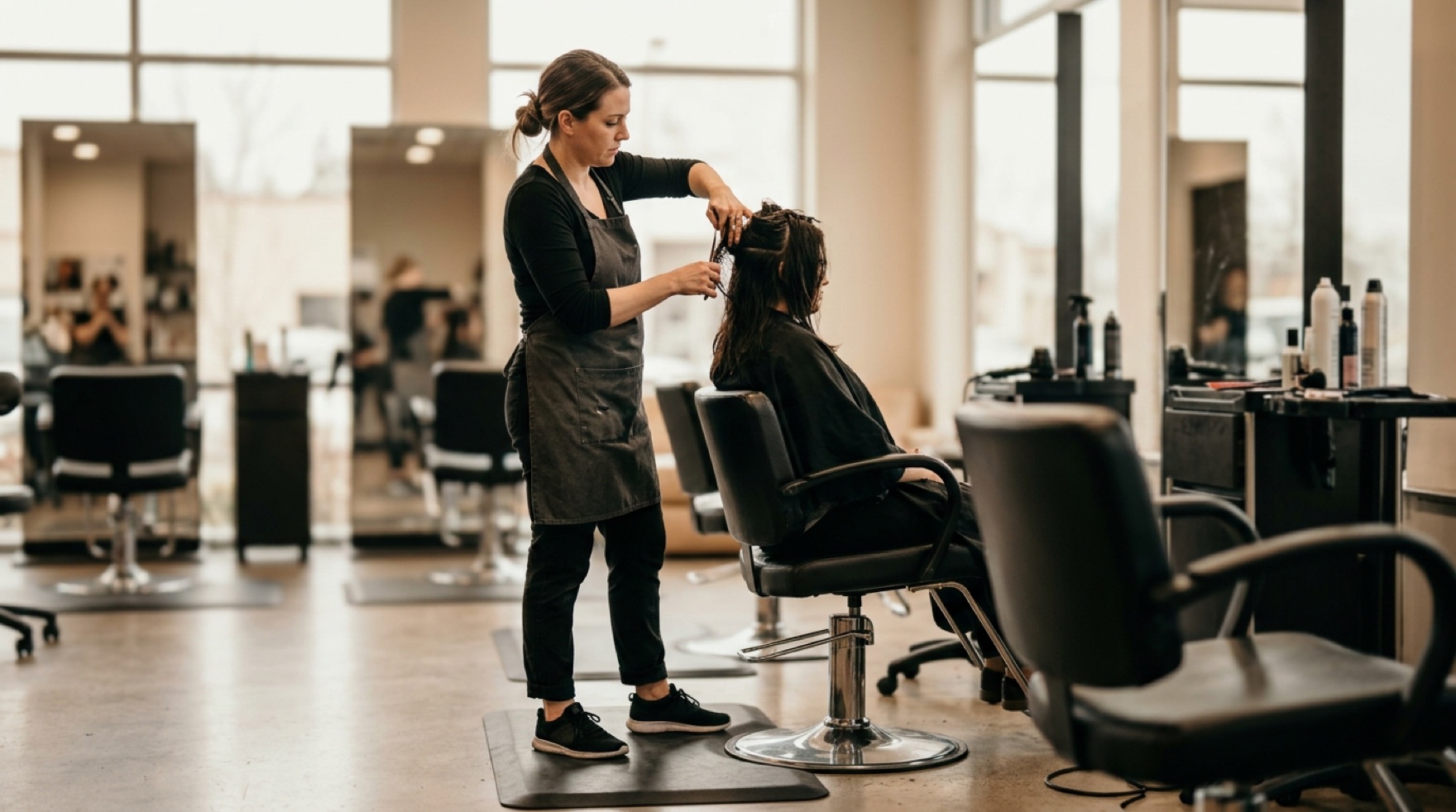
The short answer: Prolonged standing at a styling station causes sore feet, leg swelling, varicose veins, general muscular fatigue, and low-back and neck stiffness, because holding one position slows blood flow to the working muscles and lets blood pool in the legs. No single fix solves it. The Canadian Centre for Occupational Health and Safety (CCOHS) treats the problem as the combined effect of the work design, the flooring, and the footwear, so the effective response layers changing position and job rotation, a supportive floor surface, good shoes, and an anti-fatigue mat at the chair. The mat helps by cushioning a hard floor, but on its own it does not eliminate sore feet.
Why does standing all day hurt a stylist?
Standing still for long periods reduces blood flow to the leg, back and neck muscles and lets blood pool in the legs and feet, which brings on fatigue and, over time, chronic problems. According to CCOHS guidance on working in a standing position, prolonged standing is linked to sore feet, swelling of the legs, varicose veins, general muscular fatigue, low back pain, and stiffness in the neck and shoulders. The mechanism is static loading: muscles held in one posture cannot pump blood the way moving muscles do, so fatigue sets in faster and the discomfort accumulates.
For a stylist the load is compounded by overhead reach and a fixed stance at the chair. Cutting, coloring at the color bar, and blow-drying keep the arms raised and the trunk leaning while the feet stay planted, which adds sustained awkward posture and contact stress to the static standing. That combination is why the discomfort shows up in the feet and legs and in the low back and shoulders at the same time, and why a control aimed at only one of them falls short.
What actually reduces standing fatigue at the station?
The reliable approach is to change the body's position often and support it well, not to rely on any single product. CCOHS frames the discomfort of long standing as the combined effect of the work design, the worker's footwear, and the flooring, which means the controls that work are layered rather than picked one at a time. The table below compares the main layers and where each one sits, so a salon owner can see that the mat is one part of the answer.
| Control layer | What it does | Where it sits | Source |
|---|---|---|---|
| Change position and rotate tasks | Breaks up static standing so no one posture lasts long; alternates sitting and standing where a stool allows | Most effective: addresses the cause | CCOHS standing guidance |
| Station and reach layout | Adjusts chair height and working height so the stylist keeps a more neutral posture and less overhead reach | Engineering the work | CCOHS standing guidance |
| Supportive footwear | Cushions and supports the foot; a footrail lets the stylist shift weight from one leg to the other | Supports the worker | CCOHS standing guidance |
| Floor surface | Wood, cork, or rubber-covered floors are easier on the body than concrete or metal | Engineering the surface | CCOHS standing guidance |
| Anti-fatigue mat at the chair | Cushions a hard floor and absorbs shock, reducing foot fatigue at the standing spot | One layer, not a complete fix | CCOHS anti-fatigue mats |
Read the table top to bottom rather than jumping to the last row. Changing position and rotating tasks addresses the cause of static-standing fatigue, and it is free. Footwear and floor surface support the body through the whole shift. The mat is worth having, but it earns its place as the point-of-use layer at a fixed standing spot, not as the thing that makes the other layers unnecessary.
Do anti-fatigue mats help, and what are their limits?
Anti-fatigue mats do help at a fixed standing station, by cushioning a hard floor and absorbing the shock of standing and small movements, which reduces foot fatigue. According to CCOHS guidance on anti-fatigue mats, that cushioning effect is real, but a mat does not solve the whole problem on its own, because the tiredness and sore feet come from the work design, the footwear, and the flooring together. A mat at the chair placed over an unchanged all-day standing task is a partial control.
The mat also has to be chosen and placed with care, or it trades one problem for another. CCOHS advises picking a mat with some elasticity but not so soft that standing feels unstable, and specifically warns against thick foam-rubber mats, because too much cushioning can itself cause fatigue and increases the trip hazard. The mat should not slip or create a trip hazard, and sloped edges reduce the risk of catching a foot and let chairs and carts roll over the edge. In a salon those points are practical: a mat at the chair sits in a busy walk zone, so the edge detail and the grip on the floor are what keep the fatigue control from becoming a same-level fall.
How should a salon put this together?
Build the station around movement first, then support it. Give stylists the option to alternate sitting and standing where the service allows, for example by using a cutting stool for parts of a service, and rotate tasks across the day so no stylist spends the whole shift in the same fixed stance. Set the chair and working height to cut down overhead reach, because reducing the sustained awkward posture protects the shoulders and low back that the mat does nothing for.
Then add the supporting layers: supportive footwear, an easier floor surface where the fit-out allows it, and an anti-fatigue mat at each fixed standing spot, chosen with the elasticity and sloped-edge details CCOHS describes and kept flat and non-slip. Treated this way, the mat at the chair is one measurable improvement inside a work design that keeps stylists moving, which is what protects their comfort and keeps them on the floor across a long career rather than losing days to foot, leg and back complaints.