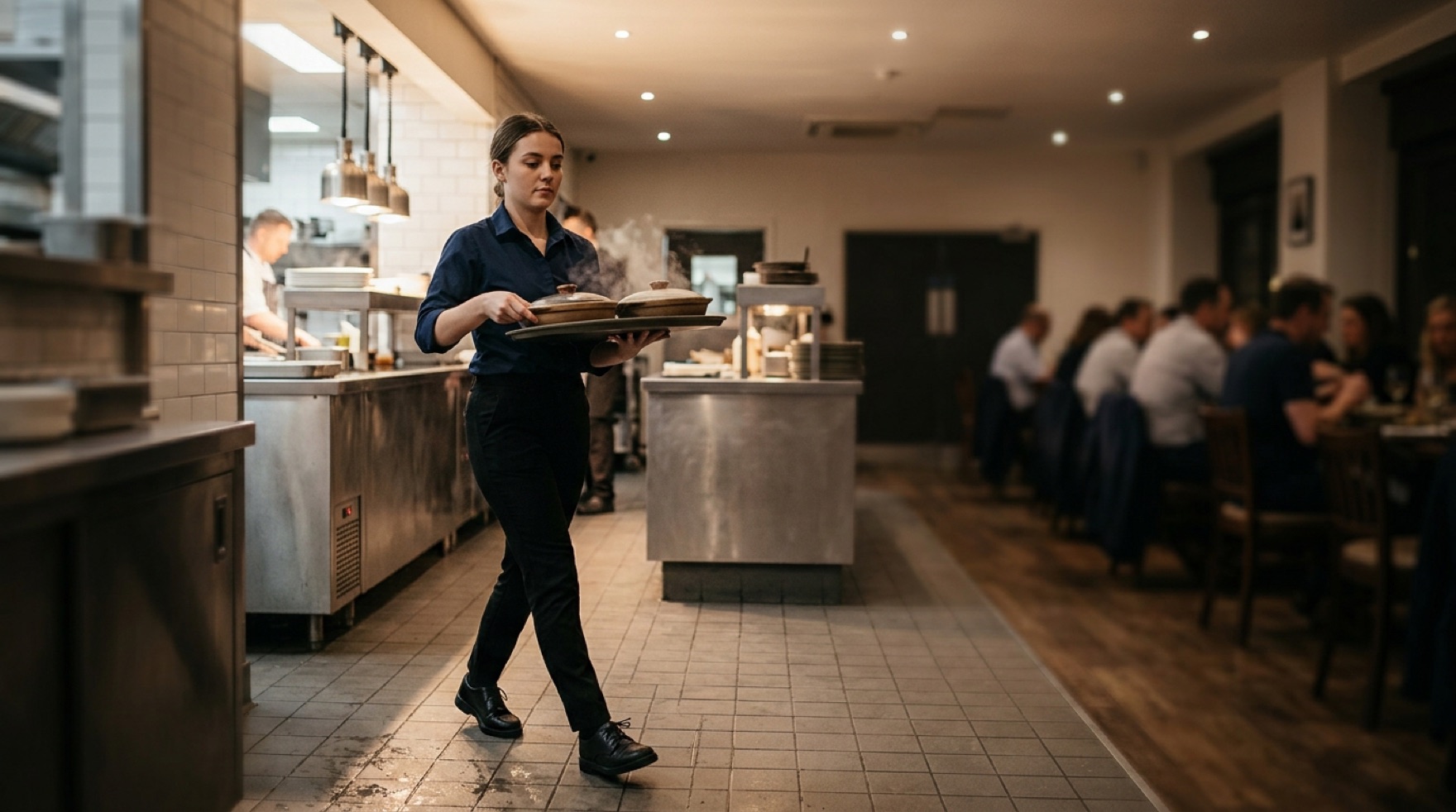
Serving looks lighter than the line, and it is not. A server covers miles of floor a shift, carries loaded trays through swinging doors, and handles plates that came straight off the flat top, so the risk is spread along the whole path from the pass to the table rather than parked at one station. In this article, we'll look at how to stop the slip where the floor changes, how to carry without wearing out your back, how to keep a hot plate off bare skin, what the front counter adds, and the one habit that ties it together.
The Slip Where the Floor Changes
The danger spot is the transition — the kitchen door where a dry dining-room floor meets a wet or greasy back-of-house floor — along with the beverage station and the ice machine. A spill is not something to leave for later; deal with it the moment it happens. The running checklist:
- Clear it now: Clear spills, dropped ice, and tracked-in grease the moment you see them, not at the next table turn.
- Sign the wet floor: Stand a wet-floor sign the second the floor goes wet, and leave it until the floor is dry.
- Mat the wet points: Put a mat at the beverage station, the ice machine, and the kitchen-door threshold.
- Wear the right shoes: Slip-resistant shoes are the layer that covers the moments between mopping.
- Re-check through the shift: The floor that was dry at five is the one that puts a server down at eight, so walk it again, not just at open and close.
Carrying: the Tray Close and Less Per Trip
Back and shoulder strain builds from the distance between the load and your spine, not from a single heavy lift. A tray held out at arm's length multiplies the force on your shoulder and lower back; the same tray tucked in close cuts it right down. The technique that holds up when the room is slammed:
- Keep it close: Keep your elbows in near your body and balance the weight over your forearm.
- Center the weight: Put heavier items in the middle of the tray so the load does not pull to one side.
- Take less per trip: Two safe trips beat one that drops.
- Stand by the guest: Serve from beside the guest rather than reaching across the table and over people.
- Get a hand: Ask for help with tables, chairs, and anything awkward rather than muscling it alone.
For anyone running the floor, this is a layout problem, not a willpower one. Size trays so a full one is still manageable, put side and bus stations where they shorten the carries, and staff a busser so plates leave in one trip. Those are the things that hold up at eight o'clock when the server is tired, which is exactly when the overloaded tray and the long reach happen.
Hot Plates and Open Flame
Burns in table service come from two moves: grabbing a plate that left the pass at serving temperature with a bare hand, and reaching across an open flame at the table. Both have a barrier or a path change that removes them:
- Keep a barrier in hand: A side towel, hot pad, or plate carrier for anything that comes off the line hot.
- Call it out: Say "hot plate" when you set one down, so nobody grabs it bare-handed after you.
- Use a tray: Carry hot plates on a tray rather than stacking them up your bare arm.
- Keep flames clear: Keep candles and open flames out of the serving reach, and do not reach over them to place or clear a plate.
- Train it in: Teach the carry and the call-out to every new server before they run food, so the safe motion is the default.
The point is not to tell servers to be careful but to take the bare-hand, cross-the-flame moment out of the job, so that being careful is not what it depends on.
At the Front Counter
Front-counter and quick-service work adds two hazards to the same list. Never scoop ice with a glass: it chips, and a chip in the bin becomes glass in a drink and a cut on the next hand in. Use a scoop with a handle, kept in a holder out of the ice, and keep hands clear of the drink and dispense points. And do the setup before the rush: the mat, the scoop, the shoe rule, and the call-out belong in place before the counter fills, which is what keeps the newest person on the crew on their feet and out of the burn kit.
The Habit That Ties It Together
Treat the near-misses as the tip-offs they are. The slip caught on the door frame, the plate nearly dropped, the tray that pulled your shoulder — each one tells you where the next mat, the next sign, or the extra busser needs to go before it stops being a near-miss.