The short answer: NFPA 70E gives you two methods to select arc-flash PPE, and you use one or the other for a given piece of equipment, never both. The incident-energy analysis method calculates the available incident energy in cal/cm² at the working distance, and you select arc-rated PPE whose arc rating (ATPV or EBT) is equal to or greater than that incident energy. The PPE category method uses NFPA 70E's tables to assign a category from 1 to 4 for a specific task, each category carrying a minimum arc rating (4, 8, 25, and 40 cal/cm²). The two must not be mixed for the same equipment. NFPA 70E is a consensus standard, and OSHA requires PPE appropriate for the work under 29 CFR 1910.335(a)(1)(i).
What are the two methods for selecting arc-flash PPE?
NFPA 70E allows either an incident-energy analysis or the PPE category table method, and both begin with a documented arc-flash risk assessment. The choice is not about which is "safer"; it is about which one you have the data to run. What NFPA 70E does not allow is blending them, for example taking a category from the table and then swapping in clothing rated for a different number, because each method is internally consistent and the tables assume specific fault current and clearing-time ranges.
The incident-energy analysis is the engineered route. It uses equations, commonly IEEE 1584, to calculate the incident energy a worker's face and chest would receive at the working distance during an arc, expressed in cal/cm². The output is equipment-specific and usually printed on an arc-flash label. The PPE category method is the table route: for a task that falls inside NFPA 70E's defined equipment, voltage, fault-current, and clearing-time ranges, the table returns a category from 1 to 4, and the category tells you the minimum arc rating and the required clothing and equipment. The table method is only valid when the equipment actually falls within those ranges; outside them, an incident-energy analysis is required.
What do arc rating and incident energy actually mean?
This is the distinction that decides whether PPE selection is right, so it is worth stating precisely. Incident energy is the thermal energy delivered by the arc to a surface at a given distance, a property of the hazard, measured in cal/cm². Arc rating is a property of the protective clothing: the maximum energy the fabric can withstand before the onset of a second-degree burn, reported as the ATPV (arc thermal performance value) or the EBT (energy breakopen threshold), also in cal/cm². The selection rule is simply that the arc rating of the PPE must meet or exceed the incident energy of the hazard.
Confusing the two produces dangerous errors in both directions. Reading an incident-energy value as if it were an arc rating, or the reverse, can put a worker in clothing that is under-rated for the exposure. The related boundary follows from the same physics: the arc-flash boundary is the distance from the arc source at which the incident energy falls to 1.2 cal/cm², the level associated with the onset of a second-degree burn on bare skin. Anyone inside that boundary needs arc-rated protection; the boundary is where the requirement to wear it begins.
What does each PPE category require?
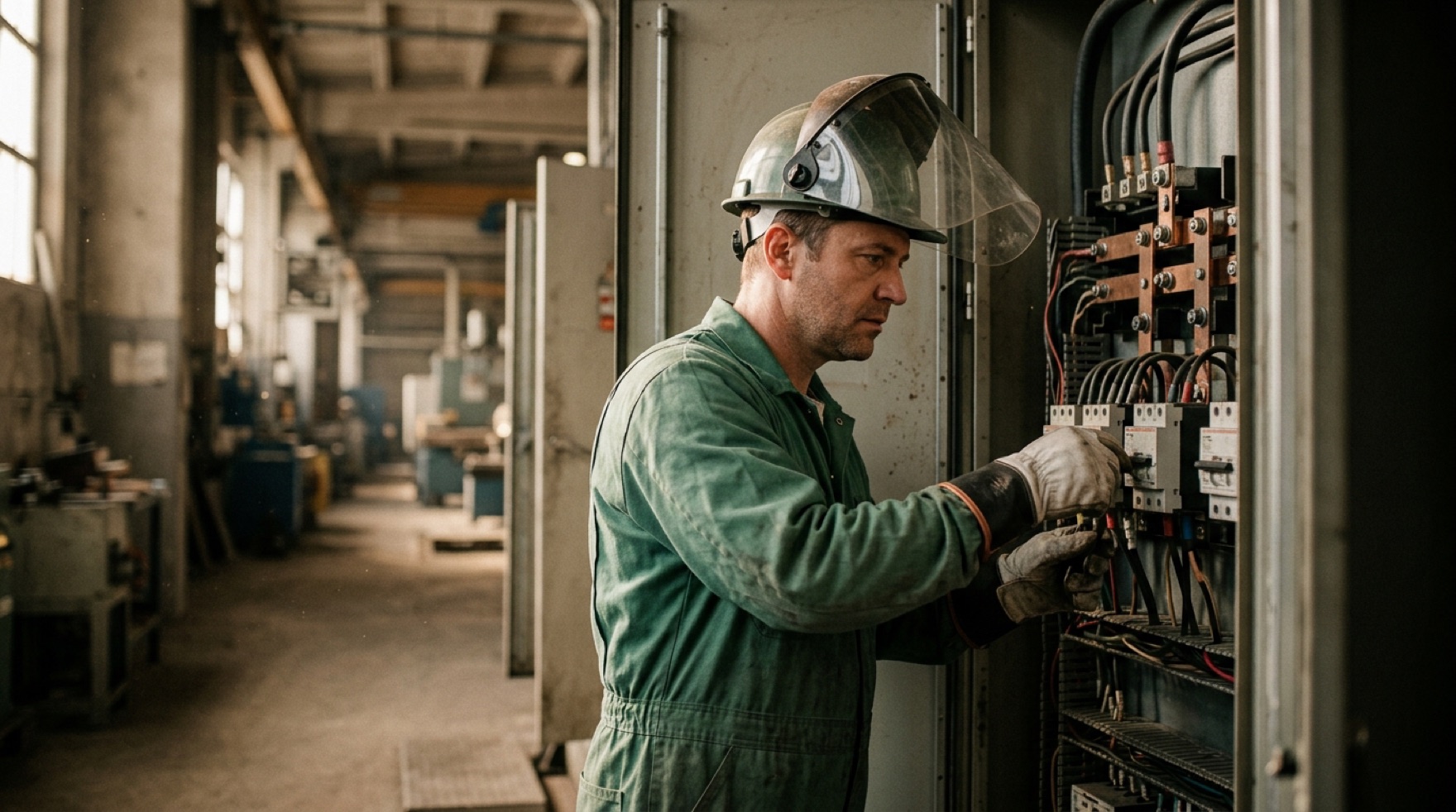
Each category carries a minimum arc rating and a defined set of arc-rated clothing and equipment, escalating from category 1 to category 4. The values below reflect NFPA 70E's PPE category table. Note that these are minimum arc ratings for the category, not a measurement of the incident energy at your specific equipment; if you have an incident-energy number, you match PPE to that number instead.
| Category | Minimum arc rating | Representative required PPE |
|---|---|---|
| 1 | 4 cal/cm² | Arc-rated long-sleeve shirt and pants or coverall, arc-rated face shield or flash-suit hood, plus hard hat, safety glasses, hearing protection, and leather gloves and footwear |
| 2 | 8 cal/cm² | Arc-rated shirt and pants or coverall, arc-rated face shield and balaclava or an arc-rated flash-suit hood, plus the same head, eye, hearing, hand, and foot protection |
| 3 | 25 cal/cm² | Arc-rated shirt, pants, and flash-suit jacket and trousers (or coverall) selected so the system arc rating meets the minimum, arc-rated flash-suit hood, and arc-rated gloves |
| 4 | 40 cal/cm² | Arc-rated flash-suit jacket and trousers over arc-rated shirt and pants, arc-rated flash-suit hood, and arc-rated gloves, with the system arc rating meeting the minimum |
Two things about the table are easy to miss. First, the category is built from a system of garments: for categories 3 and 4 the protection comes from layering, and the arc rating of the combined system, not of any single garment, is what has to meet the minimum. Second, the table method returns a category only for tasks inside its defined parameters; a task on equipment with higher fault current or a longer clearing time can produce incident energy that no category on the table covers, which is one reason many facilities run the incident-energy analysis and label their equipment directly.
Which method should a facility use?
Use the incident-energy analysis where you can, and reserve the table method for tasks that clearly fall inside its ranges. The analysis gives an equipment-specific number, supports precise labeling, and handles the cases the tables cannot, which is why larger facilities with an engineering study default to it. The table method is a legitimate, faster route for straightforward tasks on equipment within the defined parameters, and it is useful where a full study is not available. What is not legitimate is switching between them on the same equipment, or using a table category to second-guess a calculated incident energy.
Whichever method sets the number, the PPE still has to be real on the floor. 29 CFR 1910.335(a)(1)(i) requires employees to use electrical protective equipment appropriate for the specific parts of the body to be protected and for the work being performed, and 1910.335(a)(1)(ii) requires that equipment be maintained in a safe, reliable condition and periodically inspected or tested. Arc-rated clothing selected correctly but worn over flammable synthetic layers, or insulating gloves past their test date, defeats the selection. The category or the cal/cm² number is the start of the control, and inspection, layering, and consistent use are what make it hold.