The short answer: A2L refrigerants such as R-32 and R-454B are lower in toxicity but mildly flammable, a class the R-410A they replace does not carry. In Canada the equipment is governed by CSA B52, the Mechanical refrigeration code, whose 2023 edition adds provisions for A2L refrigerants, machinery-room ventilation and detection, and ignition-source control. The handling rules come from the Federal Halocarbon Regulations, 2022 for federally regulated works and from each province's own halocarbon regulations for most other workplaces: both require you to recover the refrigerant rather than release it, and to be certified to do the work. The US EPA Section 608 program does not apply in Canada. Worker duties on the job are set by the provincial or federal OHS regulator.
How is refrigerant handling regulated in Canada?
Refrigerant work in Canada sits across two systems, and neither one is the US EPA. On the environmental side, the Ozone-depleting Substances and Halocarbon Alternatives Regulations (SOR/2016-137), made under the Canadian Environmental Protection Act, 1999 and administered by Environment and Climate Change Canada, control the import, manufacture and supply of ozone-depleting substances and hydrofluorocarbons. They set the national HFC phase-down that is pushing manufacturers toward lower global-warming-potential alternatives, which is why mildly flammable A2L refrigerants are arriving in the field. Those regulations govern the supply of the gas, not the technician standing at the jobsite.
The rules that reach the technician are the handling rules, and they are split by jurisdiction. Federally regulated works and undertakings, and work on federal land, fall under the Federal Halocarbon Regulations, 2022 (SOR/2022-110), which replaced the 2003 version. Most other workplaces fall under their own province's halocarbon or environmental-protection regulations, which run comparable recovery-and-certification schemes. Because the same job can be governed by a federal regulation on one site and a provincial one on the next, the first question on any refrigerant job is which regime applies, and that is decided by who regulates the workplace rather than by the refrigerant itself.
This is the point where technicians trained on US material go wrong. EPA Section 608 of the US Clean Air Act is a United States rule: its Type I, II, III and Universal certifications and its venting prohibition are American law and carry no force in Canada. A Section 608 card is not a Canadian credential. The Canadian equivalent is a provincial environmental-awareness or refrigerant-handling certification recognized where you work, so confirm which certificate your jurisdiction accepts rather than assuming a US card transfers.
Do you need certification to recover refrigerant, and can you vent it?
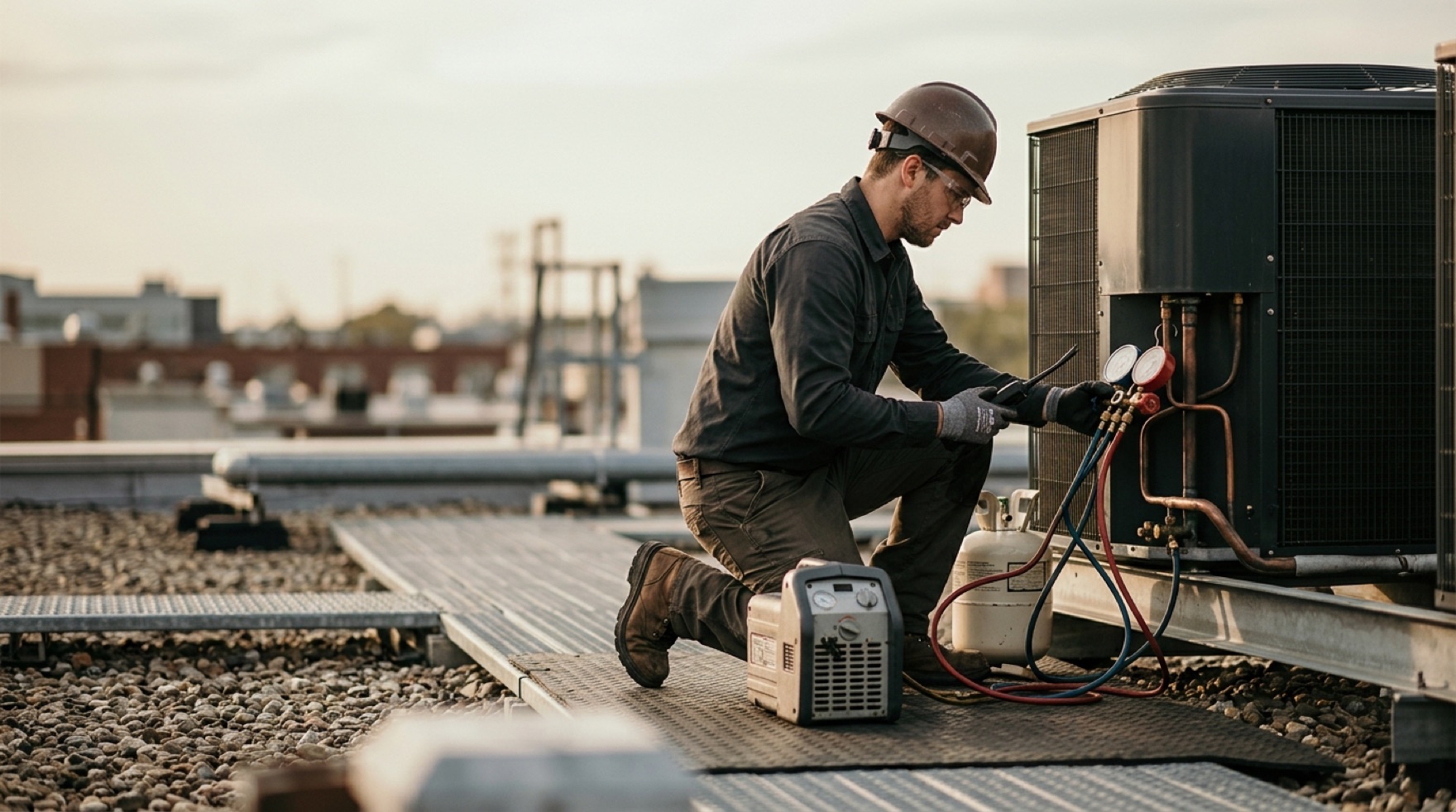
Yes to certification, no to venting. Under the Federal Halocarbon Regulations, 2022, a person must not release, or allow or cause the release of, a halocarbon from a refrigeration or air-conditioning system, with only narrow exceptions such as an unavoidable small loss when connecting or disconnecting a hose. The certified person and the responsible person must recover any halocarbon that would otherwise be released during installation, servicing or permanent withdrawal into a proper container, and only a certified person may install, service or recover the refrigerant from the system. Provincial halocarbon regulations set out the same three duties for the workplaces they govern: no release, mandatory recovery, and certified persons only.
The practical effect is that recovery, not release, is the default on every service and disposal job, and the person doing it holds a certificate recognized in that jurisdiction. The certificate is about environmental release of the gas; it does not by itself qualify a worker to manage the flammability of an A2L system, which is a separate competency addressed by CSA B52 and by the OHS regulator. Treat the halocarbon certification as the floor for touching the charge at all, not as proof the A2L-specific hazards are covered.
What does CSA B52 require for A2L systems?
CSA B52, the Mechanical refrigeration code, is the engineering standard for the system itself, and its 2023 edition adds explicit provisions for A2L and B2L refrigerants. It is a consensus standard that provinces and territories adopt by reference, so where it is adopted it carries the force of the regulation that names it. B52 governs how a system is designed and installed, how much refrigerant a space may hold, and what a machinery room handling a flammable refrigerant must provide.
For a flammable-refrigerant machinery room, the code addresses mechanical ventilation, refrigerant detection that responds to a leak by de-energizing equipment on a flammable concentration, restrictions on ignition sources and hot surfaces, and electrical-area classification tied to the Canadian Electrical Code. The specific charge limits, detector set points and ventilation rates are set in the code by refrigerant safety class and room type, and they are exactly the kind of number that should be read out of the adopted edition for the installation rather than recalled from memory, so this article names what B52 controls without quoting thresholds it does not confirm. The transferable point is that these features are designed into A2L equipment, and they only protect the technician who leaves them intact and follows the manufacturer's procedure for that model.
CSA B52 classifies refrigerants by the same two-part safety group system the industry uses everywhere: a letter for toxicity and a number for flammability, with "2L" marking a refrigerant that burns slowly enough to be treated as mildly flammable. The table below shows where the common refrigerants land. The class is a design input the technician inherits, which is why the safe habit on any unfamiliar unit is to read the nameplate for the refrigerant before assuming it behaves like the R-410A beside it.
| Safety group | What it means | Common examples |
|---|---|---|
| A1 | Lower toxicity, no flame propagation in the standard test | R-410A, R-134a |
| A2L | Lower toxicity, mildly flammable, low burning velocity | R-32, R-454B, R-1234yf |
| A2 / A3 | Lower toxicity, flammable / higher flammability | R-152a (A2), R-290 propane (A3) |
| B1 / B2L | Higher toxicity, non-flammable / mildly flammable | R-123 (B1), R-717 ammonia (B2L) |
Who sets the worker's duties on the job?
CSA B52 tells the equipment how to be built; the worker's occupational duties come from the OHS regulator. Most workplaces fall under a province's or territory's OHS act and regulations, while federally regulated workplaces follow the Canada Labour Code Part II and the COHSR. Those rules require a workplace-specific hazard assessment, safe work procedures, and training before a worker faces a hazard, and they are where the flammability and asphyxiation risks of a refrigerant leak are managed in practice. Provincial examples such as Ontario's Regulation 851 or the WorkSafeBC OHS Regulation set duties for their own jurisdictions; confirm the enforceable requirement with the regulator for your site.
The refrigerant is also a hazardous product under WHMIS 2015, so the supplier label and safety data sheet, and worker training on them, are part of the job rather than an afterthought. A leaked refrigerant in an enclosed mechanical room is an oxygen-deficient-atmosphere hazard before it is ever a fire, which is why detection and ventilation are life-safety systems and why respiratory protection for that space is supplied air, not a cartridge respirator that does nothing in a displaced-oxygen room. With an A2L charge the same leak adds a fire risk on top of the asphyxiation risk, so the controls stack rather than substitute.
Building the A2L transition into Canadian service practice
The refrigerant class is a design decision the technician inherits, and the safe response is to read it and respect it. R-32 and R-454B are lower toxicity and mildly flammable; CSA B52 tells the equipment how it must be detected, ventilated and kept clear of ignition sources; the Federal Halocarbon Regulations, 2022 and the provincial halocarbon regulations set the recover-not-vent and certified-person floor under all of it; and the OHS regulator sets the worker's duties and training. EPA Section 608 sits under none of it, because it is a US rule. A Canadian service organization moving crews from A1 to A2L work is best served by updating leak-detection equipment, machinery-room surveys and hot-work procedures together, then confirming the halocarbon certification and OHS duties that apply where each job is done.