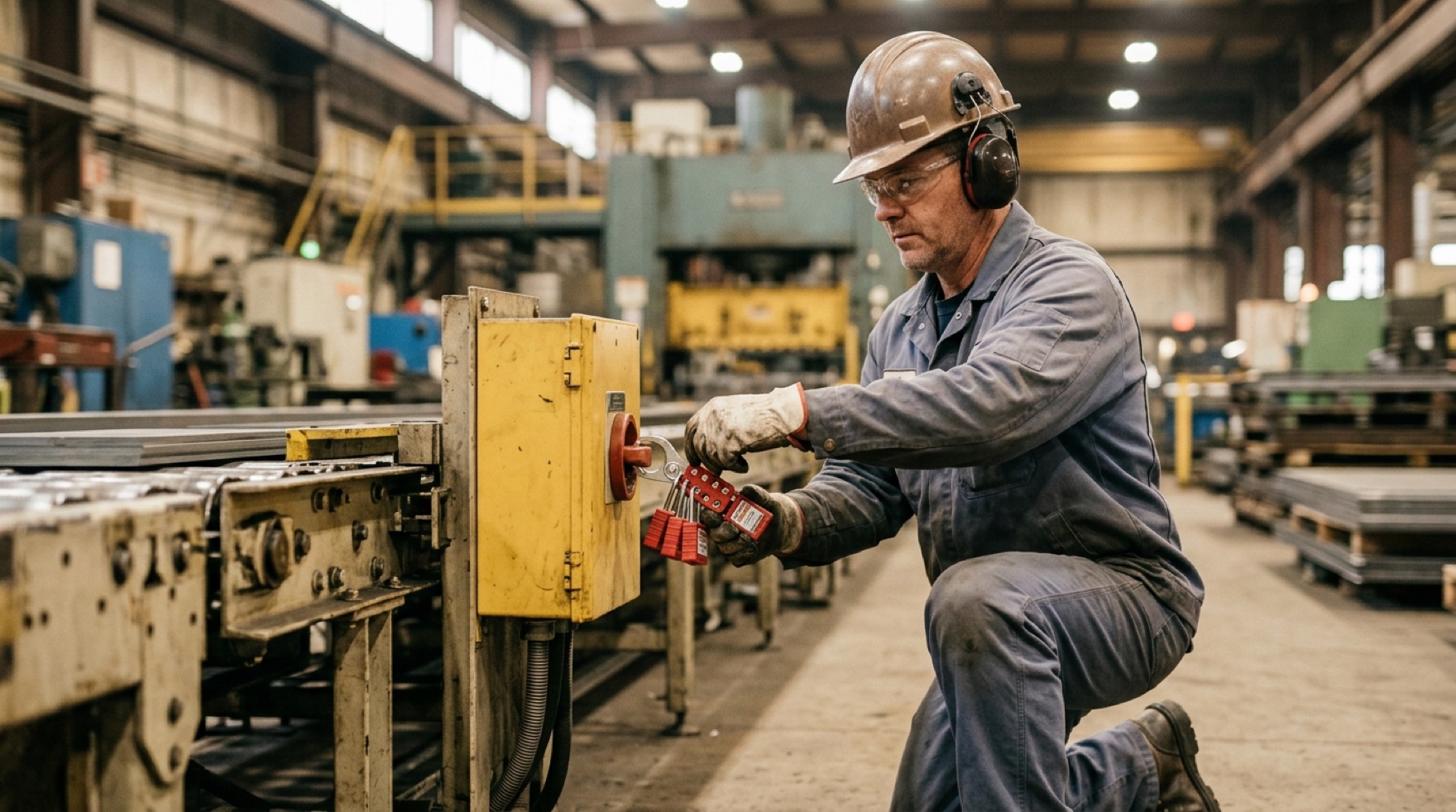
The short answer: Canada has no single national lockout standard the way the US has 29 CFR 1910.147. Control of hazardous energy is split by jurisdiction: most workplaces fall under a province's or territory's OHS regulation, while federally regulated workplaces follow the Canada Labour Code Part II and the COHSR. The recognized national reference for the program itself is CSA Z460-20, "Control of hazardous energy - Lockout and other methods." For crew work, CCOHS states there should be as many locks on the system as there are people working on it, each worker applying their own lock, and it treats dissipating stored or residual energy as a distinct step that comes after the machine is isolated, not before hands go in.
Who sets the lockout rules for maintenance work in Canada?
The duty comes from the jurisdiction that governs the workplace, not from one national rule. Provincial and territorial OHS regulations require that machinery being maintained, repaired, or adjusted be shut down and locked out or otherwise rendered incapable of movement before a worker is exposed to it. In Ontario that duty sits within Regulation 851 (Industrial Establishments), whose sections 75 and 76 deal with locking out and blocking machinery before maintenance and with work on machines that could move. In British Columbia it sits within the WorkSafeBC OHS Regulation Part 10 (De-energization and Lockout). Federally regulated employers carry an equivalent duty under the Canada Labour Code Part II and the COHSR.
Because the exact wording, recordkeeping, and procedural detail differ from one jurisdiction to the next, the practical approach for a millwright program is to build to the recognized national standard and then confirm the enforceable specifics with the regulator for the site. CCOHS, the workhorse guidance body, is explicit that its material is guidance rather than law, and it points employers to CSA Z460-20 as the standard that governs how a defensible lockout procedure is written.
What is CSA Z460, and what sequence does it drive?
CSA Z460-20, "Control of hazardous energy - Lockout and other methods," is the standard Canadian employers use to build a hazardous-energy program. CCOHS defines lockout as placing a lockout device on an energy-isolating device in accordance with an established procedure, so the machine is physically held in a safe mode. The procedure is an ordered sequence, and it only protects a crew when every stage is completed in turn. CCOHS sets it out as prepare for shutdown, notify affected personnel, shut the equipment down, isolate and de-energize each energy source, dissipate residual or stored energy, apply the locks and tags, verify isolation before work starts, do the work, then remove the devices in reverse order.
Two points in that sequence are where maintenance crews get hurt. The first is that isolation and dissipation of stored energy are separate stages: locking the disconnect handles the incoming supply, but it does nothing to energy already trapped in the machine. The second is that verification is its own step after the locks are on, not an assumption that follows from them. A machine that reads as off at the panel is not proven safe until someone confirms it.
How does group lockout keep every millwright protected?
Group lockout is the procedure for when more than one worker services a machine at the same time, which on a millwright job is the normal case rather than the exception: a gearbox change, a conveyor rebuild, or a press overhaul routinely puts electricians, mechanics, and riggers on the same equipment within one shift. Individual lockout breaks down as soon as the crew grows, because if one person's lock controls the disconnect, that person decides when the machine comes back and cannot know whether a colleague still has hands in a nip point two frames away.
CCOHS closes that gap with a simple rule: there should be as many locks on the system as there are people working on it, each worker applies their own lock, and a lock can only be removed by the person who installed it. Master keys that would let one person clear everyone's locks are not acceptable. WorkSafeBC Part 10 puts the same principle into regulation. Section 10.7 makes each worker responsible for locking out the energy-isolating devices before starting work and for keeping control of their own keys. Its group procedure at section 10.9 has qualified workers lock out the isolating devices and secure the keys, after which every other worker applies a personal lock to the key-securing system and removes it only when their own work is done. Accountability stays with the individual, and the machine cannot be released until the last personal lock comes off.
Why does stored energy stay dangerous after the disconnect is locked?
Stored or residual energy is the energy still held in a machine after its supply is isolated, and it is dangerous precisely because the locked disconnect makes the equipment look safe. CCOHS is direct that closing and locking valves only stops more energy from entering the lines, so what is already trapped has to be dealt with separately. That energy hides in raised rams and loads held up by gravity, in hydraulic and pneumatic accumulators and pressurized lines, in springs under compression or tension, in flywheels and rotating masses that coast, in capacitors holding a charge, and in thermal systems.
The control depends on the energy type. CCOHS calls for bleeding off residual pressure in hydraulic and pneumatic lines, discharging capacitors, releasing or restraining springs, and blocking, pinning, or supporting parts held up by gravity so they cannot drop. A load resting on fork tips balanced against a container edge, or a die held in the air only by a hoist that has jammed, is stored energy under this step, and it must be blocked or landed, not balanced, before anyone reaches underneath. Where energy can build back up, from a leaking valve repressurizing a bled line or a capacitor bank recharging, the verification of a safe state is not a one-time check; it has to hold until the work is finished.
How do you verify a zero-energy state before work starts?
Verification means the worker physically confirms the machine is at a zero-energy state before anyone touches it, and CCOHS treats it as a required step in its own right, after the locks are applied. It is not reading the position of a switch. In practice it means trying to start the machine at the operator controls after locking out, returning those controls to the off position, and using the right instrument to confirm the absence of voltage where electrical energy is involved, before returning to the work. The table below sets out the sequence CCOHS describes, which is the same for a lone technician and for a crew, with the group provision layered on top.
| Step | What the procedure requires | Canadian source |
|---|---|---|
| Prepare and notify | Identify every energy source and the means to control it, and tell affected workers | CCOHS lockout guidance; CSA Z460-20 |
| Shut down and isolate | Turn the equipment off in order, then operate each energy-isolating device | CCOHS; WorkSafeBC OHS Reg. s.10.3 |
| Apply the locks | Each exposed worker applies a personal lock; as many locks as workers | CCOHS; WorkSafeBC OHS Reg. ss.10.7, 10.9 |
| Dissipate stored energy | Bleed pressure, discharge capacitors, release or block springs and gravity-loaded parts | CCOHS lockout guidance; CSA Z460-20 |
| Verify zero energy | Confirm isolation and de-energization by test before starting work | CCOHS lockout guidance; CSA Z460-20 |
| Remove devices | Inspect, confirm clear, remove personal locks in reverse; only the installer removes a lock | CCOHS lockout guidance |
What should a Canadian maintenance program do with all this?
Build the written procedure to CSA Z460-20, run group work with a personal lock for every exposed worker on a key-securing box, and treat stored-energy dissipation and zero-energy verification as their own steps rather than assuming the locked disconnect covers them. Then confirm the enforceable details, the documentation duty, who counts as a qualified worker, and how shift-change transfers are handled, with the OHS regulator that governs the workplace, whether that is a province, a territory, or the federal COHSR. That combination, a program mapped to the national standard and validated against the local regulation, is what a regulator looks for after an incident: evidence that every worker who was exposed held their own lock, that trapped energy was released, and that the machine was proven dead before hands went in.