The short answer: The cleaning products janitorial staff use every shift are hazardous products communicated in Canada through WHMIS 2015 (the Workplace Hazardous Materials Information System), not the US Hazard Communication rule. WHMIS is split across two levels of government. Health Canada sets the supplier side federally under the Hazardous Products Act (HPA) and Hazardous Products Regulations (HPR), which require suppliers to classify a hazardous product and provide a compliant label and safety data sheet (SDS). Provinces, territories, and the federal Labour Program set the workplace side: the employer keeps labels intact, applies a workplace label on a decanted container, keeps current SDSs accessible during the shift, and educates and trains workers before they use the product. The single hazard the system most directly guards against on a cart is mixing incompatible products, since combining a bleach product with an acid releases chlorine gas.
Does WHMIS 2015 cover everyday cleaning products?
Yes. If a cleaning product meets the criteria for a hazard class under the HPR, and most disinfectants, degreasers, drain openers, oven cleaners, and acid descalers do, it is a hazardous product and WHMIS duties attach the moment it is used at work. There is no exemption for a spray bottle just because the same brand sits under a sink at home. WHMIS treats the product by its hazard, not by the setting, so a janitorial cart of consumer-looking products is a workplace inventory of hazardous products that has to be managed as such.
That framing decides who is responsible for what. The supplier classifies the hazard and provides the label and the SDS; the employer builds the workplace program that gets that information to the person holding the trigger. For a cleaning crew, the practical test is simple: if a product can burn skin, irritate the lungs, catch fire, or react dangerously with another product, WHMIS applies, and the worker is entitled to know it before the cap comes off.
Who sets the rules? Federal supplier side, provincial workplace side
WHMIS is deliberately jurisdictionally split, and getting the split right is the whole point. The supplier requirements (classification, the label that ships on the container, and the 16-section SDS) are federal, set by Health Canada under the Hazardous Products Act and the Hazardous Products Regulations. The workplace requirements (keeping labels legible, workplace labelling, SDS access, and worker education and training) live in the occupational health and safety law that governs the specific workplace.
For most cleaning operations that is a province's or territory's OHS act and its WHMIS regulation, for example Ontario Regulation 860 (WHMIS) under the Occupational Health and Safety Act, or the WorkSafeBC OHS Regulation in British Columbia. A federally regulated workplace instead follows the Canada Labour Code Part II and the COHSR. Because each jurisdiction words the workplace duties slightly differently, a janitorial employer should confirm the exact WHMIS obligations with the OHS regulator that governs its workplace rather than assume one national workplace rule. CCOHS publishes plain-language guidance on all of this, but CCOHS is guidance, not law.
What must a janitorial WHMIS program include?
WHMIS rests on three worker-facing elements, and each answers a different question a cleaner has in the moment: labels, safety data sheets, and education and training. The employer's job is to make all three present and usable where the work happens.
- Labels identify the product and its hazards on the container. The supplier label that ships on a product carries six elements: the product identifier, the initial supplier identifier, the hazard pictogram or pictograms, a signal word ("Danger" or "Warning"), hazard statements, and precautionary statements. The employer keeps that label legible and intact.
- Safety data sheets are the reference layer. Each SDS follows a standardized 16-section format covering identification, hazards, first aid, firefighting, handling and storage, and exposure controls, and the employer keeps a current SDS for each hazardous product accessible to workers during the shift. An SDS locked in an office a cleaner cannot reach in the minutes after a splash is not accessible in any meaningful sense.
- Education and training make the label and the SDS usable. CCOHS frames worker education around four questions a cleaner should be able to answer for every product: what are the hazards, how do I protect myself, what is the emergency response, and where do I find more information.
Supplier labels versus workplace labels: the decanted spray bottle
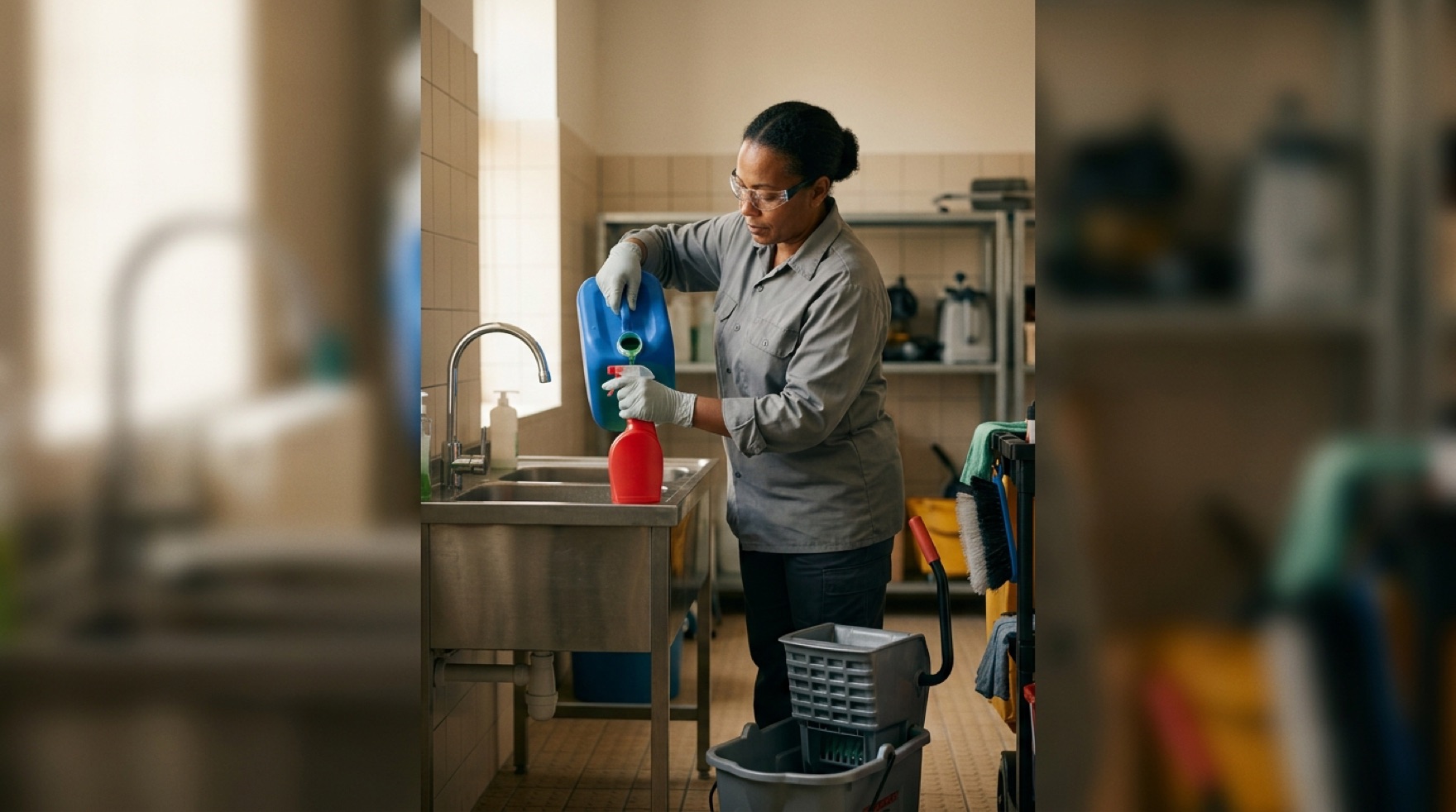
Labelling runs on two tracks, and the second one is where cleaning crews most often fall down. The supplier label is the six-element label the manufacturer or importer puts on the shipped container. A workplace label is required when a hazardous product is produced and used on site, when it is decanted into another container, or when the supplier label is lost or illegible. A workplace label generally needs the product name matching the SDS, safe-handling precautions, and a reference to the SDS.
The common exception is narrow: no workplace label is needed if the decanted product is used immediately, or stays under the control of the person who decanted it during a single shift. Beyond that, the unlabelled blue spray bottle of "cleaner" is both a WHMIS gap and a mixing hazard, because it is exactly the condition that lets someone grab the wrong product. The specific workplace-label wording is set by the province, territory, or federal regime, so confirm the detail with your regulator.
Why mixing cleaning chemicals is the hazard the SDS exists to prevent
Mixing incompatible products turns two ordinary cleaners into a toxic gas in seconds, and the SDS is where a cleaner is meant to catch it first. Section 7 (handling and storage) and section 10 (stability and reactivity) of the SDS carry the incompatibility information, and it is the reference point before combining anything. The chemistry is well established: combining a chlorine-bleach (hypochlorite) product with an acid releases chlorine gas, and combining bleach with ammonia releases chloramine gases. Both cause coughing, shortness of breath, and eye and throat irritation, and higher exposures can be serious.
The operational problem is that the reactive ingredient is usually invisible on the front of the bottle. A cleaner cannot see the acid in a descaler or the ammonia in a glass cleaner, which is why the label and the SDS carry the warning and why reading them is the control. The table below summarizes the combinations to keep off a cart. Treat it as a hard "do not," not a "ventilate and proceed," and check the SDS incompatibility sections whenever a new product joins the closet.
| Combination to avoid | What it can release | Where the reactive ingredient hides |
|---|---|---|
| Bleach + acid | Chlorine gas | Toilet-bowl cleaners, lime, rust and scale removers, some descalers |
| Bleach + ammonia | Chloramine gases | Glass cleaners, some all-purpose and floor cleaners |
| Bleach + vinegar or citrus cleaner | Chlorine-based vapour | "Natural" or citrus descaling solutions |
| Two different drain cleaners | Heat, violent reaction, and gas | Any two drain openers combined in one clogged line |
The defence is procedural: one product at a time, rinsed between, in a ventilated space, with labels intact and the SDS within reach.
What worker education and training does WHMIS require?
WHMIS worker education has to happen before the worker uses the product and be specific to the products on the cart, not a generic slideshow. Because education and training sit in the workplace OHS law, the exact frequency and recordkeeping are set by each jurisdiction, but the substance is consistent: workers learn how to read the label and the SDS, the hazards of the products they handle, the protective measures and PPE available, and the emergency response for a spill, a splash, or an exposure. For a janitorial crew, the highest-value content is the specific "never mix these" instruction and the glove and eye protection needed for the acids and disinfectants in use, delivered in a language the crew actually understands.
One point WHMIS does not settle is exposure limits. WHMIS is a hazard-communication system: classification, labels, and safety data sheets. Occupational exposure limits for a given substance are set separately by each province or territory in its OHS regulation, and largely track the ACGIH threshold limit values, so the applicable limit depends on the jurisdiction. The practical takeaway for a Canadian cleaning employer is to keep the supplier labels and SDSs current, label every decanted container, train the crew to treat each product as one chemical to be understood on its own and never combined with another, and confirm the workplace WHMIS and exposure-limit duties with the OHS regulator that governs the site.