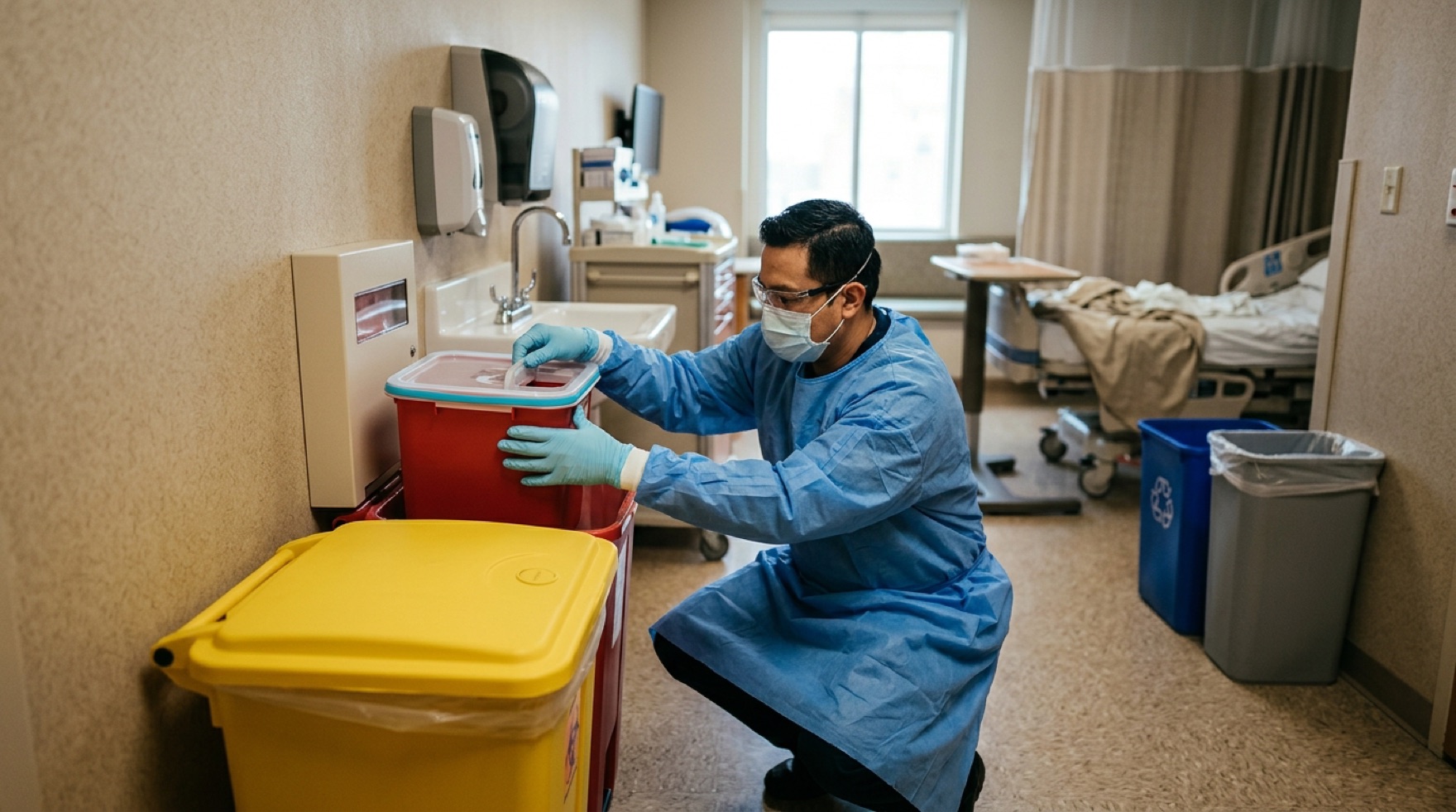
The short answer: Canada has no single national bloodborne-pathogen standard equivalent to the US rule. A cleaning or custodial crew that can reasonably be expected to contact blood or other potentially infectious material is covered instead by its province's or territory's OHS regulation on biological or biohazardous agents, while federally regulated workplaces carry equivalent duties under the Canada Labour Code Part II and the COHSR. Several provincial regulations require the employer to develop a written exposure control plan for workers who may contact blood or body fluids. On the floor, the crew treats all blood and certain body fluids as infectious under routine practices, never recaps or hand-picks a discarded needle, uses a rigid sharps container, and reports any exposure for medical follow-up.
Is there a Canadian bloodborne pathogens standard for cleaning crews?
Not a single national one, and that is the first thing to get right. Occupational health and safety in Canada is jurisdictionally split: most cleaning crews fall under their province's or territory's OHS act and regulations, and federally regulated workplaces fall under the Canada Labour Code Part II and the COHSR. There is no federal counterpart to the US bloodborne pathogens standard that applies coast to coast. Instead, the duty comes from each jurisdiction's rules on biological or biohazardous agents and exposure control.
British Columbia is a workable example of how a province frames it. The WorkSafeBC OHS Regulation Part 6 includes a Biological Agents division (sections 6.33 to 6.40); under section 6.34, if a worker has or may have occupational exposure, the employer must develop and implement an exposure control plan that meets the requirements of the general exposure-control provision in section 5.54. That plan covers risk assessment, the work activities involved, engineering and administrative controls, infection-control precautions, PPE, and worker education and training. Other provinces and the federal regime word the duty differently, so confirm the specific biohazard and exposure-control requirements with the OHS regulator that governs your workplace.
Who is covered, and how is that decided?
Coverage turns on whether contact with blood or other potentially infectious material can reasonably be anticipated, and for a lot of cleaning work it can. Emptying restroom and locker-room waste that may hide discarded needles, cleaning up a blood or body-fluid spill, and handling regulated waste all put a custodial worker in that position. Whether the exposure-control duties apply to a specific crew is a determination the employer has to make through a risk assessment and write into the exposure control plan, not a guess made on the floor.
If the assessment finds that exposure is reasonably anticipated, the program elements below are owed to the crew. A single sharps injury, or a routine of cleaning up blood, is a strong signal that a "not covered" determination needs another look. CCOHS and the Public Health Agency of Canada point to routine practices as the baseline: treat all blood, and body fluids you cannot tell apart, as potentially infectious, regardless of how minor a spill looks.
What is the main hazard, and how big is the risk?
CCOHS identifies the sharps route as the main occupational hazard, because a contaminated needle can deliver a bloodborne virus directly past the skin. The three viruses of concern are hepatitis B (HBV), hepatitis C (HCV), and HIV. CCOHS reports the following infection risks from a single contaminated needlestick, which show why the sharps controls matter more than any other single measure.
| Virus | Infection risk from one contaminated needlestick | Source |
|---|---|---|
| Hepatitis B (unvaccinated worker) | Approximately 6% to 30% | CCOHS: Needlestick and Sharps Injuries |
| Hepatitis C | Approximately 1.8% | CCOHS: Needlestick and Sharps Injuries |
| HIV | Approximately 0.3% | CCOHS: Needlestick and Sharps Injuries |
The hepatitis B figure is the one a cleaning employer can most directly act on, because vaccination changes it. CCOHS reports that hepatitis B vaccines provide reliable protection, with 90 to 95 percent of vaccinations in healthy people producing resistance to the virus. Whether the employer must offer that vaccine, and to whom, is set by the governing province, territory, or federal regime, so confirm it with your regulator.
What do you do when you find a sharp?
A discarded needle is handled with a tool and a rigid container, never with your fingers, and never by recapping it. CCOHS advises that needles should not be recapped unless there is a legal requirement to do so, and if recapping is unavoidable, only with a one-handed scoop technique. Work a found sharp like this:
- Stop and look before you reach. Never push a bare or gloved hand into a trash bag, a bin, or a crevice you cannot see into. Sharps hide in restroom bins, under paper towels, and in furniture seams.
- Use a mechanical means to pick it up: tongs, forceps, a brush and dustpan, or a grabber. Keep the point aimed away from you and anyone nearby.
- Do not recap, bend, break, or hand-carry the needle. Move it directly to the container.
- Place it in a rigid, puncture-resistant sharps container that is tamper-resistant, has no removable lid, has an opening large enough for sharps but not a hand, and resists leaking or breaking if dropped.
- Do not overfill. CCOHS advises removing and replacing a sharps container when it is three-quarters full; an overfilled container is itself a needlestick hazard.
- Report the find and any injury so the employer can log it, restock, and address why a sharp reached an unprotected area.
How do you handle a blood or body-fluid spill?
Treat every spill as infectious and put a barrier between it and you before anything else. Routine practices mean all blood, and body fluids you cannot distinguish, are handled as potentially infectious, with no exception for how minor the spill looks. Work it in order:
- Put on gloves, and add eye protection and a gown if splashing or spatter is possible. Replace disposable gloves as soon as they are contaminated or torn.
- Confine the spill and remove any broken glass or sharps with a mechanical tool, not your hands, then place them in the sharps container.
- Absorb and clean the visible material, then apply a disinfectant suitable for blood and body fluids, following the product SDS and its contact time.
- Bag contaminated material as biohazardous waste in the labelled containers your workplace uses, following the disposal rules set by your jurisdiction; do not put saturated waste in ordinary trash.
- Remove gloves without touching the outside, and wash your hands with soap and running water immediately afterward.
What do you do after an exposure?
An exposure is a medical event to report the same day, not something to shrug off. If a needle sticks you, or blood reaches your eyes, mouth, or broken skin, wash the site right away (soap and water for a needlestick or skin contact; flush the eyes or mouth with water), then report it to your supervisor immediately so the follow-up starts. Provincial exposure-control plans generally require the employer to make a confidential medical evaluation and follow-up available after an exposure incident, which can include identifying and testing the source where feasible, testing your blood with your consent, offering post-exposure treatment when medically indicated, and counselling. Hepatitis B vaccination remains available to a worker who had previously declined it.
The thread through all of this is that bloodborne-pathogen protection for Canadian cleaning crews is a system the employer builds and the worker runs, set not by one national rule but by the biohazard and exposure-control regulation of the province, territory, or federal regime that governs the site. The plan, the training, and the containers have to be in place first; then routine practices, safe sharps handling, and immediate reporting do the rest. Because the exposure-control, vaccination, training, and recordkeeping duties are set jurisdiction by jurisdiction, confirm the specific requirements with the OHS regulator that governs your workplace.