The short answer: A vehicle lift is safe only while it is the right capacity and reach for the vehicle, its arms are set on the manufacturer's designated lift points, and its safety locks are engaged. The design and certification of lifts sold in North America follow ANSI/ALI ALCTV (Safety Requirements for the Construction, Testing, and Validation of Automotive Lifts), and their operation, inspection, and maintenance follow ANSI/ALI ALOIM, which calls for a qualified lift inspector to inspect every lift at least annually. OSHA has no lift-specific standard, so the General Duty Clause, Section 5(a)(1) of the OSH Act, and these consensus standards set the expectation. The two controls that prevent most drops are matching the lift to the vehicle and spotting the load correctly before raising it.
What standard governs vehicle lift safety?
Vehicle lift safety in North America is anchored by the ANSI/ALI standards, with OSHA enforcing through the General Duty Clause. The safety standard covering the design, construction, and performance of automotive lifts is ANSI/ALI ALCTV, and a lift that has been third-party tested and certified to meet all of its requirements bears the ALI Gold Label, the mark of independent certification for the North American market. Operation, inspection, and maintenance are covered by a companion standard, ANSI/ALI ALOIM. Because OSHA does not have a standard written specifically for automotive lifts, it addresses lift hazards under Section 5(a)(1) of the OSH Act, the General Duty Clause, which requires employers to provide a workplace free of recognized hazards, and the recognized standard of care is what the ANSI/ALI documents describe.
The practical implication is that "certified" and "inspected" are two different things. ALCTV certification is done by the manufacturer before the lift leaves the factory and proves the design; it does not tell you the lift in your bay is in safe condition years later. That is the job of ongoing inspection and daily checks, which is where the responsibility sits with the shop.
What should a daily pre-use lift inspection cover?
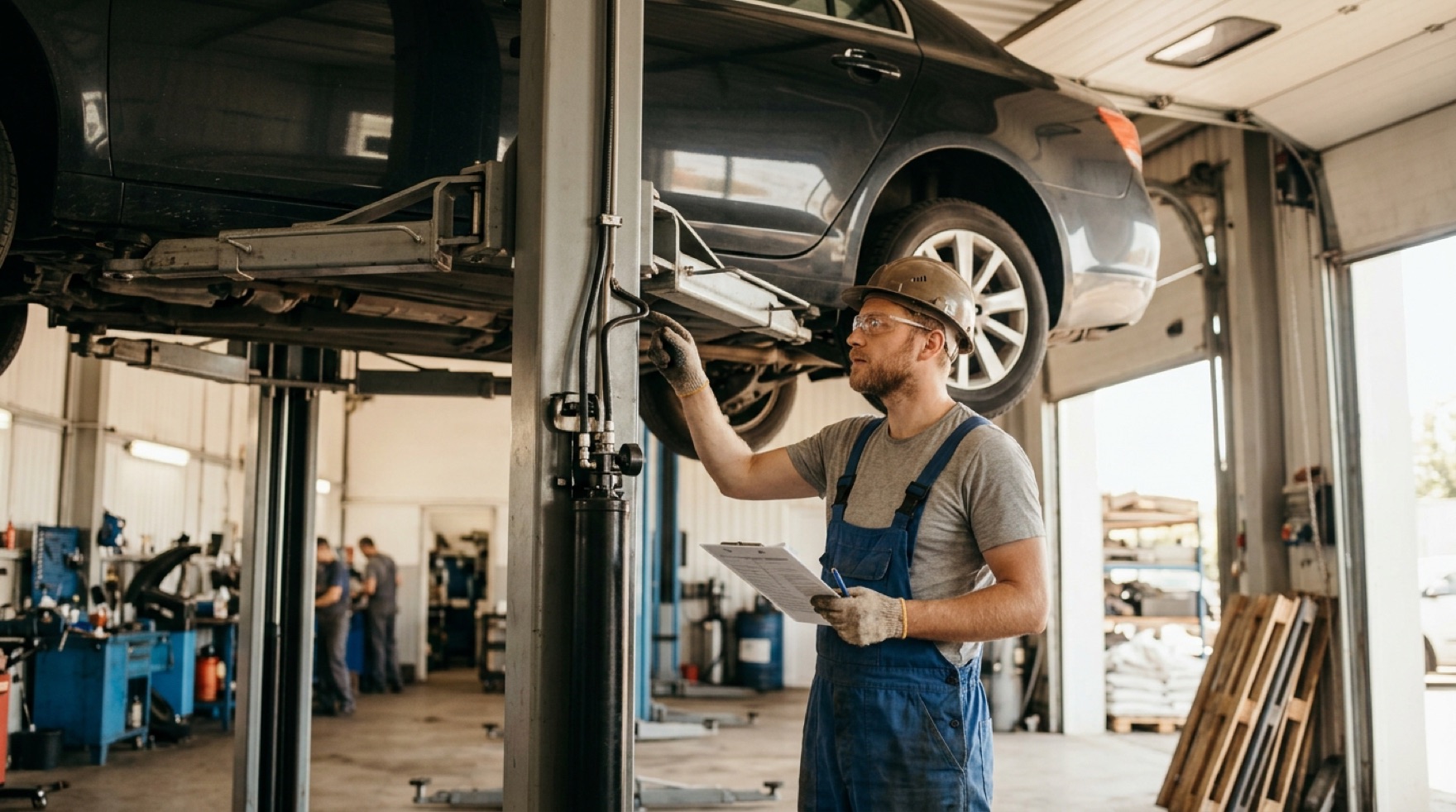
A daily pre-use check confirms the lift is sound and its safeties work before a vehicle goes up on it. It takes a minute and it catches the developing fault before it becomes a drop. Walk the lift before the first vehicle of the day:
- Capacity and data plate present and legible, and the lift rated for the heaviest vehicle it will raise that day
- Arms, arm pads, and adapters undamaged, and the pads present and seated
- Arm restraints (gear or pin) engaging so the arms cannot swing under load
- Safety locks audibly engaging as the lift rises, and holding when the lift is set down onto them
- Hydraulic system with no visible leaks, and the floor under the lift free of fresh fluid
- Cables, chains, sheaves, and hoses on cable or chain lifts free of fraying, wear, or damage
- Controls, including the raise, lower, and any lock-release, working normally with no sticking
- Anchor bolts on the floor tight and the lift stable, with no movement at the base
- Warning labels and operating instructions in place and readable
Anything that fails takes the lift out of service until it is repaired. A safety lock that does not engage, a leaking cylinder, or a damaged arm is not a "watch it today" item, it is a park-it item, and the vehicle goes on a different lift.
How often must a lift be professionally inspected, and who does it?
A qualified lift inspector must inspect every lift at least annually under ANSI/ALI ALOIM. That annual inspection is separate from the daily operator check and goes deeper: it verifies documentation, safety markings, operator training, and the installation and condition of the lift against the standard. ALI runs a certification program for lift inspectors, and an ALI Certified Lift Inspector has completed training, passed examinations, and performed a set of supervised practical inspections across lift types, which is what "qualified" means in practice for this equipment.
A passed annual inspection is documented, commonly with a dated inspection label carrying the inspector's identification. Keep those records: after an incident, the dated inspection history and the daily checks are what show the lift was maintained, and their absence is what a compliance officer notices first. The annual inspection does not replace the daily check, and the daily check does not replace the annual inspection. Both are part of keeping the lift in the safe condition its certification originally proved.
What actually makes a vehicle fall off a lift?
Most drops come down to two things: the lift arms set on the wrong points, and the lift used beyond what it can safely accommodate. A vehicle balances on small pads under specific structural points, so if the arms are not set on the manufacturer's designated lift points, or the vehicle is too long or too heavy for the lift, the load can shift and come off. The fix is procedural: identify the lift points for that vehicle, set the arms and pads on them, raise the vehicle a few inches, and confirm it is stable and the safeties are engaged before going higher or getting underneath.
A California FACE investigation shows the cost of skipping that. In report 03CA010, a 46-year-old automotive mechanic was killed in 2003 when the vehicle he was working under slipped off the lift and fell on him. The lift arms were not in alignment with the vehicle's chassis when it was raised, because the vehicle was too long for the lift to accommodate. The lift dated to around 1964, the manufacturer was out of business, and the shop had no manual, no written safety program, and no training program. Investigators recommended a written injury and illness prevention program and, specifically, ensuring the lifts in use are capable of raising the vehicle safely, noting a lift with a longer reach might have prevented the death. The transferable point is that the weight capacity being within limits was not enough: the lift has to fit the vehicle's geometry, and the arms have to sit on the real lift points, before anyone works underneath.
Keeping the lift, the vehicle, and the technician matched
Every lift rule reduces to keeping three things matched: the lift's capacity and reach, the vehicle's weight and lift points, and the technician working beneath. The daily pre-use check confirms the equipment is sound, the annual inspection by a qualified inspector confirms it stays that way, and correct spotting on the manufacturer's lift points confirms the load is stable before it goes overhead. ANSI/ALI ALCTV and ALOIM describe how to do each of those, and the General Duty Clause is what makes them the expected standard of care. The shops that follow them keep tons of steel where they put it, and the FACE record shows what happens in the ones that do not.