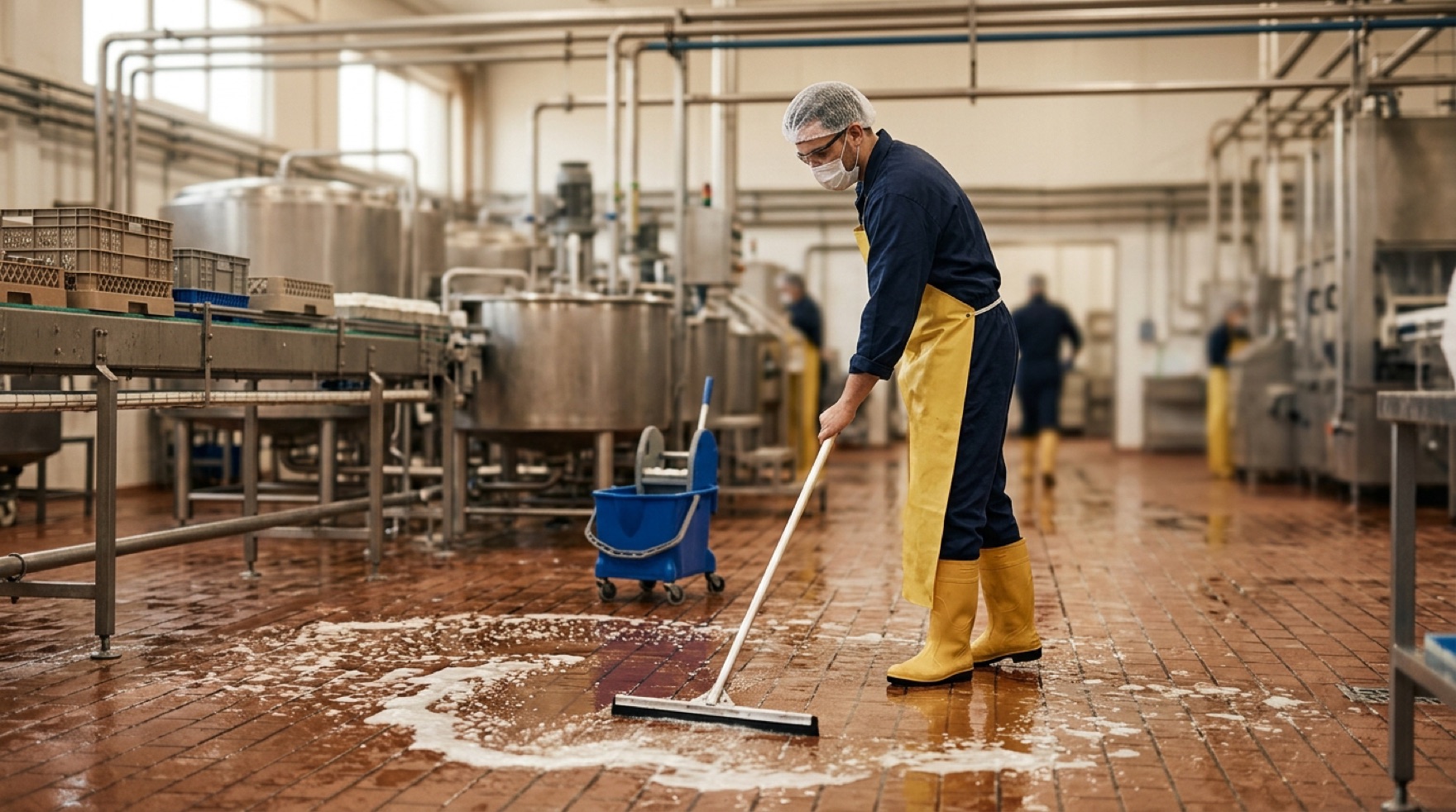
The short answer: On a wet food-processing floor, 29 CFR 1910.22(a)(2) requires the employer to keep the floor clean and, to the extent feasible, dry, and where wet processes are used to maintain drainage and provide dry standing places such as false floors, platforms, or mats. 29 CFR 1910.22(d) adds a duty to inspect walking-working surfaces regularly and correct hazards before anyone walks on them again. The slip-resistance target for the floor surface itself comes from a consensus standard, ANSI A326.3, which sets a wet dynamic coefficient of friction (DCOF) of 0.42 or greater for hard-surface floors expected to be walked on when wet. OSHA does not publish a numeric friction value, so the durable fix is drainage and surface selection first, footwear last.
Does OSHA require food plants to keep processing floors dry and slip-resistant?
Yes, through a housekeeping duty rather than a friction number. 29 CFR 1910.22(a)(1) requires that all walking-working surfaces be kept in a clean, orderly, and sanitary condition, and 1910.22(a)(2) requires that the floor of each workroom be maintained in a clean and, to the extent feasible, dry condition. The same paragraph recognizes that a processing floor cannot always be dry: where wet processes are used, it requires the employer to maintain drainage and, to the extent feasible, provide dry standing places such as false floors, platforms, or mats. That is the regulatory backbone of every wet-floor program in a plant.
The standard also makes the floor a thing that has to be watched, not just built. 1910.22(d) requires walking-working surfaces to be inspected regularly and as necessary and maintained in a safe condition, and any hazardous condition to be corrected or repaired before an employee uses the surface again. On a wash-down floor that means a spill, a failed drain, or a worn no-slip strip is a stop-and-fix item, because the standard treats an uncorrected slip hazard as a violation whether or not anyone has fallen yet. The practical implication is that the two clauses work as a pair: 1910.22(a) sets what the floor and the housekeeping have to achieve, and 1910.22(d) makes someone responsible for verifying it every shift.
What slip-resistance level should a food-processing floor meet?
The number comes from ANSI A326.3, not from OSHA. ANSI A326.3 sets a wet dynamic coefficient of friction of 0.42 or greater for hard-surface flooring materials expected to be walked on when wet with water, measured with the standard's field and laboratory method. It is a product-specification and measurement standard, so it gives a specifier and a plant a defensible target for tile, resin, or coated concrete, and it lets you verify a floor in place rather than trusting a brochure. Because it is a voluntary consensus standard, meeting 0.42 is not by itself OSHA compliance, and failing it is not by itself an OSHA violation, but it is the recognized benchmark an employer is measured against when a floor's slip resistance is questioned.
Two precision points matter here. First, A326.3 measures dynamic coefficient of friction, the friction while a foot is sliding, which is what governs a real slip; it is a different test from a static coefficient of friction and the two numbers are not interchangeable. Second, the 0.42 threshold is defined for floors wet with water. A food-processing floor is frequently wet with fat, oil, and protein rather than clean water, and the 2021 revision of A326.3 added product-use classifications that separate ordinary wet-interior service from wetter and oil-and-grease conditions, which call for a more slip-resistant surface than the plain 0.42 water figure. That means a floor certified for a dry bakery aisle is not automatically adequate for a rendering or wet-cook area, and the surface should be specified against the condition it will actually see.
In what order should you control wet and grease-laden floors?
Rank the controls so the floor and the drainage do the work before the worker's footwear has to. A same-level fall happens at the point where a foot meets a contaminated surface, so the strongest controls are the ones that keep the surface from being contaminated or that drain it, and the weakest are the ones that ask an individual to compensate for a floor that is already slick.
- Engineer the floor and the drainage (most reliable). Specify a floor surface that meets the slip-resistance class for the actual wet-or-greasy condition, slope it to trench or point drains so water and product leave the walking area, and keep the drains clear. This is the control 1910.22(a)(2) points to first when it names drainage and dry standing places, because a floor that sheds contamination does not depend on anyone noticing it is wet.
- Create dry standing places. False floors, raised platforms, and drainage mats or duckboards at fixed wet workstations lift the worker off the film of water and grease. Mounted and maintained, they are an engineering control; left to curl, clog, or slide, they become a trip hazard of their own, so they belong on the 1910.22(d) inspection route.
- Control the contamination and clean on a schedule. Contain splash at the source, squeegee and pick up product promptly, and separate wet cleaning from foot traffic with signage and timing. Housekeeping is where 1910.22(a)(1) lives day to day, and it is the control most likely to lapse under production pressure.
- Slip-resistant footwear (last, and never alone). High-grip outsoles reduce slips, but footwear is personal, wears out, and only helps the person wearing it, so it sits below the floor and the drainage. A footwear program supports a slip-resistant floor; it does not substitute for one.
The evidence that footwear belongs in the program, but at the bottom, is strong. In a NIOSH-supported cluster randomized trial described by NIOSH, roughly 17,000 food-service workers across 226 school districts were studied, and providing highly-rated slip-resistant shoes at no cost was associated with a 67 percent reduction in workers' compensation claims for slips on wet or greasy floors. The setting is food service rather than processing, but the failure surface is identical: a floor wet with water and grease. The transferable point is that footwear is a genuine control worth funding, and it still leaves a third of the slip risk on the table, which is why the floor and the drainage above it carry the load.
What belongs in a slip-and-fall program for a processing floor?
A defensible program turns the two clauses into a routine with a name on it. Build it around the inspection duty in 1910.22(d): a documented walk of the wet areas each shift that checks drains, mats, spills, and worn floor coatings, with any hazard tagged and corrected before the area reopens to traffic. Pair that with a cleaning schedule that keeps 1910.22(a)(1) housekeeping from slipping under throughput, and a footwear standard matched to the wettest area each role works in.
Then close the loop with verification. Re-test the floor's slip resistance against the A326.3 method when a surface is resurfaced, when a new process changes what the floor gets wet with, or after a cluster of slips, so the number on the floor is current rather than historical. The table below maps each duty to the control it drives.
| Requirement | What it drives on a wet processing floor | Source |
|---|---|---|
| Clean, orderly, sanitary surfaces | Housekeeping and spill pickup on a schedule that holds under production | 1910.22(a)(1) |
| Floor clean and, to the extent feasible, dry | Drainage maintained, and false floors, platforms, or mats at wet stations | 1910.22(a)(2) |
| Inspect and correct before reuse | Documented per-shift check of drains, mats, spills, and worn coatings | 1910.22(d) |
| Wet DCOF of 0.42 or greater (water) | Surface specified and field-verified for the actual wet-or-greasy condition | ANSI A326.3 |
Keeping people upright on a wet floor
The wet floor is a permanent condition in a processing plant, so the program has to be permanent too. 1910.22 tells you the floor has to be drained, kept as dry as feasible, and inspected and corrected on a cycle, and A326.3 gives you a slip-resistance number to specify and verify the surface against. Read together, they point the work in one direction: fix the floor and the drainage first, lift people onto dry standing places where the process stays wet, keep the housekeeping honest, and treat slip-resistant footwear as the last layer rather than the plan. A floor that is specified for the contamination it actually sees, drained so the contamination leaves, and checked every shift is what keeps a same-level fall from being the most predictable injury on the line.